The American-Israeli war with Iran has made the competition between Ankara and Jerusalem evident: both countries are vying for the status of the main regional power and see each other as a threat. Concerns about a possible armed confrontation are growing, writes the German Die Welt.
The American-Israeli war with Iran has made the competition between Ankara and Jerusalem evident: both countries are vying for the status of the main regional power and see each other as a threat. Concerns about a possible armed confrontation are growing, writes the German Die Welt.
The residents of Turkey are generally satisfied with how their government is responding to the regional crisis surrounding the confrontation with Iran. As a survey by the Metropoll institute showed, the approval rating of Turkish policy in the Middle East has never been as high as it is now over the past 12 years. Just under half of the respondents rated Ankara's course as successful. In previous surveys, the figure consistently hovered around 37%.
Foreign Minister Hakan Fidan participated in preparing negotiations in Islamabad and attended a quadrilateral meeting with Pakistan, Egypt, and Saudi Arabia at the end of March: its goal was to encourage direct dialogue between the U.S. and Iran. Additionally, Turkey is among the countries that convey diplomatic messages between Washington and Tehran.
At the same time, President Recep Tayyip Erdoğan's government is launching sharp criticism against the third party in the confrontation — Israel. The extent to which the tone of the polemic has escalated was demonstrated by a verbal exchange between the two governments last week.
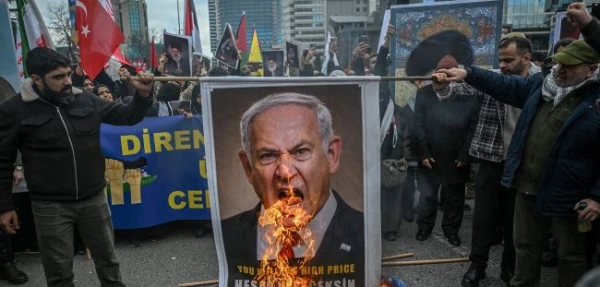
On April 11, the Istanbul Public Prosecutor's Office charged 35 individuals — among them Israeli Prime Minister Benjamin Netanyahu. The reason was an Israeli military operation against an international maritime convoy attempting to deliver humanitarian cargo to Gaza.
After this, Netanyahu publicly attacked Erdoğan, accusing him of "aiding the terrorist regime of Iran" and of actions against the Kurdish population in his own country. In response, the Turkish Foreign Ministry issued a statement calling Netanyahu "the Hitler of our time."
This mixture of diplomacy and rhetorical attacks is not new. The ability to deftly handle ambiguities and use them in politics is one of Erdoğan's key skills. However, the structural rivalry between Turkey and Israel has solidified in recent years and has become even more pronounced against the backdrop of the Iranian crisis. Now both countries view each other as a threat to their own security.
Take Iran. The Israeli government led by Netanyahu seeks a scenario in which the power in Tehran is either overthrown or weakened to the point that it no longer poses an existential danger to Israel. The possible power vacuum and chaos that will almost inevitably follow, Netanyahu is essentially willing to accept as a side effect. From his perspective, a weak and unstable Iran is more manageable than a stable regime that is getting closer to the threshold of creating an atomic bomb.
Turkey, on the other hand, wants to prevent such a scenario. Not because it sees Tehran as an ally; for example, in Syria, both countries have pursued opposing goals for years, but because for Ankara, the current regime in Iran appears to be the lesser evil. Its downfall, as feared in Turkey, would open space for the Kurdish movement to achieve greater autonomy. Turkish security forces view these aspirations as a risk to the country's security.
There is another factor: migration flows that could arise from the fall of the regime in Iran. The country's population is about 90 million people, which is four times larger than Syria's population before the onset of civil strife. At that time, hostilities forced more than six million people to flee abroad, leading to the largest migration crisis in recent decades. Turkey still feels the consequences of it.
In Syria, in recent years, Ankara and Jerusalem have also pursued different goals. Turkey is one of the key supporters of the country's new leader, Ahmed al-Sharaa, and is betting on a maximally stable, centrally governed state. The motives are largely the same as regarding Iran: Ankara seeks to prevent the consolidation of Kurdish autonomies while simultaneously preventing new waves of refugees.
Israel, however, does not trust the new authority in Damascus and attributes a dangerous Islamist ideology to it. From this perspective, a decentralized Syria with weak leadership is easier to control.
These contradictions are not exceptions. They indicate a fundamental difference in how both countries understand security and order in the region — and their own role in this system.
From Ankara's perspective, Israel justifies almost any expansion of its military operational space with security considerations, even if it comes at the expense of the territorial integrity of other states. For example, Israel has created buffer zones in Lebanon, Syria, and the Gaza Strip.
In mid-March, Turkish Foreign Minister Hakan Fidan stated in an interview with Anadolu Agency that after the Iranian conflict, Israel "cannot live without an enemy." The next, according to the Turkish interpretation, will be Ankara. The Israeli side claims that it is now trying to "declare Turkey a new enemy."
The same was said by Recep Tayyip Erdoğan back in 2024: according to him, after defeating Hamas, Israel "will not limit itself to Gaza" and sooner or later will target Turkey.
This narrative resonates in Turkish society. Surveys have recorded extremely negative attitudes toward Israel for years. According to a Pew Research Center study from June last year, 93% of respondents in Turkey expressed negative views about the Jewish state. More than a third of Turks consider Israel the main threat to their country.
This distrust is mutual. For instance, The Jerusalem Post recently cited an assessment by analyst Yoni Ben Menachem from the Jerusalem Center for Public Affairs and Security: "Turkey is the new Iran."
This reflects the belief that Ankara, if Tehran weakens, may attempt to take the lead in the region itself. With the decline of the "Shia axis," according to Menachem, a power vacuum will arise that Turkey, along with Saudi Arabia, Egypt, and Pakistan, will try to fill by forming a "Sunni bloc of power." This is not a temporary disagreement between Turkey and Israel. A long-standing dispute between the two regional powers is emerging before our eyes, as they increasingly perceive each other as strategic rivals. The more persistently both sides try to push their own interests, the higher the risk that this competition will eventually evolve into a new form of direct confrontation.