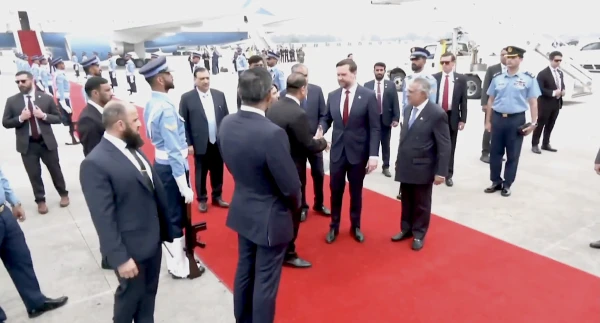
U.S. Vice President James David Vance arrived in the capital of Pakistan, Islamabad, on Saturday for talks with Iran, LETA reports citing AFP.
The Iranian delegation, led by Parliament Speaker Mohammad Baqer Qalibaf, arrived at an airbase near the capital late at night on a commercial flight to meet with the influential Chief of Army Staff of Pakistan, Asim Munir, who also has personal connections with U.S. President Donald Trump.
Munir also welcomed Vance, escorting him down the red carpet at the airbase, where U.S. Special Envoy Steve Witkoff and Trump’s son-in-law Jared Kushner were already waiting.
"We have good intentions, but we do not trust," Qalibaf stated shortly after landing, according to the Iranian state broadcaster. "Our experience in negotiations with the Americans has always ended in failures and unfulfilled promises."
"If the Iranians are ready to negotiate in good faith, we are certainly ready to extend a hand," Vance said before departing from the U.S.
However, "if they try to deceive us, they will see that the negotiating team will not be so accommodating," he added.
Pakistani Prime Minister Shehbaz Sharif, through whose mediation the parties agreed to sit at the negotiating table this week, noted that the talks would not be easy.
"A more difficult phase lies ahead," he said, referring to efforts to end the hostilities that began after U.S. and Israeli strikes on Iran on February 28, which prompted retaliatory strikes by Iran against Israel and throughout the Persian Gulf.
"This is the phase that is referred to in English as 'make or break'," Sharif emphasized.
Iran, which sent a delegation of more than 70 people to Pakistan, demanded that the ceasefire also extend to Lebanon and that its assets be unblocked for the talks in Islamabad to take place, but none of these conditions have yet been met.
From the U.S. side, President Donald Trump demanded the opening of the Strait of Hormuz as a condition for a two-week ceasefire.
However, the strait, through which one-fifth of the world's oil passes, remains closed to normal shipping, and on Friday Trump promised to secure its opening "with or without" Iran's cooperation.
He added that his main priority in the negotiations in Islamabad is to prevent Iran from acquiring nuclear weapons.
It is unclear whether the parties will meet face-to-face or use an indirect format, which was applied in negotiations under Oman's auspices before the war began.
Pakistan has formed a group of specialists to assist the parties in discussing shipping, nuclear energy, and other important topics, a diplomatic source told AFP.
Other key regional players, including Egypt and Turkey, are closely monitoring the negotiations and have assisted in mediation, while China continues to coordinate closely with Pakistan, the source noted.
Official sources reported that Beijing is being considered as a potential guarantor of any long-term agreement, and Trump confirmed to AFP that China helped Tehran come to the negotiating table.
It is unclear whether China will be directly represented at the talks or take on an official role.
The path to a sustainable ceasefire is complicated by Israel's statements that the current ceasefire does not extend to Lebanon, which contradicts the positions of Iran and Pakistan.
On Friday, Israeli airstrikes continued in Lebanon against the Iranian-backed group Hezbollah, despite Iran's demand to cease them.