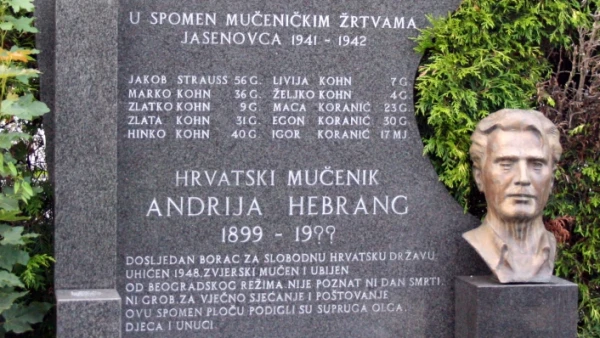
Andrija Hebrang became the scapegoat in the conflict with Stalin.
A lot has already been written and said about the famous Stalin-Tito conflict, the defeat of the internal Yugoslav opposition, and the rupture of relations between Yugoslavia and the USSR. However, the main focus of authors writing on this topic has often been concentrated only on the main characters of this story – the two "red Josephs." Yet, even in Yugoslavia itself, there were brave individuals who dared to challenge the all-powerful leader. One of them was Andrija Hebrang, a seasoned Croatian communist, one of the founders of the socialist Yugoslav state with a heroic yet tragic biography.
Andrija Hebrang was born at the turn of the nineteenth century, in 1899, in the village of Bačevec in northeastern Croatia. At that time, this territory belonged to the Hungarian part of the dual Austro-Hungarian monarchy. At the age of 13, he moved to the Hungarian town of Szentlőrinc, where he studied to become a merchant's assistant. In 1917-1918, Hebrang served in one of the artillery units of the Austro-Hungarian army, witnessing the collapse of Austria-Hungary, on the ruins of which the first unified Yugoslav state emerged. At that time, under the influence of the Russian Revolution, Andrija Hebrang became fascinated with communist ideas. In 1919, he joined the Socialist Labor Party (Communists), which was soon renamed the Communist Party of Yugoslavia (CPY), and shortly thereafter became a member of the city committee of the party in Zagreb. The party was becoming increasingly popular among the people, and in 1920, the authorities of the Kingdom of Serbs, Croats, and Slovenes banned its activities. However, Hebrang and his comrades did not abandon the struggle. In 1924, he was arrested for participating in unauthorized demonstrations and was held in prison for several days, but just a year later, the hero of our story became the secretary of the Zagreb city committee of the CPY while also engaging in trade union activities. During those years, Hebrang and Tito were allies, doing everything to unite the party ranks. But everything changed in 1928. First, Hebrang, who was planning to travel to Moscow for the Comintern congress, was detained at the border and was not allowed to leave the country. At that time, the loudest political assassination of those years occurred – at a session of the Skupština (Yugoslav parliament), Serbian nationalist Račić shot the leader of the Croatian Peasant Party and killed him. Following the protests that arose after this, the government tightened the political regime. Hebrang and his associates were arrested. Interestingly, at the trial, Hebrang did not officially acknowledge his affiliation with the CPY but described himself as a "communist by conviction." This, however, did not spare him from a sentence of 12 years in prison.
Despite the deprivation of liberty, for which the government of royal Yugoslavia sentenced Hebrang, this did not prevent him from obtaining an education while in prison. The authorities allowed him to study materials on history, political economy, and all the disciplines that interested him. Moreover, Yugoslav leftists managed to engage in intra-party struggles even in prison. For instance, Montenegrin communist Petko Miletić incited other communist prisoners to constantly oppose the prison administration, while Hebrang tried to prevent this. In 1937, Miletić and his supporters organized an assassination attempt against Hebrang in prison, and when it failed, he found nothing better than to accuse his opponent of... Trotskyism. In those years, this was a very serious accusation within the global left movement for many. Petko Miletić was released from prison two years before Hebrang, immediately emigrated to the USSR, where he was soon shot. Hebrang himself was released in February 1941, shortly before the entry of royal Yugoslavia into World War II.
After his release from prison, Hebrang secretly moved to Zagreb. In 1937, while he was still in prison, a separate Communist Party of Croatia was established as part of the CPY at the initiative of Tito, who was then at large, and Hebrang became involved in its illegal activities in the already occupied "Independent State of Croatia" by German and allied armies. Some of Hebrang's contemporaries, and later historians, claimed that he met with the Minister of the Interior of the Ustaše government, Mladen Lorković, and the chief ideologist of the Ustaše regime, Mile Budak, discussing the possibility of legal activities for the Communist Party of Croatia in the new Croatian "independent state." However, this is not known for certain. What is known is that on June 22, 1941, when Nazi Germany attacked the USSR, Hebrang, along with his comrade Vladimir Bakarić, composed and transmitted a proclamation via an illegal radio station in Zagreb, calling on Croats to resist mobilization and not to go to the Eastern Front "for the blood of their Soviet brothers."
In the summer of 1941, a special envoy from the Central Committee of the Communist Party of Yugoslavia, Vlado Popović, arrived in Zagreb. Josip Broz Tito appointed Hebrang and another future partisan hero, Rade Končar, as his closest associates, and from July 6, 1941, the three of them formed the Operational Leadership of the Communist Party of Croatia (in the photo, Hebrang is third from the right of Tito).
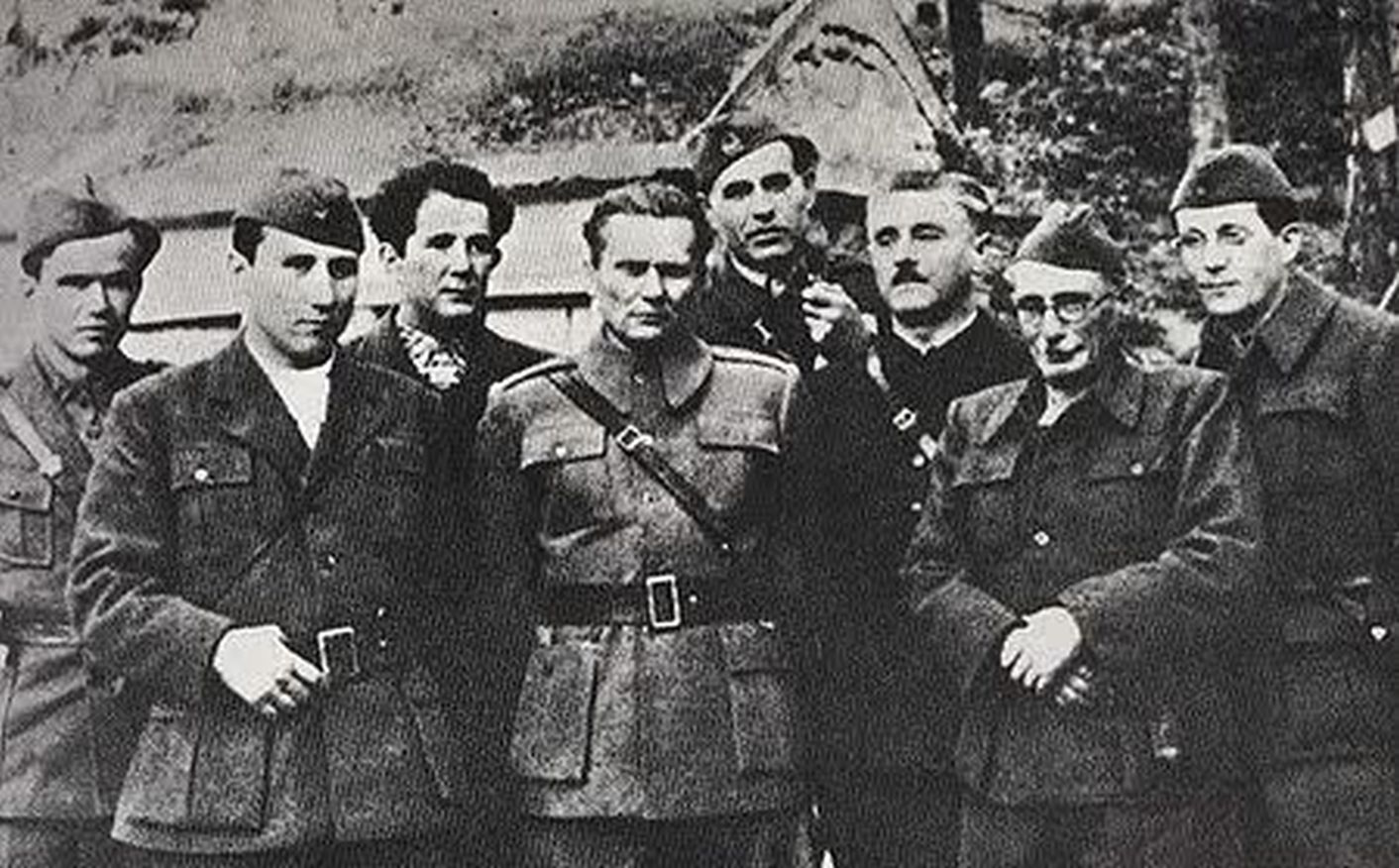
After the arrest of Rade Končar in Split on November 17, 1941, Hebrang became the secretary of the Central Committee of the Croatian Communist Party.
But in February 1942, the Ustaše police arrested Hebrang, nearly shooting him. According to the arrested man's own words, "they came to the apartment, surrounded the house, and found me inside. They shot, and I shot. This continued for two hours. Reinforcements were brought in. I defended myself until I was wounded." After a brief stay in the prison hospital, Hebrang, who was blinded in his right eye as a result of the injury, was sent to the infamous Ustaše concentration camp of Stara Gradiška. Before that, he categorically refused to cooperate with the occupiers. It should be noted that Hebrang was much luckier than Končar, who was shot. Hebrang spent only until September 1942 in the concentration camp when the Ustaše authorities exchanged him for their and German officers captured by partisans.
Hebrang returned to his duties as secretary of the Communist Party of Croatia. He also distinguished himself as an outstanding organizer: out of the 11 corps of the Yugoslav People's Liberation Army, 5 were Croatian, and the territory liberated by them in 1942-1943 continued to expand, in which Hebrang played a significant role. In the partisan hierarchy, Hebrang ranked only after Tito, as recalled by various people later, from his comrade Milovan Đilas to Randolph Churchill, who was the head of the British military mission with the partisans and the son of Winston Churchill.
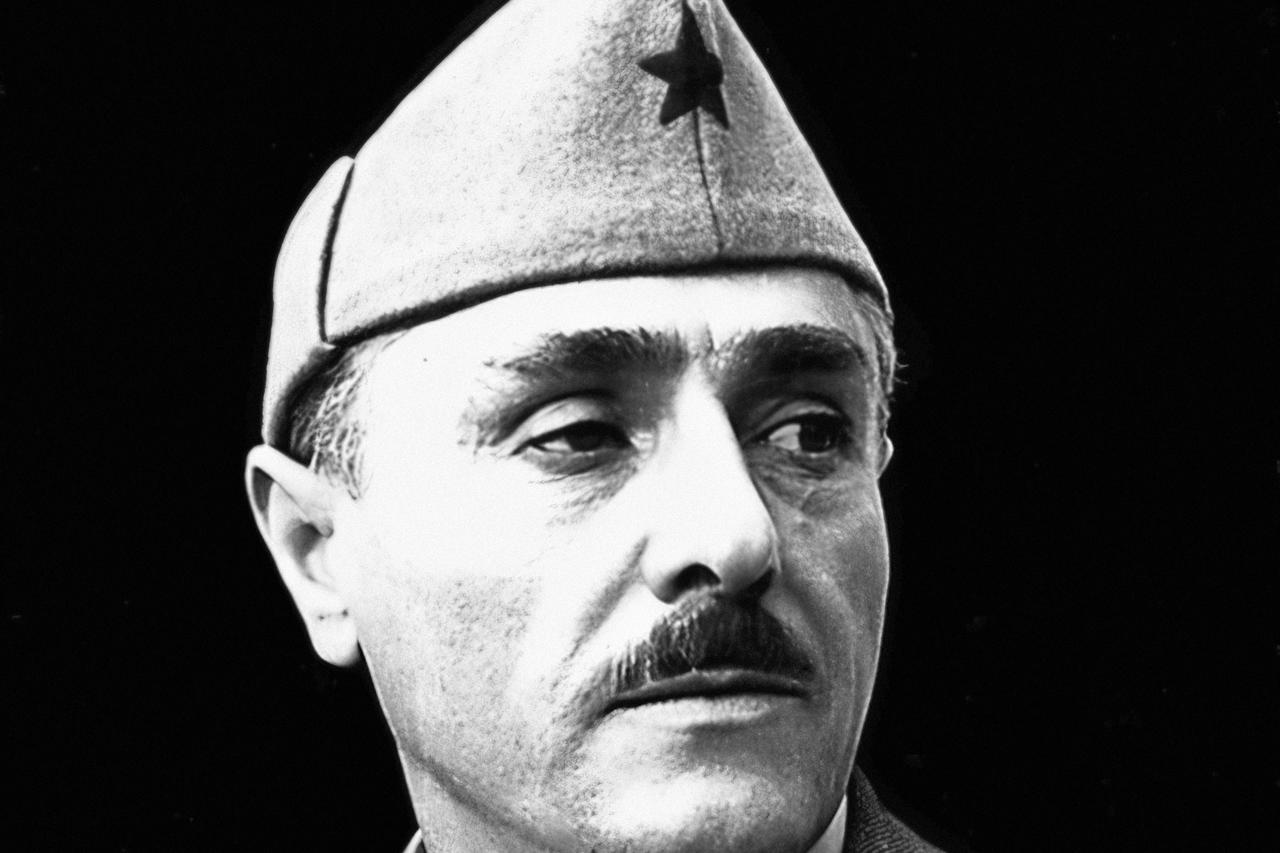
However, even before the end of the war, tensions began to arise between Andrija Hebrang and other leaders of the Yugoslav communists. Despite his communist beliefs, Hebrang always considered himself first and foremost a Croat and only then a communist. This was even reflected in small details. For example, he advocated the creation of a separate Croatian telegraph agency, while since November 1943, there had already existed (and still exists today) a unified Yugoslav telegraph agency, Tanjug. Tito opposed this, publicly accusing Hebrang of "sliding into separatism." In turn, Hebrang was strongly against the creation of a separate "National Front for the Liberation of Serbs in Croatia."
All this led to the fact that in the autumn of 1944, the leader of the Slovenian communists, Edvard Kardelj, supported by Serbian communist Aleksandar Ranković, Montenegrins Ivan Milutinović and Milovan Đilas, addressed Tito with an open letter, accusing Hebrang of nationalism: "In Andrija, at every step, a nationalist, Croatian attitude manifests itself, a real hostility towards Yugoslavia. I doubt that I exaggerate if I say that Andrija does not like Serbs and Slovenes and considers Yugoslavia, to a greater or lesser extent, a necessary evil."
Tito acted as follows. In October 1944, he instructed Kardelj and Đilas to enter the leadership of the Croatian Communist Party themselves, while summoning Hebrang to Belgrade and appointing him Minister of Industry, Chairman of the State Planning Commission, and Economic Council of the new unified Yugoslav government. On one hand, Hebrang was promoted, on the other hand, he was cut off from his homeland.
But then came 1948. A rupture occurred between Yugoslavia and the USSR, and Tito and Stalin became bitter enemies. However, many Yugoslav communists were pro-Soviet – Stalin's authority in Yugoslavia was still very high. At the April 1948 plenum of the CPY Central Committee, when the conflict was just beginning to flare up, a letter from Stalin and Molotov to the CPY Central Committee was discussed, containing sharp criticism of the Yugoslav leadership. The only ones who took a pro-Soviet position at this plenum were the General Secretary of the People's Front of Yugoslavia, Sreten Žujović, and Andrija Hebrang. The latter even addressed the plenum with his separate letter, expressing agreement with the positions of Stalin and Molotov. For those times, this was very bold.
The consequences were swift. In May of the same year, Hebrang was expelled from the party, stripped of his ministerial post, and arrested. It was then that rumors about his contacts with the Ustaše regime surfaced at a very opportune time. This was compounded by accusations of pro-Stalinist and pro-Soviet sentiments. Hebrang's situation was not improved by the intervention of the Central Committee of the VKP(b), whose representatives initially wanted to participate in the party investigation of his case (which they were, of course, refused), and later, in a separate letter in June 1948 to the CPY Central Committee, called the case against Hebrang "hastily concocted" and placed all responsibility for his fate personally on Tito.
Unlike Žujović, who was also arrested but wrote a penitential letter to Tito, Hebrang refused to acknowledge his position as erroneous and was (for the umpteenth time in his life) deprived of his freedom. This time he ended up in one of the Belgrade prisons, where he committed suicide by hanging himself on a radiator (according to another version, he was killed) in June 1949. No trial was even held against him, as he simply did not live to see it.
Justice regarding Hebrang was restored only after the breakup of Yugoslavia. By a resolution of the Croatian Sabor in 1992, he was recognized as a victim of the communist regime and rehabilitated. Streets in many Croatian cities are named in his honor.
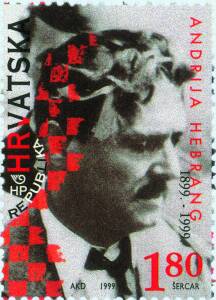
Andrija Hebrang's son, Andrija Hebrang Jr., who is still alive, does not let Croats forget about Hebrang. He held the position of Minister of Health in independent Croatia and even participated in the presidential elections in 2009, finishing third with 12 percent of the votes. The Hebrang family has three children, so who knows, perhaps this political dynasty will continue in the future.