"Well, some incompetent deputy minister comes, reads something off a paper."
"Servant of the People" is finding it increasingly difficult to gather votes even for key parliamentary decisions. Publicly, members of the faction state that the reason is the interest of NABU and SAP in the work of the MPs, although in reality, there are many more problems.
"We haven’t started living anew, and we won’t live anew," one of the leaders of the parliamentary "Servant of the People" told RBC-Ukraine. He refers to the hopes that arose among the deputies after the "Mindyhgate" and the dismissal of the head of the Office of the President Andriy Yermak, which RBC-Ukraine reported on in detail.
The political atmosphere within the government, in general, has undoubtedly improved after those events – this is acknowledged by absolutely all the publication's interlocutors. However, the Verkhovna Rada, in recent months, has actually become even more dysfunctional than before.
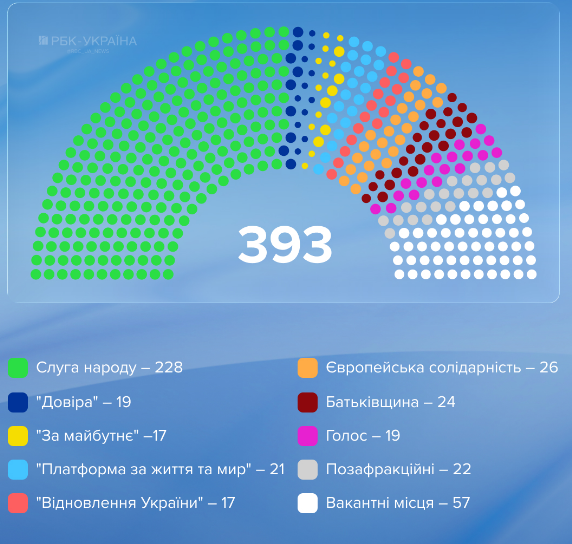
Having lost several MPs for various reasons, the monoband has long existed only formally, failing to independently secure the required 226 votes.
The breakdown looked approximately like this: the Servant of the People provided about 180 votes "for," while the missing half a hundred votes were secured by external partners: parliamentary groups or non-factional deputies.
Now, even 180 votes within the presidential faction are hard to come by – unless for some completely "harmless" projects, like ratifications, or those related to the war and military, and even then, not always. As a result, even with the usual support from partners, the "servants" cannot ensure not only uninterrupted but even minimally decent work of the Rada.
The most telling example was the failure to vote for digital platforms, also known as the "OLX tax law." Deputies gave only 168 votes "for," of which "Servant of the People" provided only 126. The MPs could not even send the bill for revision – there were not enough votes for that either.
This project is one of Ukraine's key commitments to receive funding from the IMF. And it also affects the receipt of a €90 billion loan from the European Union, which already has many problems.
After speaking with many members of parliament from the presidential faction and beyond, RBC-Ukraine identified the reasons for the current crisis and whether there are ways out of it, as reported by the rbc.ua website.
Almost all interlocutors of the publication agreed that one of the main problems is the dissatisfaction of deputies with the Cabinet of Ministers led by Yulia Svyrydenko, whom they appointed in July last year.
"When Svyrydenko came in, there were many promises along the lines of 'I will hear everyone.' At first, ministers and the prime minister indeed came to the committees, engaged with MPs online. There were many words, but no deeds. And then even that communication decreased," one MP recounts.
Other interlocutors express even more harsh opinions. "Yulia sees herself as a star, and deputies are nobody to her, unlike those from Bankova," another source complains.
However, compared to the previous government of Denys Shmyhal, the Cabinet and the Verkhovna Rada still interact more: Svyrydenko's ministers do not ignore the Friday "question hour for the government," they either come themselves or send their deputies to committee meetings, etc.
"Well, some incompetent deputy minister comes, reads something off a paper. Or a 'cosmonaut' who is all about high matters, and he has no time for deputies' problems. What’s the use of being sent if... not much," says one deputy.
At the same time, the very fact of poor or insufficiently effective communication would be something the deputies could endure with great difficulty. Throughout the term, they have already gotten used to the almost undisguised contempt towards them from other centers of power.
The real problem "under the dome" is seen in how the government's words diverge from its actions. On one hand, deputies are forced to vote for unpopular bills, explaining this by the critical shortage of money in the state budget and the need to obtain external financing.
On the other hand, the authorities regularly arrange the distribution of "money from helicopters" in the form of various cashbacks and other "support programs." Moreover, sometimes this happens literally simultaneously: as with the "OLX tax" and the cashback for fuel.
"The government tells us 'there's no money, we need to vote for difficult initiatives to get funding from the IMF.' And then they go and adopt PR and populist decisions, like the fuel cashback – for 13 million Ukrainians. Do all these 13 million Ukrainians need this cashback?" explains one of the reasons for irritation with the Cabinet.
Another source for RBC-Ukraine clarified that votes for projects necessary for the IMF or the Ukraine facility program could be found. However, for this, at least an honest conversation with the deputies is needed, which, according to him, has not been done.
"The Cabinet essentially agreed to these initiatives itself. For such projects, conversations with MPs need to be held, votes need to be gathered, explanations and persuasion are necessary. But they just dropped it into parliament and that’s it – left it to itself. It won’t work that way. And Svyrydenko wants to play the honor student and not get involved in any negativity. Maybe we shouldn’t have changed Shmyhal. This Cabinet is very weak," one of the MPs surveyed by the publication believes.
"We even sometimes say: 'Shmyhal is doing great, managing everywhere. If only we had such a person – as prime minister!" another interlocutor jokes.