
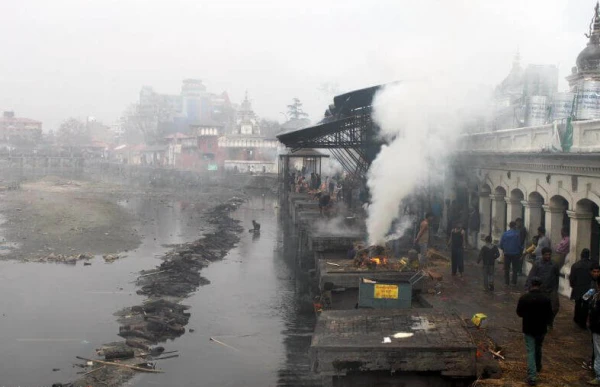
The foundation of popularity is the anti-corruption rhetoric.
In September 2025, Nepal became the epicenter of the first successful "Zoomer revolution." Protests, which began with the blocking of 26 social media platforms by the government of Khadga Prasad Sharma Oli, quickly escalated into a mass uprising against corruption, unemployment, and elitist politics. The youth, coordinated through the Hami Nepal Discord server and Telegram, burned down the parliament and the Singha Durbar complex, forcing the Prime Minister to resign. The interim Prime Minister, chosen through "network voting," was former Chief Justice Sushila Karki, making her the first woman in this position.
As of early 2026, Nepal's population stands at approximately 29.6–30 million people. It is a multi-ethnic state in South Asia, where the majority of the population practices Hinduism. The annual population growth rate has slowed, and women make up about 51% of the population.
Six months later, on March 5, 2026, in the first elections after the coup, 35-year-old former rapper and Mayor of Kathmandu Balendra Shah, representing the Rastriya Swatantra Party (RSP), achieved an unprecedented victory. His party secured 122 out of 165 seats under the majoritarian system. As a result, Generation Z not only overthrew the government but also brought their candidate to power. However, the new government also brings new risks. We explore how Nepal has changed and what is happening in other countries where Zoomers have nearly or completely replicated this scenario.
After the events of September 2025, Nepal found itself in a difficult situation. The mass protests, which lasted less than a week but resulted in the burning of the parliament, government buildings, and other facilities, caused direct economic damage estimated at around $586 million. This is the official estimate from a government commission, which included costs for restoring damaged property, losses from business shutdowns, and paralysis of government operations.
Economic growth, which was expected to be around 4.3–4.6% for the 2025–2026 financial year, sharply slowed. According to World Bank forecasts, GDP is expected to grow by only 2.1–3.0% in the 2026 financial year (some early estimates even indicated a threat of negative growth). The service and tourism sectors, which are crucial for the country, were particularly hard hit. Investors and entrepreneurs became wary: trust in government institutions has significantly eroded, and the private sector recorded a historically low level of confidence.
Youth still faces high unemployment rates of 20-25%. Thousands continue to leave for work in Kuwait, Malaysia, the Gulf countries, and other destinations. Large-scale labor migration remains one of the main ways out of the situation.
At the same time, the macroeconomy has held steady and has not slipped into crisis. Remittances from migrants increased (by 32% in the first months after the protests), foreign exchange reserves reached record levels (around $22.5 billion), and inflation remained low at about 2–2.5%. This helped prevent default and a sharp economic downturn.
On September 12, 2025, former Chief Justice Sushila Karki headed the transitional government — the first in Nepal's history led by a woman. She was partly appointed out of "necessity," as the constitution simply did not foresee such a scenario for the transfer of power. The parliament, as is known, was dissolved, and new elections were scheduled for March 2026.
Karki immediately signed a 10-point reform plan with representatives of the protesters. It mentioned investigating the deaths of protesters and the use of force by the police, creating an anti-corruption commission, preparing constitutional amendments, and reforms of the electoral system, judiciary, and public administration. Some of these measures have already begun to be implemented — for example, internet and social media access was fully restored, those arrested were released, and a commission to investigate the events of September was established.
And despite the extra-legal election of the Prime Minister through Discord and the burned parliament, the army supported the transfer of power, which helped avoid a large-scale civil war. In six months, the streets were stabilized, and protests subsided.
However, skepticism from businesses and investors has not disappeared. Trust in institutions has fallen, foreign investments remain minimal (less than 1% of GDP), and companies are postponing projects due to uncertainty. The transitional government managed to keep the country from collapse, but fundamental problems have not gone away. Everything now depends on whether the new government can turn the street momentum into real change after the elections.
Balendra Shah, known simply as Balen, was born on April 27, 1990, in Nepal. He is now 35 years old — he has become one of the youngest and most unusual leaders in the country's history.
Initially, he earned two degrees in civil engineering (including a master's degree abroad), but he gained real fame as a rapper. His tracks were hard-hitting and straightforward: he openly criticized the political elite, corruption, and a system where the poor have no voice. One of his most famous hits is Garibko Chameli ("The Poor Man's Chameli"), where he sang something like: "No one speaks for the poor." These songs quickly spread among the youth and made him a symbol of protest against the old regime.
In 2022, Balen ran for Mayor of Kathmandu as an independent candidate — without the support of major parties. And unexpectedly, he won. In three and a half years as mayor, he managed to:
-
Launch the Smart Tole program — where residents of each neighborhood decide where to direct funds for improvements: for street lighting, cleaning, tree planting, etc.
-
Tackle illegal constructions that spoiled the city's appearance.
-
Make part of central Kathmandu pedestrian-only.
-
Organize scholarships for talented children from poor families.
-
Launch free ambulances and mobile medical points for those who cannot afford treatment.
Of course, there were also complaints: some accused him of being too harsh on street vendors and small entrepreneurs. But for most young Nepalis, he became an example of a politician who is genuinely making a difference.
At the end of 2025, after the September protests, Balen decided to take it further. In December 2025, he officially joined the Rastriya Swatantra Party (RSP), founded by former journalist Ravi Lamichhane. In January 2026, he resigned as mayor and led the party as the main candidate for Prime Minister.
The RSP program was simple and understandable to the youth:
-
Complete intolerance for corruption.
-
Money primarily for healthcare and education for the poor.
-
Job creation to prevent youth from leaving for abroad.
-
"Real federalism" — more powers to regions and less control from Kathmandu.
And as we know, in the elections on March 5, 2026, the RSP achieved a crushing victory. Balen himself ran in the Jhapa-5 district and defeated former Prime Minister K. P. Sharma Oli — receiving almost four times more votes (68,348 against 18,734).
It is also worth noting that the RSP is not a radical party, but rather centrist and reformist. Its slogans and anti-corruption rhetoric perfectly matched what the protesters demanded on Discord and in the streets in September 2025.
On the geopolitical front, Nepal has balanced between India and China for decades. Now two-thirds of the new parliament (mostly young RSP deputies) are skeptical of Beijing — the RSP's election program emphasizes "balanced diplomacy" and national interests rather than large Chinese projects. India, on the other hand, welcomes the change of power (especially the departure of Oli, who was considered too close to China in New Delhi). Balen Shah has already publicly promised to strengthen ties with India, risking complicating relations with Beijing and creating problems with access to Chinese investments.
The constitutional commission is already working on amendments, but a referendum or new elections under changed rules are still ahead. The most critical moment for the RSP is the next 12–18 months. If the party does not quickly begin to implement the 10-point plan, does not create at least a few hundred thousand jobs, and does not slow down the outflow of youth — the enthusiasm of the "Zoomers" will quickly turn into disappointment. In that case, the next "Discord rebellion" may strike those whom the youth have just brought to power.








Leave a comment