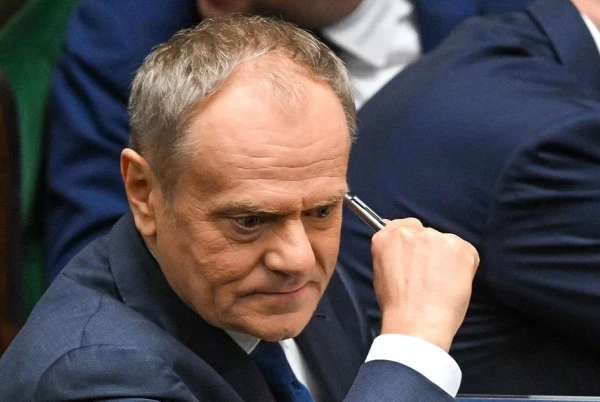
The current government lacks the votes to override Navrocki's veto.
The SAFE program is causing increasing tension in Poland. Prime Minister Donald Tusk has re-entered the discussion, stating that the upcoming elections will determine the country's future in Europe, referring to the president's veto and the objections of the opposition party Law and Justice (PiS) against the EU loan for armaments. "We must together stop the political madmen," he wrote.
The threat of Poland exiting the European Union (EU) is quite real. This was stated by the country's Prime Minister Donald Tusk on his social media account on X.
According to him, both confederations of the right-wing alliance and the opposition conservative party Law and Justice (PiS) want this.
"Navrocki is their patron," he added.
In Tusk's opinion, external factors are also seeking to undermine European unity. If Poland exits the EU, it would be a catastrophe for the country, the politician emphasized.
Tusk's statement came after Polish President Karol Navrocki vetoed a bill regarding Warsaw's participation in the European SAFE loan program, created for investments in the military sector. Navrocki proposed to finance the Polish defense industry from the profits of the National Bank. Tusk's government lacks a parliamentary majority to override the veto.
"Navrocki was elected President of Poland in June 2025. The politician opposes Ukraine's membership in the EU and NATO.
The dispute concerns the mechanism for financing investments in EU security and defense, from which Poland could receive billions of euros for modernizing its army and developing its national defense industry. SAFE provides for preferential loans to member states from European funds for defense-related expenses. In Poland's case, this amounts to several tens of billions of euros.
In Poland, it is emphasized that a significant portion of these funds could go to Polish arms companies and support the development of domestic military capabilities. However, critics of the program point to the risk of debt and the so-called conditionality mechanism for the allocation of funds. The government, in turn, insists that it only has a supervisory and anti-corruption nature.
<iframe width="560" height="315" src="https://www.youtube.com/embed/4oxzwircWiE?si=HNPuYNtCm2xM0lyG" title="YouTube video player" frameborder="0" allow="accelerometer; autoplay; clipboard-write; encrypted-media; gyroscope; picture-in-picture; web-share" referrerpolicy="strict-origin-when-cross-origin" allowfullscreen></iframe>