
No one dared to publicly criticize the actions of the authorities.
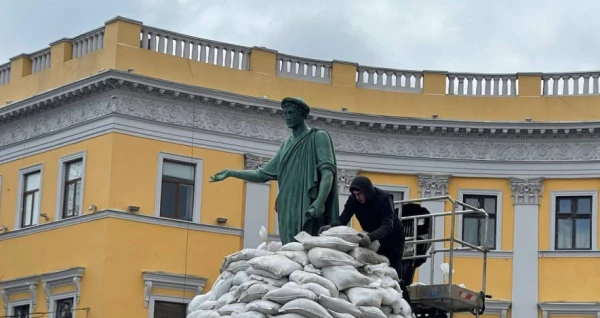
It all started in March 2022 when the sculpture was surrounded by sandbags. Initially, the initiators were volunteers, and later the city council (or regional administration, there are differing accounts).
At the first stage, 3,500 bags (95 tons) were brought in. In December of the same year, some were removed (they had torn), the monument was washed, and another 3,000 bags (90 tons) were added. Moreover, they were laid tightly, leaving no gap between the bronze and the "covering." As a result, there were 185 tons of "protection" around the monument.
No one from the representatives of monument protection institutions dared to publicly criticize the actions of the authorities. However, on the condition of anonymity, two of our interlocutors shared their views on the situation, writes the Odessa website dumskaya.net.
"This (laying the bags tightly) is categorically unacceptable, regardless of whether it’s a stone slab, a marble statue, or, as in our case, bronze. There should always be a distance between the protective barrier (sandbags, — Ed.) and the object itself, so that the monument can ventilate and to avoid direct contact with the bags," explains the source.
There are several points here. Firstly, sand quickly absorbs moisture. Depending on the season and weather, this can be up to 15% of its weight. Secondly, sand compacts. In simple terms — it settles.
Today, it is no longer damp sand; it is simply wet. And this difference is significant; the mass of water can weigh down the base not by percentages, but by multiples. And the least of the problems that has accompanied our Duke for the last four years is metal corrosion and the abrasive action of sand.
In simple terms, the slow oxidation process, which does not lead to rust (since there is no iron), is accelerated many times over, forming a patina (a greenish coating). And the sand in the bags turns into real sandpaper, severely damaging the surface.
"The bags need to be urgently removed to assess the extent of the damage. A group of restorers should be invited because it’s simply a bouquet of issues. Corrosion, cracks in the monument, subsidence under the foundation. It’s quite possible that to level the pedestal, the monument will have to be dismantled. Then the pedestal will need to be completely reassembled. It’s very meticulous work," summarizes our interlocutor.
Duke is a monument of national architectural significance. Thus, its preservation is the responsibility of both local government bodies and the Ministry of Culture. The representative of the Ministry of Culture is the regional department for the protection of cultural heritage. As Elena Vorobieva, its head, informed "Dumskaya," the initiator of the work in 2022 was the regional military administration. She reminded that at that time, the head of the OVA was Maxim Marchenko.
"From the perspective of monument protection legislation, this is not conservation, but measures for protection. Nothing bad has happened to Duke. In my opinion, the protective barrier is not that dense. On the other hand, everything is ventilated. Our department did not participate in the works. Now the object is awaiting restoration," Vorobieva explained.
In the city council, the initiators of all these processes claimed to be themselves. In everything else, they are unanimous with the regional administration.
"The temporary covering with sandbags was chosen based on the experience of other cities and recommendations from safety specialists as the most effective way to protect against fragmentary damage without interfering with the structure of the monument."
It turns out that neither regional nor city officials see any problems with Duke. The main attraction of the city, a monument, I reiterate, of national significance, our jewel, is simply covered with bags of wet sand and is being overgrown with moss. Without any project. Without risk assessment. Essentially without consultations with monument protection experts. They only consulted safety specialists.
Here, a small digression-reminder is necessary. In 2022, everyone was panicking; there was no particular logic in the actions of the local authorities at that time. I remind you, they blocked almost half of the city center, and tanks were brought to Duke. People were not allowed on Primorsky Boulevard and Potemkin Stairs for a long time.
The main goal of the sand dances around Duke at that time was to protect the sculpture from debris, shrapnel, and some not very powerful elements. But it’s now 2026. The nature of the war has changed significantly. The enemy is striking precisely at the ports.
Anatoly Izotov, the chief architect of the capital's reserve "Ancient Kyiv," lived and worked in Odessa for several years. He is well acquainted with the problems of our monuments. The candidate of architecture fears that the sandbags, which are supposed to protect the monument, will instead harm it.
"Today, the port is one of the main targets for the Russians. Their accuracy is well-known. If there is a powerful explosion with a greater shock wave, then all this excess mass of sand will simply help the monument fall. It will also press down from above. Right now, this sand will help like a dead weight," Anatoly explains.
The restorer adds that it would be much more reliable to temporarily remove the sculpture and place it in storage. It can be returned when it becomes safe. I can already imagine how many angry comments such a proposal will provoke. Of course. It’s like touching the sacred...
But that’s not all the problems of Odessa's Duke. A crack in the hand, and perhaps not just in the hand and not just a crack, is probably the most serious, but far from the only one. The slope down which the Potemkin Stairs descend is landslide-prone. This is the opinion of geologists, that is, not officials or public figures, but scientists.
The restoration of the stairs, the improvement of Istanbul and Greek parks, has somewhat improved the situation; however, it has not stopped the movement of the earth. And these works did not pursue such a goal: there was no large-scale reinforcement of the slope. Cladding the retaining wall with granite, as the Turks did, is clearly insufficient to prevent a landslide.
Literally 20 meters from Duke towards European Square is a completely clogged stormwater collector. Towards Primorsky Boulevard, it makes a knee turn, and there is no drain. That’s where all the water goes, into the Potemkin Stairs. Remember, during the reconstruction, giant icicles formed in its vaults? This was a consequence, among other things, of improper drainage in this area.
"Under the asphalt and granite, there is a real swamp, in the literal sense of the word. Anyone who has been to peat bogs knows what it looks like. The surface seems solid; you jump, and it moves under you in waves. The same goes for the soil around Duke now; it is extremely saturated," continues the source.
At the beginning of 2025, the authors of the report on the state of the surrounding natural environment of Odessa region (prepared by the Department of Ecology and Natural Resources of the OVA) stated that "recently, there has been an intensification of landslide deformation processes... in certain local areas where a complex of coastal protection and anti-landslide structures has been built."
The state of the slope was characterized by geologists with the phrase "critical equilibrium." In human language — on the verge of collapse. That is, with a certain combination of factors, everything will slide down. And this can happen at any moment.
So it turns out that Duke stands on softened ground, and for the last four years, an additional 200 tons have been added on top of it. The tilt of the pedestal is a matter of time. Or it may have already happened.
We became curious as to why the city council was so concerned about the Duke monument while simply waving off the bust of "the sun of Russian poetry." The city council's response was more like a joke from the series: seriously, Captain.
"The Pushkin monument is a hydraulic structure. Therefore, the method of covering it with sandbags was unacceptable, as the system would not withstand such a load," the city council's response stated.
In other words, the officials did not dare to cover the fountain, suspecting that it was not as simple as it seemed. Maybe a project is needed. They closed it with wooden slabs not long ago, and not at all to protect it. Initially, they did nothing with the bust, just to be on the safe side. But for Duke, they "made an effort"…







Leave a comment