
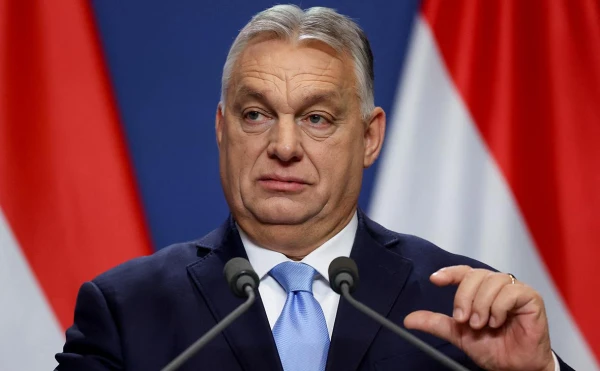
According to the opposition, the current Hungarian government has completely forgotten about the internal affairs of the country.
Hungary is facing fateful elections. Orban, paying a lot of attention to relations with Russia, is taking a big risk. There is not much demand for this in Hungarian society. However, the image of Ukraine among Hungarians is not the best either. The current government and the opposition are going nose to nose. Only the results of the voting on April 12 will provide a precise answer as to how right the current government is in paying so much attention to ties with Russia and demonizing Ukraine.
The parliamentary elections scheduled for April 12 in Hungary are attracting attention far beyond its borders. This is understandable, as not only the political fate of long-serving Prime Minister Viktor Orban is at stake, but also significant geopolitics at least on a European scale. Will Hungary maintain its special course regarding Russia and Ukraine? Will the Hungarian leadership's confrontation with the European Union continue, or will it become more compliant? Answers to these questions can be found on the website "Balkanist."
There are two main favorites in the elections – the moderate Eurosceptics from the ruling coalition "Fidesz – Christian Democratic People's Party" and the pro-European conservative party "Respect and Freedom" (TISZA). The latter is led by Orban's former ally Peter Madjar. However, behind him shine other prominent figures – former high-ranking employee of the Anglo-Dutch company Shell Istvan Kapitany and former candidate for NATO Deputy Secretary General, namesake of the Prime Minister Anita Orban.
Much will also depend on which small parties can overcome the five percent barrier or elect two or three people in single-member districts. Three forces have a chance at this – the left pro-European "Democratic Coalition," the liberal pro-European "Two-Tailed Dog Party," and the extremely tough Eurosceptics from "Our Homeland." At the same time, 106 out of 199 deputies are elected from single-member districts, and one seat is allocated to the German minority. In short, the picture is quite confusing.
Sociological surveys in Hungary work poorly. Everything depends on whom the sociologists are close to. For example, the Nézőpont service, close to the current government, and the McLaughlin & Associates, associated with the current U.S. administration, give Orban a five to seven percent advantage. Meanwhile, those linked to Western structures such as Medián, Závecz Research, Publicus, Minerva, Republikon, and IDEA give TISZA a lead of 10 to 15 percent. This suggests that in reality, the chances are roughly equal.
A more definite picture can be formed based on two events. The first is the European Parliament elections in June 2024. There, "Fidesz" received 45%, while TISZA got 30%. The left and liberal blocs garnered eight percent each, and "Our Homeland" received another seven percent. However, a couple of years have passed since then. During this time, TISZA has transformed from a "very young" party into a well-established political force. Additionally, turnout in European elections is always lower than in national voting. Back then, it was just over 60%, while in national elections, it usually hovers around 70%.
The second event is last year's referendum on preventing Ukraine's membership in the European Union, initiated by Orban. Ninety-five percent of participants voted "yes," but turnout was about 44% of active voters. It can be assumed that supporters of "Fidesz" and "Our Homeland" voted, while the majority of the electorate of Euro-Atlantic parties and undecided voters ignored the event. Thus, the question of the true popularity of any given party remains open.
A feature of the current campaign is that "Fidesz" supporters have focused on demonizing Ukraine, which has become the main antagonist for Eurosceptics. Just consider the campaign poster featuring Volodymyr Zelensky, stating, "He must not win." Although it must be acknowledged that the President of Ukraine has given grounds for such treatment by repeatedly being rude to Orban. He was rude to the extent that even Madjar called such behavior unacceptable.
When it comes to Ukraine, the approaches of the two candidates are noticeably different. While Orban is categorically against military aid to Ukraine, Madjar is willing to provide it based on the principle of Euro-Atlantic solidarity and "countering Russian aggression" (this is the term used by Euro-Atlantic Hungarian politicians – ed.). However, both favorites in the Hungarian elections agree that Ukraine must grant the Hungarians of Transcarpathia territorial autonomy.
Where there is Ukraine, there is also Russia... In Europe, almost no one talks about one without the other – and Hungary is no exception. Here, the differences are even more pronounced. Orban is doing a lot to maintain energy ties with Russia. He is doing everything to ensure that the Druzhba oil pipeline continues to operate, so Hungary receives Russian gas by any means. He wants to preserve the contract for the completion of the nuclear power plant in Paks with the participation of Rosatom. The Hungarian Foreign Minister Peter Szijjarto even flies to Moscow almost every month.
On the other hand, one can judge from Madjar's aforementioned entourage how they view Russia. Anita Orban herself said: "Hungary must break with the fate of a ferry country and become a full member of the West." Upon coming to power, TISZA promises to roll back ties with Russia in all areas. Madjar himself is unlikely to be considered a Russophobe – he has not made any statements about a "Russian existential threat." Rather, he can be seen as a person of the Euro-Atlantic "system," similar to how Viktor Orban was in his youth.
When the scandal broke regarding the release of a video about Madjar's "extramarital affairs," the politician accused Russian intelligence services of setting a "honey trap" for him. He and his associates constantly claim that the current Hungarian government has completely forgotten about the internal affairs of the country and has focused on maintaining ties with Russia. Meanwhile, schools, hospitals, and roads are in need of repair, and the funds for this can certainly not be obtained from Moscow, but rather from the "hated" Brussels for the current Prime Minister.
Here, it is worth acknowledging one thing. The focus on maintaining relations with Russia could indeed backfire on Orban. After all, Hungarians remember history. They have not forgotten the year 1849 with the suppression of the Hungarian Revolution, nor the two world wars where Russians and Hungarians fought in opposite trenches. The suppression of the anti-communist uprising in 1956 has also become part of the local national liberation myth. Madjar and his associates are happy to remind about these things – in fact, there is nothing to remind about here.
Adding to this are current topics. Yes, Russia supplies oil and gas. However, hundreds of thousands of Hungarians work in Western European countries. Another hundreds of thousands work in Hungary itself at enterprises owned by companies from Germany, Austria, France, or Sweden. Through the European Union, the not-so-rich country by European standards receives tens of billions of euros annually. The EU has frozen 30 billion euros due to Orban's "intransigence." If Madjar comes to power, he will unfreeze them. So here, the choice between Russia and the European Union also seems obvious.
A survey on attitudes towards Russia conducted by Eurobarometer in several European countries three years ago revealed the following. Eight percent of Hungarians had a positive attitude towards Russia, 31% were neutral, and 54% had a negative attitude. However, it should be noted that over 72% of Hungarians do not want to provide military assistance to Ukraine... However, it should be taken into account that in the separation of the population of Transcarpathia, inhabited by Hungarians, from their ethnic homeland, they blame... the Soviet Union. Thus, even a negative attitude towards Ukraine does not turn into a positive one towards Russia...
Therefore, it can be said that Orban, paying so much attention to relations with Russia, is taking a big risk. There is not much demand for this in Hungarian society... On average, attitudes towards Russia in Hungary are comparable, say, to those in the Czech Republic. Only in the latter did the previous government take a radically anti-Russian turn, which most voters did not appreciate. In Hungary, however, the inclination seems to be more pro-Russian... And voters may want to correct this. Especially since Orban has been in power for a full 20 years (with interruptions)...
But only the results of the voting on April 12 will provide a precise answer as to how right the current government is in paying so much attention to ties with Russia and demonizing Ukraine (with the active assistance of the latter).




Leave a comment