
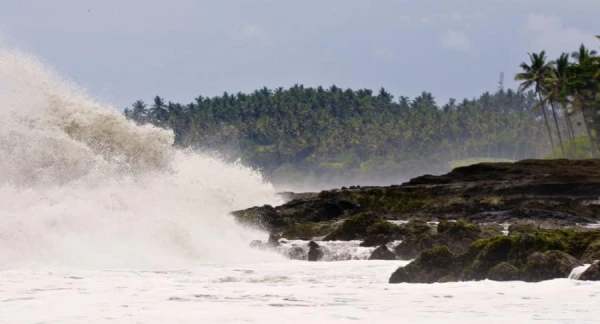
Since the early 20th century, about 100 tsunamis have been recorded in the Mediterranean and neighboring regions - about 10% of all registered events worldwide. Researchers expect new tsunamis in this region with high probability in the coming decades.
The Mediterranean is generally considered a safe region; however, experts warn that tsunamis pose a real danger - even here. There is a 100 percent probability that a tsunami of at least one meter in height will occur in the Mediterranean in the next 30–50 years, claims UNESCO.
Even if one meter does not seem like a large amount, densely populated coastlines with seismic and volcanic activity must actively consider the risk of small and potentially destructive tsunamis in the northeastern Atlantic.
Tsunamis are usually caused by earthquakes or volcanic eruptions and form several successive waves. Experts note that the first wave is not necessarily the strongest. Strong currents pose a particular danger, which can flood harbors, catch swimmers off guard, and cause significant damage to developed coastal areas.
Several regions of the Mediterranean are considered high-risk tsunami zones, for example, because they are located near active faults.
Here are the most important "hot spots":
Greece is considered the Mediterranean country with the highest tsunami risk, particularly the island of Crete, the Hellenic Arc, and the Aegean Sea. It is here that the African Plate is subducting beneath the Eurasian Plate, which can trigger strong earthquakes that provoke tsunamis. The famous earthquake in Crete in 365 AD caused a massive tsunami that spread throughout the eastern Mediterranean.
The southern part of Italy is at particular risk, especially Sicily, the Strait of Messina, and areas near Mount Etna. The Messina earthquake of 1908 triggered a tsunami that reached approximately 13 meters in height.
In Spain and the western Mediterranean, the Balearic Islands and part of the Valencia coastline are at particular risk. Tsunamis occur less frequently here but can arise if triggered in North Africa.
North Africa is especially vulnerable along the coastal areas of Algeria and Morocco. The earthquake in Boumerdes in 2003 caused a small tsunami that affected part of the western Mediterranean.
Portugal is part of the northeastern Atlantic, where the African and Eurasian Plates converge - a tectonically active zone that can cause earthquakes and sometimes tsunamis. According to experts from the Portuguese Institute of Sea and Atmosphere (IPMA), the risk of a tsunami occurring along the Portuguese coast is quite real, although the likelihood of very large waves is lower than in seismically active regions such as the Pacific Ocean. This is partly explained by the fact that large earthquakes in the northeastern Atlantic occur extremely rarely.
Western Turkey is particularly at risk along the Aegean Sea coast, especially around Izmir and the Bodrum Peninsula. Frequent earthquakes along active faults can trigger small tsunamis.
The Mediterranean coast of southern France, especially the areas around Nice, Marseille, Toulon, and the French Riviera, is at moderate risk of tsunamis due to proximity to tectonically active zones. Although extremely large waves are rare, fast tsunami waves can reach the coast within 20–60 minutes, making prevention and early warning systems crucial.
All the mentioned countries participate in the joint regional UNESCO tsunami warning system (NEAMTWS) in the Mediterranean region.
France, Italy, Greece, Turkey, and Portugal have their own national warning centers or accredited "tsunami service providers" in addition to membership in NEAMTWS and relay warnings in case of an alert.
Highest Tectonic Activity in the Eastern Mediterranean
Generally, the eastern Mediterranean (Greece, Turkey, Italy) is at the highest risk due to strong tectonic activity. The central Mediterranean has a moderate risk, while the western (Spain, France) is lower but not zero.
Interesting fact: since the Mediterranean is relatively small, tsunamis can reach nearby shores in just 20–40 minutes, meaning that an earthquake is often the most important warning signal. This also means that the warning time is much shorter than in larger oceans like the Pacific.
Many Mediterranean countries are interconnected through the joint regional UNESCO tsunami warning system, which can coordinate and relay information.






Leave a comment