
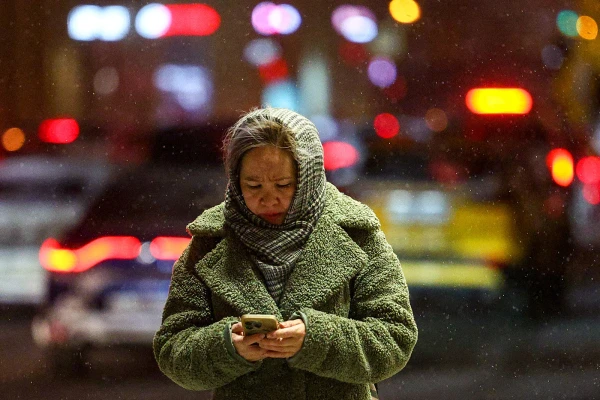
The authorities tend to believe that only a small part is vibrating from their negative decisions.
All disconnections of mobile internet and other communication restrictions in Moscow, St. Petersburg, and other major cities in Russia occur to ensure security, stated the press secretary of the President of the Russian Federation, Dmitry Peskov. What the authorities are actually afraid of, whether they can further disconnect home internet and ban VPNs, which could lead to irreversible technological backwardness for Russia, is discussed by political scientist and author of the Telegram channel "The Гращенков" Ilya Graschenkov.
The Real Reasons for Mobile Internet Disconnection in Both Capitals
When this question is raised, three possible answers are usually discussed — anti-terrorist exercises, technical maintenance of "white list" websites, or the authorities preparing for something. This question, of course, should be addressed not to political scientists, but to the authorities, because we all would like to know the reason.
We see that the decision to disconnect or not disconnect the internet is far from straightforward. For example, in Ukraine, the internet is not disconnected, and it cannot be said that this circumstance helps or hinders missile and drone attacks one hundred percent.
Therefore, decisions are made based on some considerations that have a clear interpretation in the public space — security. However, different agencies and different supporters of this measure may have different underlying reasons. This is why political scientists are currently noting a growing anxiety in society due to the disconnection of familiar means of communication. This anxiety understandably transforms into suspicion.
The absence of communication in the modern world is a measure as serious as the absence of salt in stores in the last century and the absence of light in homes in the 20th century. In other words, the disconnection of communication significantly impacts people's lives. They are now informational beings for whom social networks and familiar communication are much more important than, perhaps, even food and other basic needs.
Therefore, when people do not see obvious reasons for such a serious measure, they certainly believe that the authorities are preparing for something. Hence the rumors, word of mouth, and possible scenarios regarding what exactly the authorities might be preparing for. It would therefore be optimal if the authorities themselves could dispel these rumors somehow; otherwise, they risk becoming prisoners of speculation.
This, unfortunately, could become a repetition of a rather poor situation from the late Soviet era, when people believed rumors and external information much more than official statements because they initially considered them distorted. Therefore, anti-terrorist exercises and the "white list" are more of a justification for measures that do not seem commensurate with the stated problems to many.
As for the "white list," it is quite a strict story. I have already been in several regions where no internet works except for websites from this very "white list." Of course, it is periodically supplemented, but in any case, this not only does not restore the familiar world of informational interaction but rather shows the unattractiveness of the alternative.
Is the Authority Afraid of Angering Broad Sectors of Society?
Undoubtedly, the authorities are afraid of society, which is why their communication has long been built on the principle of mutual study. Numerous sociological services are a method to poke a stick into a substance that one does not quite understand or feel. The authorities in our country are not so much unpeople's as their social group is too detached from the realities that are quickly forming in the populace.
Roughly speaking, some remember society as it was when they were an active part of it — for example, as a military person or engineer in the Soviet Union. Some remember society from the mid-90s and tend to project the needs and tasks of that society onto today.
Some representatives of the authorities communicate with random messengers from this society — for example, in a taxi, in a restaurant with a waitress, or with distant relatives. They think they know this society, but they perceive it as something not just dangerous but as something uncontrollable. Therefore, one of the authorities' tasks is to gain control over what they believe is inclined to such chaotic movement.
The authorities are indeed afraid of angering society, believing that any of their actions can be perceived in only two ways: either swallowed or spat out. However, the authorities cannot help but respond to what they perceive as threats with escalations — this is their habitual modus operandi. If a problem arises, it must be solved either by prohibition or by some other problem that would overshadow the first.
Thus, the authorities always behave this way, while observing people's reactions and collecting relevant sociological data. Either society has truly rallied around the flag, or it is currently indifferent to any problems because it is mainly occupied with survival.
In any case, the authorities tend to believe that only a small part of society — the so-called middle class — is vibrating from their negative decisions. Therefore, these people are designated by the authorities as responsible for the unrest that arises in society, and they try to mitigate it either with new prohibitions or by clearing the space where this unrest occurs. Hence the attempts to block Telegram and other prohibitions and restrictions, or the desire to split this monolithic part of society into smaller groups that cannot come to an agreement with each other.
Nevertheless, overall, society has become more informational. Everyone now uses mobile internet. Grandmothers at the entrances watch series on their phones, children watch cartoons, and adults are more inclined to spend time reading news on social media than watching television. Unfortunately, this is still not an obvious fact for the authorities.







Leave a comment