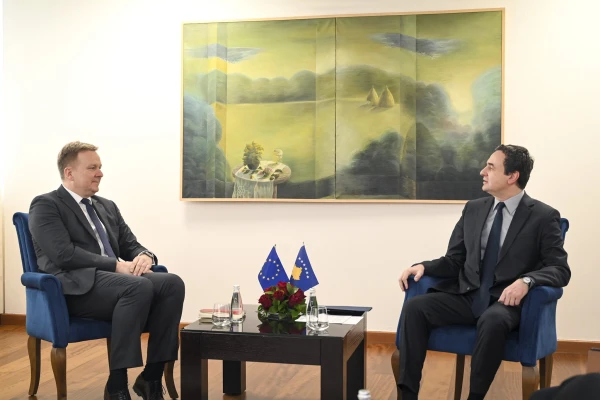
The government of Kosovo has decided to postpone the introduction of new regulations for the entry of foreigners into the country, Prime Minister Albin Kurti announced on Saturday, thus avoiding political disagreements with ethnic Serbs, LETA reported citing AFP.
The so-called foreigners' law stipulated that all foreigners arriving in Kosovo for various reasons — from employment to family reunification — would need to obtain a residence permit. The decision provides for the postponement of the law's introduction for one year.
It also prohibits vehicles with foreign license plates from being on the roads for more than three months.
The law was expected to complicate relations between Kosovo and neighboring Serbia, as well as the situation in northern Kosovo, where the majority of the population is ethnic Serbs.
After meeting with the European Union (EU) Special Representative for the dialogue between Kosovo and Serbia, Peter Sørensen, Kurti stated that his government would offer Serbian workers and students a "temporary residence permit for 12 months with the possibility of extension."
Emphasizing that the EU "has been engaged in intensive discussions with the government of Kosovo in recent weeks" on this issue, Sørensen stated that the decision to postpone the law's entry into force was made "to avoid disrupting the provision of healthcare and education services" in regions where Serbs predominantly live.
The EU High Representative for Foreign Affairs and Security Policy, Josep Borrell, noted on the platform "X" that this decision is "an important step forward that benefits all residents of Kosovo."
Serbia fully finances a parallel system of education and healthcare, and many of its workers, holding Serbian identity documents, do not recognize Kosovo's independence.
The law, which was initially set to come into force on Monday, would have affected both Serbian citizens and ethnic Serbs in Kosovo who use these services.
Kurti also announced another concession to ethnic Serbs, promising to simplify the process of obtaining Kosovo identity documents.
Serbia effectively lost control over predominantly Albanian-populated Kosovo in 1999 after NATO's military intervention in the Kosovo conflict, and in 2008, Pristina unilaterally declared independence from Serbia. However, Belgrade still considers the former province part of its territory and encourages the 120,000-strong Serbian minority, which predominantly resides in northern Kosovo, not to comply with the authorities in Pristina.