"The worst-case scenario is a rapid escalation of conflict, followed by some unpredictable or predictable incident."
For the first time since the Cold War in the 1980s, the United States and Russia, the two largest nuclear powers in the world, are without legal frameworks that limit their strategic arsenals, writes Bloomberg.
This event occurs against the backdrop of escalating global instability, the war in Ukraine, and China's rapid nuclear buildup, creating the conditions for a dangerous trilateral arms race.
What does the end of the treaty mean for global security and strategic stability?
The Collapse of the Last Treaty and the Risk of Escalation
The New START treaty came into force in 2011 and limited the number of deployed strategic warheads, the number of deployed delivery systems, and established verification procedures and data exchanges. The initial term of the agreement was set to expire in 2021; however, the parties extended it for five years.
However, in 2023, amid confrontation over the invasion of Ukraine, Russian President Vladimir Putin suspended Russia's participation in the treaty, halting inspections and data exchanges, although he promised to adhere to the limits, notes Bloomberg.
In September 2025, Russia proposed a temporary, one-year extension of the treaty. U.S. President Donald Trump publicly called this idea "not bad," but there was no official response from the U.S. Consequently, the Russian Foreign Ministry stated that Russia considers itself free from any obligations related to New START, CNN reports.
Experts note that the main loss is not so much the limits themselves but the verification mechanisms. "The real loss is the loss of transparency, and this will increase political risks," Bloomberg quotes Pavel Podvig from the United Nations Institute for Disarmament Research.
Without inspections and data exchanges, both sides may revert to planning based on "worst-case scenarios," assuming that the opponent is secretly building up forces.
"The worst-case scenario is a rapid escalation of conflict, followed by some unpredictable or predictable incident that quickly escalates into a nuclear conflict," CNN quotes former acting U.S. Deputy Secretary of State Thomas Countryman.
The China Factor. Why Trump Disagreed with Putin
The Trump administration and Republicans in Congress argue that the refusal to extend New START is necessary to bring China into negotiations. Critics of the old treaty point out that it limited the U.S. and Russia while leaving Beijing with "free hands," as it actively builds up its arsenal, CNN notes.
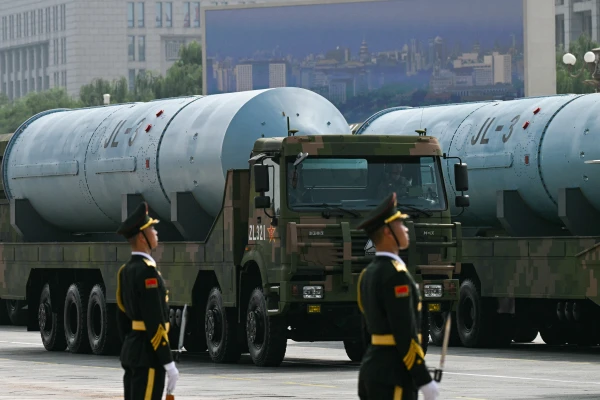
China plans to achieve "strategic equilibrium" with the U.S. by 2027 and may have over 1,000 warheads by 2030, compared to low figures of 200 at the beginning of the decade, according to a Pentagon report. The number of Chinese intercontinental ballistic missiles (ICBMs) has already increased by 88% during the New START period. Since 2010, China has increased the number of intermediate-range ballistic missiles by 635% and added new types of strategic and non-strategic delivery vehicles, according to CSIS.
However, Beijing rejects the idea of trilateral negotiations. Chinese Foreign Ministry spokesman Lin Jian called the demand to join the negotiations "unfair and unreasonable." His argument is that China's nuclear capability is "nowhere near" that of the U.S. or Russia. Beijing refuses to discuss measures to reduce nuclear risks in both bilateral and multilateral formats, despite its policy of "no first use of nuclear weapons," writes Bloomberg.
The U.S. is Falling Behind. Prospects of a New Nuclear Arms Race
Statistics indicate an asymmetry in the development of nuclear forces over the past decade. While the U.S. has exercised restraint, reducing or maintaining its arsenal at a stable level, Russia and China have actively modernized.
According to CSIS:
Russia. Increased the number of systems capable of carrying nuclear weapons by 22%, particularly submarines and submarine-launched ballistic missiles by 20%. Moscow has also developed new types of weapons, such as the hypersonic "Dagger" complex, the "Poseidon" torpedo, and the "Burevestnik" cruise missile with a nuclear power plant.
The U.S. The number of American ICBMs has actually decreased by 11%, and submarine-launched ballistic missiles (SLBMs) by 17%. Platforms for non-strategic nuclear weapons have been reduced by 33%.
The U.S. is starting a potential nuclear arms race from a disadvantageous position, writes CSIS.
"If a nuclear arms race has already begun, the U.S. will lose it. If it has not yet begun, the U.S. will start from behind," writes Heather Williams, director of the nuclear program at CSIS.
Russia has active production lines and can quickly increase the number of deployed warheads, leaving the U.S. "in the dust" while Washington is only preparing for changes, says CNN's Rose Gottemoeller, former chief U.S. negotiator for New START.
Washington's Strategy. How the U.S. Can Catch Up
The end of the treaty does not necessarily mean an immediate arms race but opens the way to an "unlimited nuclear era."
Washington is considering several key scenarios. The U.S. could "reload" existing intercontinental ballistic missiles and submarine-launched missiles with additional warheads, potentially doubling the number of deployed warheads compared to the limits of New START, writes CSIS.
Another approach is diversification and modernization of the arsenal, creating more flexible and resilient systems to deter regional and global threats from Russia and China, according to CSIS. This includes intermediate-range missiles, new B-21 strategic bombers, and Columbia-class submarines.
Resuming nuclear testing is seen as an additional tool to demonstrate resolve. Trump previously threatened to resume testing, and Russia is preparing for a possible increase in warhead production in response, creating a risk of rapid escalation, notes CNN.
Despite the formal end of New START, the U.S. and Russia are negotiating a practical extension of compliance with the treaty's provisions for at least six months, according to Axios. So far, this concerns unofficial agreements; the final document has not been agreed upon by the presidents of both countries. "We agreed with Russia to act in good faith and discuss possible updates to the treaty," a U.S. representative noted. This temporary extension will preserve key transparency and control mechanisms, even if the treaty has legally concluded.