European leaders proposed the idea of a two-speed union as the quickest way to overcome the political deadlock on the economic reforms needed to reboot the European economy, while French President Emmanuel Macron set the summer as a deadline for reaching a broad agreement.
"Today we decided that we need to finalize the agenda by June," Macron said as he left the castle. "If we do not have concrete prospects and concrete progress by June, we will continue with enhanced cooperation."
Although the EU is built on the consensus of 27 countries, frustration with the pace of reforms has led to calls for working in smaller groups of countries, which would signal a shift in European politics where action and speed are preferred over unanimity.
The so-called enhanced cooperation is a legal provision in EU treaties that allows at least nine countries to join forces and independently promote initiatives. It gained prominence in December when EU leaders launched a mechanism to provide a €90 billion loan to Ukraine without the participation of Hungary, Slovakia, and the Czech Republic.
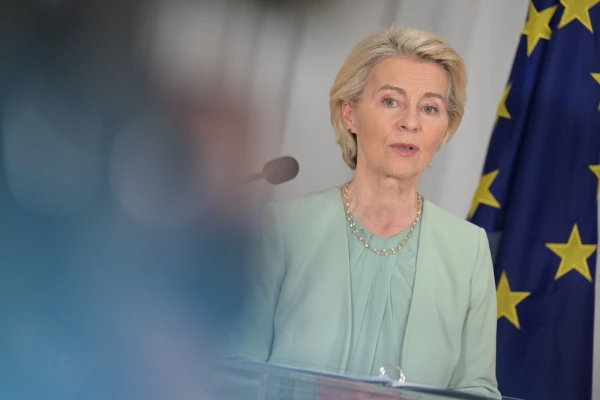
"Often we move forward very slowly, and enhanced cooperation allows us to avoid that," said Ursula von der Leyen, President of the European Commission, at the closing press conference.
Von der Leyen mentioned two legislative files for which a legal instrument will be considered: the first phase of the Union of Savings and Investments, aimed at creating a cross-border system to mobilize private savings for strategic projects, and the 28th regime, aimed at developing a unified framework for creating companies across the entire bloc.
According to her, if capitals do not achieve "sufficient progress," the issue of enhancing cooperation on the Union of Savings and Investments may be addressed as early as June.
European Council President António Costa stated that he would "work to avoid" the emergence of a two-speed Europe as much as possible and would always strive to reach an agreement among all 27 member states.
"This is our primary goal," Costa emphasized. "If that fails, then, of course, the Lisbon Treaty offers several solutions. One of them is enhanced cooperation."
Von der Leyen supported this view. "Don’t get me wrong, I prefer approval by all 27 countries," she said.
Urgent Changes
The desire to break the deadlock was shared by other leaders present at the off-site meeting in Alden Biesen Castle in eastern Belgium, where the focus was on competitiveness. Capitals are increasingly despairing over the growing gap between the EU and its main global competitors, namely the US and China.
German Chancellor Friedrich Merz, who sought to create an image of unity with Macron after public disagreements over eurobonds (joint debt) and "Made in Europe" preferences, expressed a "strong sense of urgency" for change.
"The European Union must act quickly and decisively," he said.
Earlier on Thursday, Danish Prime Minister Mette Frederiksen called a two-speed Europe an appropriate way to act under current conditions.
"If you had asked me five or ten years ago, I would have said 'no,'" Frederiksen told reporters. "Today, if you ask me about it, I will say 'yes.'
"Some (countries) may prevent Europe from doing what is necessary for Europe, and I think we will see pro-Russian governments that are actually against Europe," added the Danish Prime Minister, stating that it is unacceptable for "us not to do what is necessary for Europe because of one or two countries."
Spanish Prime Minister Pedro Sánchez also expressed support.
Additional support came from Mario Draghi, former President of the European Central Bank, author of a highly influential report on competitiveness, who attended the summit on Thursday as a special guest.
In his address to the leaders, Draghi recommended exploring the possibility of using enhanced cooperation to "move faster" in priority areas such as the Union of Savings and Investments, the single market, and energy prices, an EU spokesperson reported.
A two-speed Europe is inherently controversial as it divides member states into different leagues, but in many ways, it has already become a reality. The Eurozone and the Schengen Area are the most vivid examples of a two-tier system.
Before the loan to Ukraine, enhanced cooperation was used to create the European Public Prosecutor's Office (EPPO), introduce a unitary patent, and harmonize divorce legislation.
In addition to these structures backed by legislation, European countries regularly come together in informal groups to protect common interests, such as the "Frugal Four" and "Friends of Cohesion" during budget negotiations. The Weimar Triangle, MED9, the Visegrád Group, and the Northern Baltic Eight are other examples.
Last month, the finance ministers of Germany, France, Italy, the Netherlands, Poland, and Spain formed a new coalition called E6 to push for "decisive action and rapid progress" in four strategic areas, including defense and supply chains.
"We are giving momentum, and other countries can join us," said German Finance Minister Lars Klingbeil, extending an open invitation.