At the 6th Zionist Congress in 1903, participants voted to send a group to gather information in the region.
Ideas about the mass resettlement of Jews occupied a special place in the political discussions of the late 19th century: the creation of a Jewish state was one of the key issues not only for the Zionist movement but also for anti-Semites and for European governments seeking to use the situation for their own purposes.
There were quite a few places where a Jewish state could have been established, aside from historical territories — from New Guinea to Texas; however, some of the most developed resettlement plans pertained specifically to Africa.
The ideas of resettling Jews in Africa, specifically in "Uganda," which was actually entirely located within modern-day Kenya, emerged in Britain at the end of the 19th century. The reasons for this were economic — Britain was experiencing difficulties in East Africa. Despite investments, the region was not yielding the expected profits, which prompted British officials to consider increasing the flow of European immigrants.
Jews entered this plan thanks to Joseph Chamberlain, the then Secretary of State for the Colonies in Britain. In 1902, through his acquaintances in the Jewish community of Britain, the banker brothers Rothschild, Nathan and Alfred, he met with the leader of the Zionists, Theodor Herzl. At that time, the movement was actively discussing the creation of a Jewish state, considering not only the Promised Land but also other territories, including, for example, Cyprus and Sinai.
In December 1902, Chamberlain traveled to South Africa, stopping in Mombasa along the way. It was there that British settlers complained to Chamberlain about a lack of labor. During his travels in Kenya, Chamberlain noted that the country would be ideal for Herzl.
Initially, "Uganda" did not excite Herzl; however, due to the escalation of Jewish pogroms, the issue of resettlement became particularly relevant. Although "Uganda" did not have historical significance for Jews, this plan was more promising than alternatives. At the 6th Zionist Congress in 1903, participants voted to send a group to gather information in the region, despite the fact that "Uganda" nearly put the Zionists on the brink of a split — many viewed the project as a betrayal of the idea of returning to historical lands.
British settlers also opposed the project, creating the "Anti-Zionist Immigration Committee." Ultimately, "Uganda" was definitively rejected at the 7th Zionist Congress in 1905, after Herzl's death. Despite the failure of the plan, many Zionists continued to explore options for creating Jewish settlements in Canada, Mesopotamia, Cyrenaica, Angola, and even Ethiopia.
The topic of Jewish resettlement did not lose relevance and resurfaced in 1937 at the initiative of France and Poland, which planned to create settlements in Madagascar, allegedly having "ancient Jewish roots"; however, the island was deemed not entirely suitable.
In 1938, the issue was actively discussed by Nazi ideologues: at that time, up to 10% of Jews under German jurisdiction were Polish citizens, who refused to accept their return. At the same time, the French government also refused to accept Jews. In this context, Ernst Kaltenbrunner, then leader of the Austrian SS, proposed a plan to resettle Jews in Australia.
Madagascar became the center of discussions at the initiative of Foreign Ministry official Franz Rademacher in the context of transferring the island to Germany after France exited the war. According to Adolf Eichmann, who was working on the plan, it was proposed to resettle 4 million Jews to Madagascar over 4 years. The island itself was to be governed as a police state under SS control.
The plan proved unfeasible due to the British naval blockade and was later postponed due to the Nazis' defeat in the Battle of Britain in September 1940. In November 1942, the plan finally lost its significance — the British reclaimed Madagascar from French collaborators, closing the topic of creating a Jewish state in Africa.
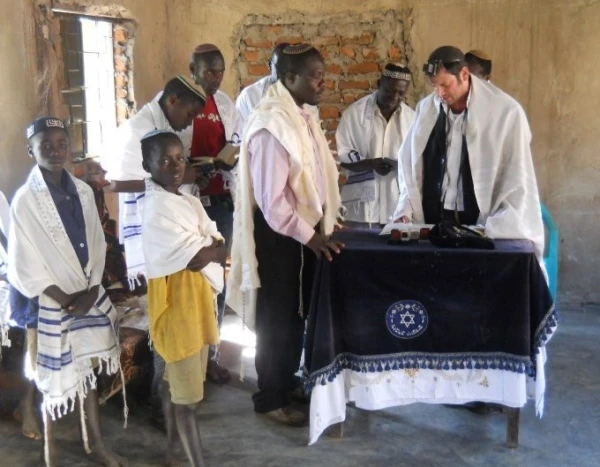
Nevertheless, in Uganda, there remains Namutumba, the largest settlement — a thriving Jewish community of about 244 people with an active synagogue. The community built an interfaith primary school — the "Tikkun Olam" (TOPS) primary school, serving the entire community, actively working on economic development, and striving to improve the lives of all its members. Yoash Mayende is the director of TOPS, which operates entirely on solar energy.
Rabbi Levi Shadrach Mugoya is their current spiritual leader. Senior Rabbi Eri appointed Shadrach as his successor, calling it "a great honor and a great responsibility." Shadrach studied at Uganda Christian University and received a degree in project planning and entrepreneurship in 2013. He also studied at the yeshiva of Chief Rabbi Abayudaya, Gershom Sizomu. Shadrach is currently continuing his education at ALEPH (Alliance for Jewish Renewal) to lead his people well as a rabbi. A conservative yeshiva in Israel has accepted him for training.