
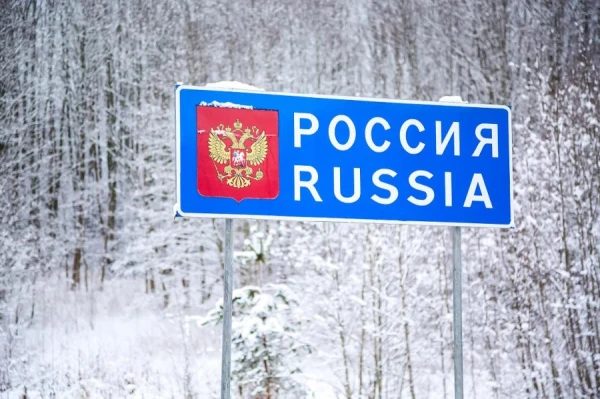
As a result of Donald Trump's negotiations with the Kremlin, residents of Russia began to consider the USA a less hostile country than before. A survey conducted by the Levada Center on behalf of the Sakharov Society also shows how strongly propaganda influences the sentiments of Russians.
Once, Germany was the most friendly Western country towards Russia. But nearly four years after the start of Vladimir Putin's aggressive war against Ukraine, most residents of Russia perceive Germany as an "enemy." This is the result of a study conducted by the Levada Center in Moscow on behalf of the German Sakharov Society.
Due in large part to Kremlin propaganda, the negative rating of Germany among Russians reached 66 percent as early as May 2022—similar to that of the USA and the UK, according to the study.
After Donald Trump announced a "deal" with Russia, open hostility towards Washington, according to the study, decreased, but respondents' attitudes towards Germany and the UK remained unchanged.
Who are Russia's "enemies"?
The head of the study, Russian sociologist Lev Gudkov from the independent Levada Center in Moscow, explained in Berlin that many Russians believe their country is "surrounded by enemies, and they see themselves as victims."
According to the survey, the main "enemies" of Russia are Poland and Lithuania, followed by the UK. Germany ranks fourth, followed by Sweden, the USA, and Israel.
Which countries pose a threat to Russia
In the list of countries that pose a "real threat" to Russia, the USA leads. Russians consider the UK, Poland, and Germany to be slightly less dangerous. The collective Baltic States rank a respectable fifth.
According to the survey, the most negative attitudes towards Germany are held by older respondents (70%), Muscovites (75%), those who approve of Putin's activities as president (62%), and those who trust television as a source of information (69%).
The most positive attitudes towards Germany are held by young people under 25 (48%), those who believe that things are going wrong in the country (34%), those who disapprove of Putin's work as president (38%), and those who use alternative sources of information (especially Telegram).
According to the survey, Russians want "foreigners not to interfere in our affairs" (66%) and "to stop imposing their ideas on us" (81%; 2024).
Envy of the West
According to the study, the West evokes both disapproval and envy among Russians, especially regarding the wealthy countries of Europe and the USA.
Although Russians are willing to accept some restrictions due to the war against Ukraine, this willingness reaches its limit due to significant losses.
Recently, a scandal erupted in Russia after one of the clothing companies invited influencers and press representatives on a VIP trip to the luxurious French ski resort Courchevel, which was once popular among Russians.
Allies and Friends
The study concludes that the "principle of 'the enemy of my enemy is my friend' works perfectly." This is because "dictatorial or authoritarian regimes, such as North Korea, China, and Iran, appear related in the collective Russian consciousness, as they also reject Western culture, democracy, and liberalism. Their anti-American stance immediately makes them allies of Russia in the war against Ukraine in public opinion—after all, most Russians believe that the war was provoked by the USA."
North Korea also supports Russia with soldiers in the war against Ukraine, Iran supplies Shahed drones, and China refuses to condemn the war.
Russians consider Belarus, China, Kazakhstan, North Korea, and India to be "close friends and partners."
Putin's aggressive war against Ukraine, which has overshadowed relations between the West and Moscow since the invasion of Russian troops on February 24, 2022, increasingly defines the lives of Russians.
The author of the study and sociologist Lev Gudkov sees in Russia "anti-liberal propaganda and the formation of an authoritarian regime that is becoming increasingly repressive and militaristic."




Leave a comment