
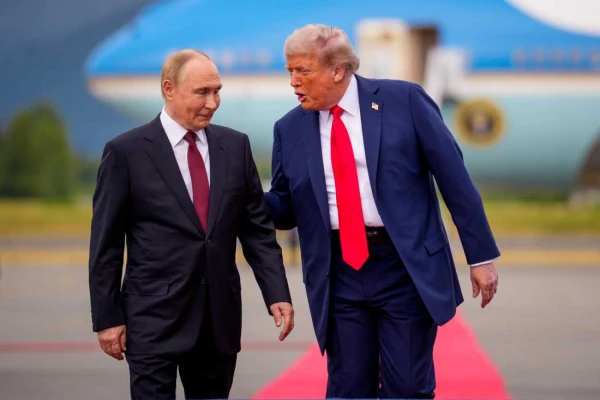
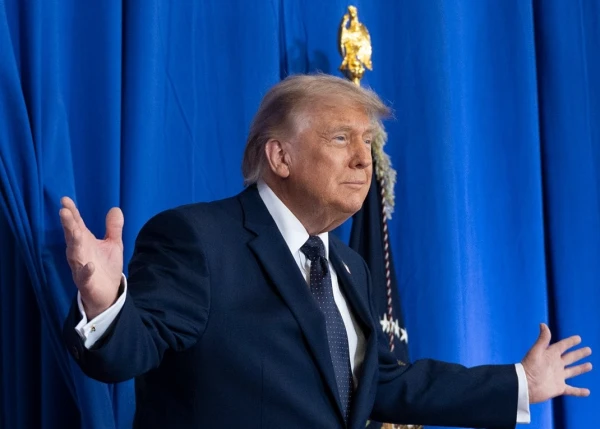
The first year of the presidency has proven that there is no isolationist in the White House.
What has Trump accomplished in a year? This was asked by the media to Thomas Graham, a former assistant for Russia and Eurasia to President George W. Bush and a fellow at the American Council on Foreign Relations.
— During the election campaign, Donald Trump positioned himself as a leader who would not drag the U.S. into new conflicts or start new wars, but in the year since he took office, the U.S. has participated in an attack on Iran's nuclear facilities, kidnapped Venezuelan President Nicolás Maduro, and announced intentions to annex Greenland. What do you attribute this shift to?
— Well, if you were to ask Donald Trump, he would tell you that he has not dragged the U.S. into any new conflicts or wars. The actions you mentioned — Iran and Venezuela — were limited in scale and duration military operations. As for Greenland, it is still unclear how that situation will develop.
Donald Trump believes that all these actions are important for advancing U.S. national interests, as he sees them and as they are described in the new National Security Strategy of the country. He reaffirms U.S. influence and dominance in the Western Hemisphere, solidifies U.S. priorities regarding the Iranian nuclear program and Iran's ability to influence the situation in the region, thereby contributing to the resolution of the situation around Gaza.
He explains the necessity of Greenland becoming part of the U.S. with security considerations, but I think his interest is more related to what he said in his inaugural address about the intention to make America great again — great, apparently, also in terms of territorial expansion.
Overall, I would not say that his actions on the international stage significantly diverge from what he said during the election campaign. But part of his electorate, especially supporters of the so-called MAGA movement, expected something different. They hoped he would pay much more attention to domestic policy rather than foreign policy. Essentially, these people advocate for isolationism. But over the past 12 months, it has become clear that Donald Trump himself is not an isolationist at all. He is ready for much more decisive actions on the international stage than many of his predecessors.
— You said that part of Donald Trump's electorate expected something different from him, but overall, if we look at public opinion polls, most Americans do not support aggressive actions like those in Venezuela and are against the annexation of Greenland. Does he not care much about public opinion?
— At the moment, he is not paying much attention to public opinion polls, both in foreign and domestic policy. Apparently, he does not think they can significantly influence his ability to pursue the policy he deems necessary.
— But in November, there will be midterm elections for Congress. Shouldn't the president care about listening to voters in such a situation?
— In some aspects, he does listen. One of the recent examples is the extension of the ObamaCare program, although it has faced criticism from many Republicans.
As for foreign policy, it has only a limited influence on American voters' behavior, and in this regard, the president, you could say, has his hands virtually untied, regardless of what the polls show.
On Spheres of Influence and American Power
— You mentioned the new U.S. National Security Strategy. Some experts in Russia see in it the U.S. intention to make the Western Hemisphere a zone of its exclusive influence, but at the same time expressed hope that the U.S. will henceforth be more understanding of the desire of other great powers to have their own spheres of influence. In practice, however, we see that the former is happening, while the latter is not.
— The National Security Strategy does not mention spheres of influence. This document focuses on restoring American power — both domestically and abroad. U.S. dominance in the Western Hemisphere has been a component of American foreign policy for decades, if not centuries, although, of course, not all American presidents have pursued it as actively in practice as Donald Trump.
At the same time, the National Security Strategy talks about U.S. concerns in the Indo-Pacific region: the U.S. is worried about the growing influence of China both economically and geopolitically.
The document also mentions U.S. interests in Europe, although the wording is noticeably different from what was said under previous administrations.
— The wording regarding Europe is quite critical.
— Critical towards some European leaders, but not necessarily towards Europe as a whole. Donald Trump would prefer that Europe be governed by people whose views are closer to his own. But he does not reject Europe; he wants it to play a greater role in ensuring its own security. As for trade and economic relations, the U.S. remains very interested in Europe.
Part of the strategy is also dedicated to U.S. interests in the Middle East, although it is not significant.
The document also discusses the internal situation in the U.S. — about the reindustrialization of the country and the associated tariff policy, immigration policy, and other issues.
All of this fits into the slogan proclaimed by Donald Trump, America First — he wants to restore American power both domestically and abroad.
But America First is not only about him making decisions based on his own understanding of American priorities. It is also about the U.S. needing to remain the most powerful country in the world.
At the same time, it is certainly striking that the wording about China and Russia in the U.S. National Security Strategy is not nearly as harsh as it was under his predecessor.
— Yes, they are no longer called enemies.
— But the president clearly considers them competitors. Look at his statements about Greenland — he repeatedly says that if the U.S. does not occupy it, then China or Russia will.
From the parts of the strategy that discuss the Indo-Pacific region, it is clear that the U.S. sees China as its main competitor there. And when it comes to Europe, it is clear that in this region, the U.S. sees Russia as its competitor, and in the long term, also China. And the president clearly believes that in this competition, the leading positions should belong to the U.S.
— But the National Security Strategy suggests that the U.S. should no longer strive for the role of a "global policeman." In practice, however, it seems that Donald Trump cares about everything happening in the world.
— Part of this is simply telephone diplomacy, attempts to reconcile warring parties, say, Thailand and Cambodia; he does not engage American resources, but essentially works on his reputation, on his desire to win the Nobel Peace Prize. But if you look at how key American resources, including military ones, are engaged and for what tasks, then his approach does not differ much from the policy pursued by his predecessors over the past 30–40 years.
On Law and Power
— Recently, Donald Trump openly stated that he does not need international law, as he relies on his own morality, and his advisor Stephen Miller directly said that everything in the world is decided by force. Is this a break from the concept of a "rules-based order" previously promoted by the U.S. and its European partners?
— Yes, absolutely. Trump personally does not believe in this concept. He thinks that power is much more important than rules. This is reflected in his domestic policy, as he tries to eliminate legal restrictions placed on the executive branch. Look, for example, at how he deploys federal units to combat criminals and illegal immigrants in several states. His approach largely diverges from how these forces are supposed to be utilized by the American legal system, and many people in the U.S. consider this an abuse of power.
In any case, he clearly regards laws and rights with less reverence than most of his predecessors, which is also reflected in his actions on the international stage. He believes that U.S. interests can and should be promoted by force.
— And do other countries, from his perspective, have the right to promote their interests by force? Russia, China?
— Yes, but the question is how the promotion of these interests relates to U.S. interests. And here Donald Trump's approach differs from that of his predecessors. In the case of conflicting interests of other states with American ones, they spoke about violations of international law, trying to garner support from other countries in this way. The current president does not talk about this. But when he sees that Russia's use of force to promote its interests contradicts U.S. interests, he resists it in one way or another. Essentially, this is a power struggle. From the perspective of the U.S., it does not imply dividing the world into spheres of interest and influence. If Russia's or China's actions contradict U.S. interests, then the U.S. will oppose them wherever they may be. Just without references to international law, the spread of democracy, human rights, and so on.
— A strange kind of multipolar world is emerging.
— It all depends on which countries can establish themselves as "poles" and how well they can defend their national interests through force and its many manifestations. Trump clearly sees the U.S. as the dominant power in the world, and he intends to continue strengthening this power in economic, military, and geopolitical terms. He understands that there are certain limits, including regarding his actions towards Russia, as this involves significant risks. The same applies to China.
On Russia and Ukraine
— How do you assess Donald Trump's actions regarding the Ukrainian settlement and the normalization of Russian-American relations? Over the year, there have been moments when it seemed there was "light at the end of the tunnel," but at the same time, the American president has proven surprisingly susceptible to external influence from those who are inclined to continue the conflict.
— The situation with Russia and Ukraine is indeed very complicated. What we can say is that without Donald Trump, there would not have been any serious consultations aimed at resolving the conflict at all. Yes, the process is moving extremely slowly, but nevertheless, we are gradually moving towards full negotiations. Donald Trump has already forced Ukraine and Europeans to look realistically at the situation and tackle complex issues — what concessions Ukraine is willing to make, what guarantees its European allies can provide, and so on. In terms of changing Russia's approaches, the effect of his actions is less noticeable, but we know that the Russian authorities have also stated their readiness to calibrate some of their demands if other conditions are met.






Leave a comment