
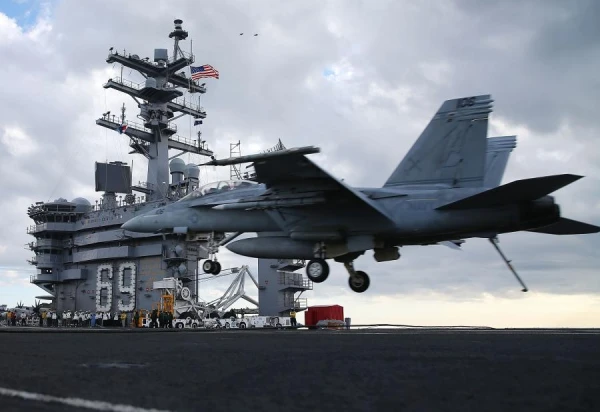
According to tracking data and photographs from observers, several U.S. military ships have moved from the South China Sea to the Middle East. We detail the armament and range of the 'armada' that Trump threatens Iran with.
A week ago, the American naval vessel Abraham Lincoln crossed the Malacca Strait. This is evidenced by maritime tracking records and photographs obtained from local observers. The nuclear aircraft carrier passed by Singapore shortly before midnight last Sunday with minimal lights, accompanied by the destroyers USS Frank E. Petersen Jr, USS Spruance, and USS Michael Murphy.
Just last week, the ship was operating in the South China Sea. Now it is heading towards the Indian Ocean. Neither the Pentagon nor the Navy has officially confirmed the final destination, but navigational data indicates this direction.
This is already the third instance in a year where a strike group stationed in the Indo-Pacific region has been ordered to redirect to the Persian Gulf. The Abraham Lincoln itself has already been redirected during its deployment in 2024, and the Nimitz aircraft carrier received similar orders in June of last year.
USS Abraham Lincoln (CVN-72)
USS Abraham Lincoln is a Nimitz-class nuclear aircraft carrier in the United States Navy. Laid down in 1982 and commissioned in November 1989, this warship represents one of the most powerful naval platforms in the world.
With a displacement of 880,000 tons and a length of 332.8 meters, the Lincoln is equipped with two Westinghouse A4W nuclear reactors, providing it with unlimited range and a speed of over 30 knots (56 km/h). Its power plant with two nuclear engines generates 260,000 horsepower through four steam turbines.
In terms of defensive armament, the ship is equipped with Sea Sparrow launchers, RAM RIM-116 missile systems, and three CIWS Phalanx systems for point defense. Additionally, it features modern air search radars AN/SPS-48E and AN/SPS-49, electronic warfare systems, and several air traffic control radars.
The total crew consists of 5,680 personnel, divided into 3,200 ship's company and 2,480 air wing members. It can carry up to 90 aircraft, including planes and helicopters, operated by four catapults and four elevators, with a hangar below deck.
On board the Abraham Lincoln is the 9th Air Wing, equipped with F/A-18E/F Super Hornet fighters, EA-18G Growler electronic warfare aircraft, E-2D Advanced Hawkeye early warning aircraft, and MH-60 helicopters.
USS Frank E. Petersen Jr. (DDG-121)
The destroyer USS Frank E. Petersen Jr. was commissioned in May 2022 as the 71st Arleigh Burke-class destroyer, named in honor of the first African American aviator and Marine Corps general. The ship has a displacement of 8,373 tons and a length of 155 meters, powered by four gas turbines, allowing it to reach speeds of over 30 knots.
Equipped with the Aegis Baseline 9C2 combat system, it possesses advanced air and missile defense capabilities. Its armament includes a 5-inch gun, 96 vertical launch cells for various types of missiles (Standard, Tomahawk, ESSM, and VL-ASROC), a CIWS Phalanx system, torpedo tubes, and the capability to operate two SH-60 helicopters.
USS Spruance (DDG-111)
In service since October 2011, the destroyer USS Spruance honors Admiral Raymond A. Spruance from World War II and operates out of San Diego, California.
Having the same dimensions as its sister ships (155 meters in length and 8,373 tons), this Flight IIA-class destroyer is equipped with the Aegis system featuring the AN/SPY-1D radar for tracking and fire control against multiple targets.
Its arsenal includes a 5-inch main gun, 96 vertical launch cells, eight Harpoon anti-ship missiles, torpedoes, and additional light armament. The flight deck allows for the operation of two SH-60B anti-submarine helicopters, providing enhanced ASW capabilities.
USS Michael Murphy (DDG-112)
The destroyer USS Michael Murphy, commissioned in 2012 and based in Pearl Harbor, is dedicated to Lieutenant Michael P. Murphy of the Navy SEALs, who was posthumously awarded the Medal of Honor after his death in Afghanistan during Operation Red Wings in 2005.
This Flight IIA-class destroyer has standard specifications for its class: 155 meters in length, a gas turbine power plant capable of exceeding 30 knots, and a range of over 4,400 nautical miles. It is equipped with the Aegis combat system with missile defense capabilities.
The armament configuration mirrors that of other Flight IIA submarines: 96 VLS cells, a 5-inch gun, Harpoon missiles, a Phalanx system, and a complete package for two landing helicopters.
*Note: It is assumed that a fast attack submarine will also be part of the group, however, its affiliation remains classified, and at the time of writing, its presence has not been confirmed.
Strike Range When Deployed in the Middle East
All three destroyers have the same armament, as they belong to the Arleigh Burke Flight IIA class, so their strike range is identical. The maximum operational range is primarily determined by their onboard missiles in the Mk 41 VLS cells.
The longest-range system is the Standard SM-6 missile, which depending on the sources reaches between 240 to 463 kilometers, although some estimates suggest up to 400 kilometers in anti-ship mode. This multi-role missile can engage aerial threats, cruise missiles, and even surface targets, providing the capability to strike beyond the horizon through integration with external sensors.
The Tomahawk cruise missiles have the longest strike range against land targets. Current Block IV versions have a range of about 1,600 kilometers (about 1,000 nautical miles), while Block V versions maintain a similar range. This weapon allows for precise strikes against well-defended ground targets from a safe distance.
For anti-ship warfare, the Harpoon missiles mounted on these destroyers have a range of about 130-240 km depending on the Block II or Block II+ ER modification. The 5-inch Mk 45 gun has an effective range of about 24 kilometers and is primarily used for point defense and naval gunfire support.
The range of the Abraham Lincoln is limited not by its own armament but by its air wing. The F/A-18E/F Super Hornet fighters constitute its main offensive potential with a combat radius of about 722 kilometers (390 nautical miles) in air-to-ground and air-to-air strike configurations, which can be significantly extended through aerial refueling.
Vacuum in the Pacific, Concentration in the Persian Gulf
With the departure of the Abraham Lincoln from Asian waters, the only American aircraft carrier remaining in the Indo-Pacific region is the USS George Washington. However, this ship is currently undergoing maintenance in Yokosuka, Japan, and its air wing must complete certification training before becoming operational again.
Washington maintains a three-pronged position in the region: deterrence through visible military capability, countering Iranian influence through sanctions and indirect operations, and security guarantees to regional partners such as Israel and Gulf states.
The speed of the redeployment, which interrupted planned operations in the Pacific, indicates that American military leaders consider strengthening response capabilities in the Middle East a priority. Now, as the aircraft carrier moves towards waters under the jurisdiction of U.S. Central Command, the question is no longer whether it will arrive, but what it will find upon arrival and what orders it will receive from Donald Trump.









Leave a comment