
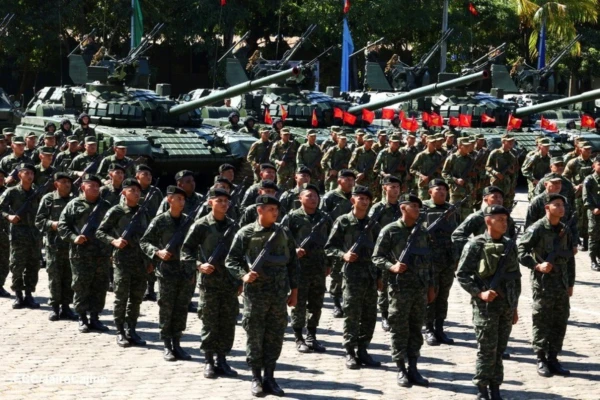
A country with a population of 6.7 million people is ruled by a duo of the president and his wife.
In Nicaragua, a presidential decree has been issued allowing the entry, transit, and parking of troops, ships, and aircraft belonging to foreign armed forces on the territory of the country. The decree, published in the official gazette "La Gaceta," will be in effect from January 1 to June 30, 2026, and is officially aimed primarily at exchange and humanitarian assistance in emergency situations.
The decree, designated as No. 14-2025, provides for the participation of the armed forces of countries such as Russia, the USA, Mexico, Cuba, and Venezuela, as well as Central American countries that are part of the Central American Armed Forces Conference (CFAC): Guatemala, El Salvador, Honduras, and the Dominican Republic. Additionally, the departure of Nicaraguan troops abroad for joint exercises is permitted, which strengthens regional cooperation in defense and disaster response.
According to the official document, the foreign military presence in Nicaragua will focus on humanitarian assistance operations, search and rescue operations, and rescue operations in the event of natural disasters or hazardous situations. Military exercises are also planned to train operations against illegal activities in the maritime areas of the Caribbean Sea and the Pacific Ocean, as well as technical and tactical exchanges with the naval forces and the Special Operations Command of the Nicaraguan army.
In the case of the Russian Federation, its participation in joint military exercises, as well as in the fight against drug trafficking and transnational organized crime, is emphasized. Venezuela, for its part, will cooperate in ensuring security and planning humanitarian exercises. Cuba and Mexico will join activities aimed at exchanging experiences and providing assistance in the event of natural disasters. The decree states that any operation must be pre-approved by the Nicaraguan army, including entry into ports and landing at national airports.
In November 2024, the government presented a partial constitutional reform that established extensive changes in the government. The reform defined Nicaragua as a revolutionary socialist state with the flag of the Sandinista National Liberation Front as a national symbol, prohibited violations of "the principles of security, peace, and welfare established in the Constitution," and declared opponents of this as "traitors to the homeland," whether inside or outside the national territory. This reform also increased presidential powers by establishing co-presidency capable of "coordinating" actions with other "state bodies," such as the legislative, judicial, and executive branches. Among other changes, the reform increases the presidential term from 5 to 6 years, creates a voluntary civil police as an "auxiliary body in support of the National Police," and restricts any expressions or religious rites that "disturb public order" and constitutional principles.
The reform has been widely criticized by the OAS and opposition figures as an official legitimization of repressive practices, the elimination of checks and balances, and the establishment of a "two-headed dictatorship." It has been condemned as "the most egregious violation of human rights" as it "concerns the constitution." The OAS further criticized the reform as "illegal" and as "an improper form of institutionalizing marital dictatorship."
On January 30, 2025, a constitutional reform was carried out in Nicaragua, establishing a presidential diarchy in the country, with the co-presidents being the incumbent president Daniel Ortega (80) and his wife Rosario Murillo (74), who held the position of vice president.








Leave a comment