
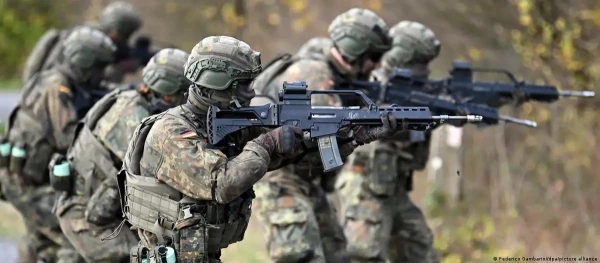
We are one of the largest countries. This means that we must work together.
Europe has proposed creating multinational forces in the event of a ceasefire in Ukraine. What do German politicians say about the possible participation of Bundeswehr forces in this mission?
European allies of Ukraine, following December negotiations in Berlin, proposed creating "multinational forces" to ensure a potential peace agreement between Kyiv and Moscow. The forces, led by Europe, could be formed from "interested countries" within a "Coalition of the Willing" with the support of the United States, according to a statement from the allies.
The multinational forces are intended to facilitate the "restoration of Ukraine's armed forces, ensure the security of Ukrainian airspace, and maintain security at sea, including conducting operations on Ukrainian territory." The document does not specify the number of these forces or which countries' militaries they will consist of. However, the mere fact of reaching an agreement has already led to a renewed discussion in Germany about the possible deployment of Bundeswehr forces to Ukraine.
German Chancellor Friedrich Merz evaded a direct question from ZDF about whether the agreement means the participation of Bundeswehr soldiers in the mission in Ukraine. Merz only emphasized that the "Coalition of the Willing" includes not only European countries but also, for example, Australia and Canada. "And if it comes to this (deployment of multinational forces - Ed.), an agreement on a ceasefire will be reached with Russia," said Merz.
In response to ZDF's remark that the Kremlin rejects the possibility of foreign troops being stationed in Ukraine, Merz stated: "Putin has said 'no' to many things. At some point, he will have to say 'yes' when it comes to ending this war. It is this period after the end of the war that we are currently discussing, and Ukraine needs protection during this period." Later, when answering questions in the Bundestag about the participation of German military in a possible mission, Merz said: "There are questions in this world that are not as easy to answer as they may seem. And this is one of them."
Kremlin spokesman Dmitry Peskov, commenting on the new agreements of Europeans regarding their troops in Ukraine, hinted at a readiness for negotiations. "Our position on foreign military contingents on the territory of Ukraine is well known. It has been articulated by both the president and at other working levels. It is well known, absolutely consistent, and clear. But again, this is a subject for discussion," he said.
German Defense Minister Boris Pistorius called the proposals for multinational forces in Ukraine "generally good," but emphasized that he personally did not take part in their development. The minister welcomed the commitments of Europeans to share responsibility, pointing out that the development of events and the elaboration of details depend on both Washington's and Moscow's reactions.
It is too early to talk about specific plans for the participation of Bundeswehr soldiers, Pistorius continued, as too many questions remain open: under whose command the forces could be deployed, what exactly will happen on the ground, where and within what frameworks.
Chairman of the Bundestag Defense Committee Thomas Röwekamp, who in the past had allowed for the deployment of German military to Ukraine, maintained his opinion even after the agreements reached in Berlin. The politician from the ruling coalition Christian Democratic Union (CDU) called the possible deployment of German soldiers as part of "multinational forces" "likely."
"A sustainable peace in Ukraine will require a clear commitment to security policy. Therefore, Germany must participate in a multinational mission by sending personnel and equipment," Röwekamp said, adding that he does not expect a permanent presence of large Bundeswehr units for "monitoring the ceasefire and providing military support in case of renewed Russian aggression."
The details of a possible mission, as well as the contributions of individual countries, should be coordinated with NATO partners who will participate in the multinational forces, Röwekamp urged.
Any deployment of German soldiers as part of multinational forces in Ukraine will require approval from the Bundestag, so the position of the coalition's conservative bloc CDU/CSU and the Social Democratic Party of Germany (SPD) is crucial, notes Der Spiegel magazine.
Head of the SPD parliamentary faction Matthias Mirsch did not rule out Germany's participation, noting, however, that the declaration adopted at the negotiations in Berlin is very broad in nature, and the results of its adoption will become clear in the coming weeks. "We do not exclude anything, but the deployment of troops largely depends on the situation, context, and specific tasks," Mirsch said.
Former SPD chairman and current Vice Chancellor of Germany Lars Klingbeil also urged not to get ahead of events when discussing the possible deployment of the Bundeswehr to Ukraine. "One should not put the cart before the horse; this issue should only be discussed when it is truly necessary," Klingbeil believes.
According to him, the decisive question remains whether Russian President Vladimir Putin will concede. "Now the ball is in his court. I still have serious doubts about whether Putin wants peace," Klingbeil said. "One thing is clear: Germany will always fulfill its obligations. We are already the largest ally of Ukraine," added the Vice Chancellor.
Strack-Zimmermann: Germany Must Be Part of Multinational Forces
Marie-Agnes Strack-Zimmermann, an expert on foreign policy from the Free Democratic Party (FDP) and head of the European Parliament's Security and Defense Committee, expressed support for the Bundeswehr's participation in a possible mission in Ukraine. "We are one of the largest countries. This means that we must work together. And we can discuss the size of the armed forces stationed at the Ukrainian border or within Ukraine," she said in an interview with DW.
Strack-Zimmermann, following her colleagues, pointed out the many questions that remain open in this context - for example, the reaction in the event of renewed Russian aggression after a ceasefire is achieved. "Who will protect Ukraine? Will these troops really be ready to defend Ukraine then? I cannot answer that question today. But the fact that Europe is now considering sending soldiers to Ukraine to support the country in peacetime is very significant," the politician emphasized.
The far-right party "Alternative for Germany" (AfD), which has recently become the most popular in Germany according to the latest polls, is unequivocally against the possible deployment of the Bundeswehr to Ukraine. "We do not want German soldiers to be stationed in Ukraine. However, we need to discuss effective security guarantees," stated the foreign policy expert of the AfD parliamentary faction and deputy head of the faction in the Bundestag Markus Frohnmaier.
The discussion about the possible participation of the Bundeswehr in a mission in Ukraine in the event of a ceasefire is not new. It has been ongoing in one form or another for the past year. German observers and experts agree that if Europeans send their military to Ukraine after the end of the war, it will not be possible without the participation of the Bundeswehr in one form or another.
"Germany is unlikely to be able to remain on the sidelines if it claims a leading role in Europe and, given its size, is the largest country in terms of territory and population. The question is what the scope of this assistance will be and what will ultimately be included in the mandate," said Margarete Klein, an expert at the Berlin-based Science and Politics Foundation (SWP), in August.







Leave a comment