

When assessing the situation regarding the cost of the grocery basket in different European countries, experts urge to consider not nominal food prices, but the share of the budget that a family spends on food.
Food is one of the largest expense items for households in Europe: on average, it accounts for about 11.9% of expenditures across the EU, while in countries like Romania, this figure reaches 20%.
Food prices in Europe vary significantly from country to country. The price level index calculated by Eurostat serves as a useful basis for comparison. If the average cost of the grocery basket in the EU is 100 euros, the index can be used to determine how much the same basket will cost in a particular country.
A price level above 100 indicates that the country is more expensive than the EU average, while a figure below 100 means it is cheaper.
According to Eurostat, in 2024, North Macedonia was the cheapest country for food prices among 36 European states. The standard grocery basket there cost 73 euros, which is 27% cheaper than the EU average.
The most expensive country is Switzerland, where food prices are 61.1% higher than the EU average, with a grocery basket costing 161.1 euros.
North Macedonia is a candidate country for EU membership—it has not yet become a member but has active trade agreements, while Switzerland is not part of the EEA and relies on a network of bilateral agreements with the EU.
In the EU, the lowest food prices are in Romania (74.6 euros), while the highest are in Luxembourg (125.7 euros). Compared to the EU average, food is 25.4% cheaper in Romania and 25.7% more expensive in Luxembourg.
Following Switzerland, the top three is completed by two other countries from the European Free Trade Association (EFTA): Iceland (146.3 euros) and Norway (130.6 euros).
EFTA countries are states that are not part of the EU but cooperate with the bloc mainly in trade and market access while maintaining greater national control over laws, borders, and policies.
Food prices are also at least 10% higher than the EU average in Denmark (€119.3), Ireland (€111.9), France (€111.5), Austria (€110.9), and Malta (€110.9).
In Southeast Europe and the Western Balkans, food prices are generally the lowest. Besides North Macedonia and Romania, prices in Turkey (75.7 euros), Bosnia and Herzegovina (82.5 euros), Montenegro (82.6 euros), and Bulgaria (87.1 euros) are significantly lower than the EU average.
Serbia (95.7 euros) and Albania (98.7 euros) are also cheaper than in the EU.
Among the "big four" of the EU, food prices are higher than the EU average in Italy (€104) and Germany (€102.9). Spain (94.6 euros) is 5.4% cheaper than the EU.
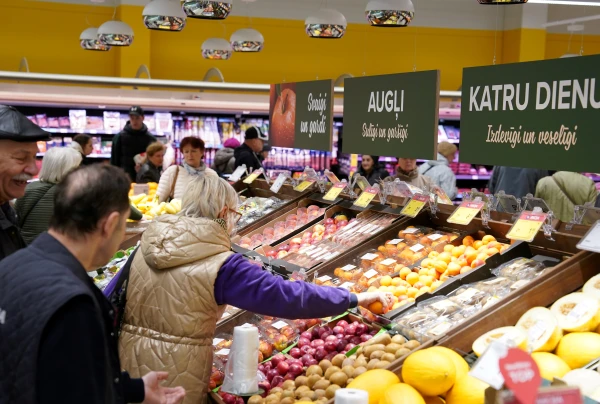
In most Central and some Eastern European countries, prices remain below or close to the EU average, including Slovakia, Poland, the Czech Republic, and Hungary. Latvia is in the middle with 103.1.












Leave a comment