
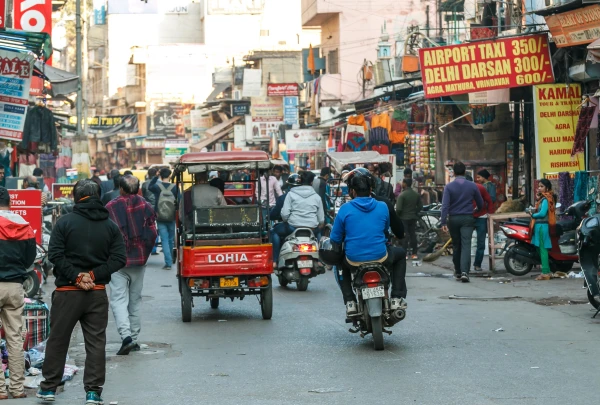
The huge population makes the country an attractive market.
A foreigner walking down the street can be approached every ten minutes by ordinary passersby. They will want to know where you are from, ask to take a photo together, offer to show you the way, suggest what to see, and finally, simply try to sell you their humble goods and do something for you for money. Not everyone who approaches you on the street wants to profit from a foreigner, but there are enough of them too.
India — still a poor country
There is nothing surprising in the fact that people react strongly to any foreigner, because a foreigner is a person with money. Here, a foreigner tried to buy a small souvenir from a street vendor for one dollar — and was immediately surrounded by a crowd of other street vendors who saw a chance to sell their goods.
In India, about 100 million people do not have access to drinking water. Almost 300 million people do not have electricity in their homes. Not to mention electricity — half of the country's population (which is 1.4 billion people) cannot maintain any sanitary standards in their homes. There is no central hot water supply, half of the houses do not have toilets, and people relieve themselves right on the street.
Major Indian cities are huge slums. In Mumbai (formerly British Bombay), 60% of the population lives in slums. The most famous of them, Dharavi, covers an area of 215 hectares. About a million people reside there.
Absolute poverty coexists here with mind-boggling wealth.
According to Forbes, there are 284 billionaires in India. The fortune of the richest among them, Mukesh Ambani, the owner of the telecom operator Jio, reaches $100 billion. For his son's wedding in February of this year, estimates suggest that between $300 million to $600 million was spent. This is 6-12 times more than Jeff Bezos spent on his wedding in Venice.
Journalists in New Delhi were greeted by a notable message on their phone screens: "Air quality: very harmful conditions."
This is absolutely true. Delhi is recognized as one of the most polluted cities in the world. Air pollution here exceeds the permissible norm by almost 20 times. Indians themselves say that the culprits are non-ecological construction technologies, a large number of gas stoves, as well as emissions from cars and coal-fired power plants.
In fact, this is not entirely true. Cleanliness has never been a virtue in India. At least, cleanliness in its European, material understanding.
Indian cities are literally drowning in garbage. Trash is thrown everywhere — on the street, on the roadway, in parks, and gardens. Here, a candy wrapper, a banana peel, or an empty chip bag has almost no chance of ending up in a trash can — Indians are more likely to just throw garbage at their feet. Local animals do not add to the cleanliness either. For example, packs of monkeys that can live right in the city center freely rummage through garbage bins and scatter all the waste around.
The Ganges is the main and sacred river of India, recognized as the dirtiest in the world. In the middle of it, you can even see artificial garbage islands. The water is so black that it is frightening to even dip a hand into it. Nevertheless, Indians not only wash their clothes and bathe in it while conducting sacred rituals, but also even drink from it. The same situation exists with many other rivers in the country.
Near Delhi, there is a giant landfill nicknamed "Garbage Everest." When the mountain of waste grew to 70 meters, the authorities of Delhi realized that helicopters and airplanes could crash into it. But the dump was not removed; they simply installed warning lights on it for the safety of aircraft.
But India is a country of contrasts, so there is also the opposite example. There is a city in the country, Indore, which holds the title of the cleanest city in the country. There, surveillance cameras are installed on the streets, through which the authorities monitor and punish people who litter on the streets.
Of course, the problem of garbage is related to the monstrous overpopulation of the country, as well as a relatively low level of education. It is worth noting that Indian authorities are making titanic efforts to change the mentality of their fellow citizens. At least in New Delhi, the administrative center of the country, where government institutions are located, they have relatively succeeded. The city looks much cleaner than others. However, even here, everything looks as if the garbage is not being removed but simply swept into nearby bushes.
And despite all this, India is a country of enormous opportunities. This country already plays an important role in international politics, and it is constantly growing.
The huge population makes the country an attractive market. Many Western brands dream of entering here. Moreover, the large population means a potentially large number of cheap labor. Due to the growing confrontation between the US and China, many Western companies have begun to look for a new country to relocate their factories from the Celestial Empire. India looks like the main (if not the only) candidate to take the title of "world factory" from China.
For example, Apple already assembles 7% of its iPhones in India. By 2027, the corporation plans to increase this figure to 50%. Thanks to a large amount of foreign investment, India's economy is growing by 7% per year.
However, such a relocation of production cannot be quick and is already facing problems. The main one is the low quality of the workforce in India.
As the Financial Times reported, half of the components produced at the factory in the industrial town of Hosur in India are of good enough quality to be sent for iPhone assembly. Labor productivity in India is also still lower than in China. For example, former Apple employees recalled that Chinese suppliers solved in one day tasks that they allocated several weeks for — just to get a contract with Apple "at all costs." In India, however, "there is simply no sense of urgency." Many other companies that are relocating their production to India face similar problems. Additionally, convoluted Indian laws and a high level of corruption hinder foreign businesses.
But local authorities are trying to address all these problems, fully aware of what is at stake. And now, many technological sectors in India are experiencing rapid growth.












Leave a comment