
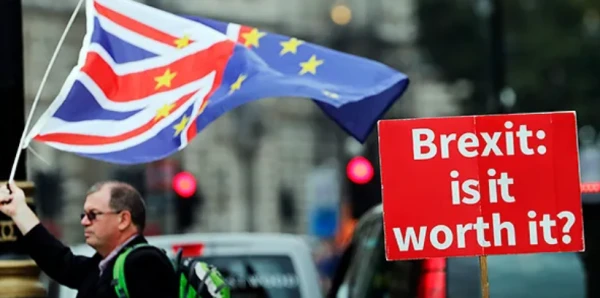
56% of citizens believe that voting to leave was a mistake.
British Prime Minister Keir Starmer suddenly stated that "the Brexit deal... has caused significant damage to our economy." Moreover, he demands "to move towards closer relations with the EU." Essentially, we are witnessing a radical shift in British politics.
When Britons were offered to leave the EU in 2016, they were promised to "take back control" over borders and economic policy, to strike beneficial deals with the US and Commonwealth countries, to lift the "stranglehold of Brussels bureaucracy," and to direct the saved billions into the healthcare system. Nine years later, the official figures look far less rosy. The Office for Budget Responsibility (OBR – an agency under the British Treasury) has been projecting since 2016 that, in the long term, Britain will be about 4% poorer in GDP than if it had remained in the EU. The reason is a decline in trade and a slowdown in productivity growth due to reduced foreign investment.
A new study, which made headlines in the fall of 2025, estimates the actual damage already at 6–8% GDP per capita. According to Stanford economists, investments by British companies after the referendum were 12–18% lower than in a hypothetical "alternative Britain without Brexit," employment was down by 3–4%, and productivity also declined.
For the average Briton, these are not abstract percentages, but a weaker pound and rising import costs, increased prices for food and goods from Europe due to checks, paperwork, and new requirements, and chronically sluggish wage growth. Of course, the problems were exacerbated by COVID and the energy crisis of 2022. But even against this backdrop, most analysts agree on one thing: Brexit has not been a growth accelerator, nor even a straw, but an additional "sandbag" on the back of the British economy.
How British Sentiments Have Changed
In 2016, Britain voted to leave the EU by a narrow margin – 52% to 48%. At that time, it seemed like an almost equal split in society. Now the situation is different. According to regular YouGov polls and the What UK Thinks project, by the summer of 2025, 56% of Britons believe that voting to leave was a mistake, with only about a third still considering that decision correct. 62% say that Brexit has turned out to be more of a failure than a success. An important detail: about one in six of those who voted for leaving now admits that they were wrong.
However, this does not mean that the country dreams of "returning back" to the European Union tomorrow. 53% of respondents would theoretically support a return to the EU, but this is not on the list of top priorities. A much more widespread demand is for "closer but pragmatic relations": 66% of Britons want closer cooperation with the EU, and only 17% want even greater distancing.
Figuratively speaking, most already consider Brexit a mistake, but perceive a new referendum as unnecessary stress. People want not symbolic battles for flags, but corrections of economic consequences – easing trade, resolving migration and defense issues.
Why the Topic of Brexit Has Returned to the Center of British Politics
After the early elections of 2024, the Labour Party led by Keir Starmer came to power with a large majority in Parliament. It seemed that the topic of Brexit would fade into the background for a while: both major parties promised to "respect the result of the referendum," not to return to the EU, and mainly debated taxes and spending.
But by the end of 2025, the situation changed. The economy is growing, but slowly, taxes are high, and real incomes are under pressure. Against this backdrop, support for the right-wing populist Reform Party led by Nigel Farage, which advocates an even tougher, "real" version of Brexit, is sharply increasing. According to models from the political consulting firm Electoral Calculus, if a vote were held now, Reform UK would have the best chance of becoming the largest faction in Parliament.
The Labour Party is rapidly losing support: some of its voters are moving to the "Greens" and the new left party Your Party (created by former Labour members Jeremy Corbyn and Zara Sultana), while others – paradoxically – are going to the same Reform Party, and many are simply falling into apathy. Against this backdrop, it becomes clearer why Keir Starmer decided to speak openly about what he previously preferred to hint at.




Leave a comment