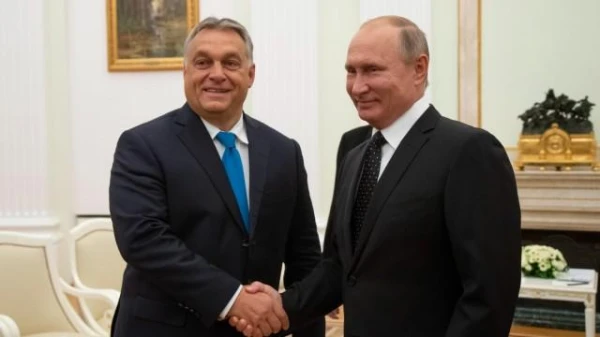
The Prime Minister of Hungary arrived in Moscow to negotiate an increase in supplies of Russian energy resources, while the EU is trying to reduce their imports by 2027.
Hungarian Prime Minister Viktor Orban met with Russian President Vladimir Putin in the Kremlin to secure additional supplies of oil and gas. Earlier, Budapest was granted a waiver from sanctions in this area by U.S. President Donald Trump.
There are still countries in the EU that continue to import significant volumes of Russian fossil fuels. Hungary openly opposes the bloc's collective efforts to halt this import.
"We have important areas of cooperation, and we have not abandoned any of them, regardless of external pressure," Orban said. "Russian energy remains and will be the foundation of Hungary's energy supply."
During his opening remarks in the Kremlin, Putin noted Orban's "balanced position" regarding Russia's war in Ukraine.
The Hungarian leader's approach has disappointed Hungary's partners in the EU and NATO, who have repeatedly condemned Russia's full-scale invasion as a violation of international law and a threat to the security of Eastern Europe.
Orban advocates for an end to the war without specifying the conditions and consequences for Ukraine's territorial integrity and its future defense.
"All we need is oil and gas"
Earlier this month, Orban secured a sanctions waiver from Trump during a meeting in Washington. This exemption allows Hungary to continue purchasing Russian oil and gas from Lukoil and Rosneft, despite a new package of restrictive measures imposed by the U.S. administration against these companies.
"Right now, we only need oil and gas that we can buy from the Russians," Orban said on Friday. "I am going there to ensure Hungary's energy supply at an affordable price both this winter and next year."
Hungary insists that importing Russian energy resources is essential for its economic survival. Specifically, Orban claims that transitioning to alternative sources would lead to an immediate collapse of the country's economy.
While other European countries have begun to gradually sever energy ties with Russia, Hungary has maintained and expanded its imports and continues to do so. At the same time, it opposes the EU's plans to completely abandon Russian fossil fuels by the end of 2027.
The Trump administration stated that its sanctions against major Russian oil producers limit Moscow's economic capabilities to finance military actions. As evidence, the prices of Russian oil have sharply declined, leading to reduced revenues in the Russian budget, as Indian and Chinese buyers complied with U.S. demands.
Next in Moscow - Whitcoff?
Meanwhile, the White House announced on Tuesday that the 28-point Russian-American plan, which European allies described as beneficial to Moscow, had been "refined," and confirmed the dispatch of its representative Steve Whitcoff to meet with Putin, while Army Secretary Dan Driscoll would negotiate with Ukrainian officials.
Trump also mentioned that he might meet personally with Putin and Zelensky in the final stages of the negotiation process.
On Thursday, the President of Russia announced that U.S. representatives would arrive in Moscow early next week, naming Whitcoff as the likely representative of the American side. Putin plans to visit India on December 4-5 for talks with Prime Minister Narendra Modi, the Kremlin reported on Friday.
Press Secretary of the Russian President Dmitry Peskov declined to confirm the date of Whitcoff's visit, stating that the Kremlin would announce it "in due time."