
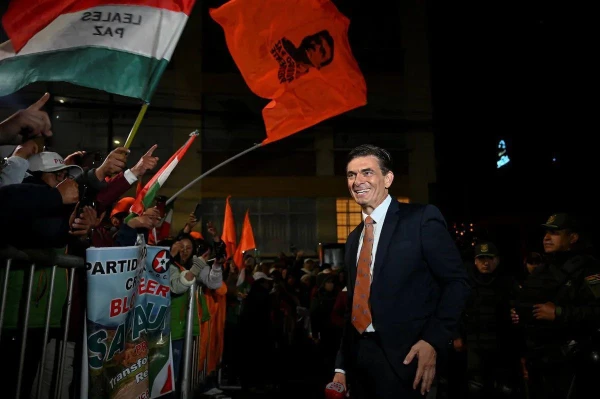
He criticizes austerity measures, the sale of rights to develop lithium to foreigners, and turning to the IMF for loans.
In the second round of the presidential elections in Bolivia, centrist senator Rodrigo Pas, representing the Christian Democratic Party, won. He received about 54.5% of the votes, while his right-liberal opponent Jorge Quiroga garnered around 45.5% support.
Pas achieved a stunning victory despite all the polls clearly favoring Quiroga in the second round. It can be confidently stated that Pas won precisely due to the votes of indigenous people who previously voted for the ruling leftist party MAS. He proposed a very moderate economic program. Pas criticizes not only the ruling socialists but also the old right-liberal opposition represented by Quiroga and others. For example, he criticizes the right's plans to implement austerity measures, sell rights to develop Bolivian lithium to foreigners, and turn to the IMF for loans. Most former MAS voters, disillusioned with the ruling party's policies, voted for Pas.
Rodrigo Pas will take office as president on November 8 and will become the 65th president in Bolivia's history.
In the new parliament, the largest faction belongs to Pas's Christian Democrats. In his administration, he will easily be able to rely on the votes of deputies from other moderate center-right parties that form the Unida alliance, led by early first-round favorite Doria Medina.
Bolivia (officially known as the Plurinational State of Bolivia) is a country in the central part of South America.
Bolivia borders Brazil to the north and northeast, Paraguay to the southeast (it has no access to the sea), Argentina to the south, and Chile and Peru to the southwest and west. Like Paraguay, Bolivia also has no access to the sea (the largest country by area and population in South America with this feature), however, in 2010, a treaty was signed with Peru to lease a small coastal area for 99 years for the construction of a port. Bolivia is separated from the Pacific Ocean by just over 100 km. The administrative capital is Sucre, but most government institutions are located in La Paz. The country has 37 official state languages.







Leave a comment