The situation is in a positional stalemate, moreover, it is "beneficial to the enemy."
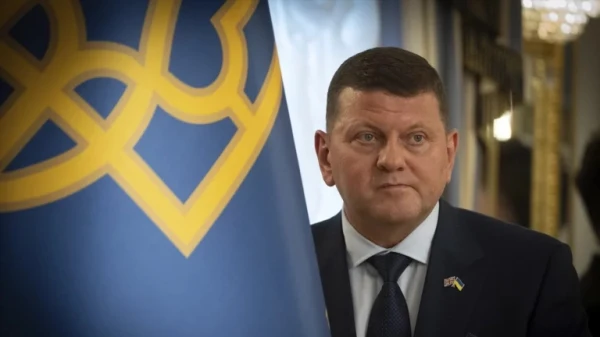
The Western press names Ukraine's ambassador to the UK, Valerii Zaluzhny, as a likely candidate for the presidency of Ukraine or even a future president, but the former commander-in-chief of the Armed Forces of Ukraine has never publicly stated his political ambitions. Zaluzhny's residence in London has become a pilgrimage site for representatives of the Ukrainian economic elite, politicians, and military personnel, both former and current. At the same time, Zaluzhny is the only one in the upper echelons of power who continues to publicly analyze the course of military actions and predict their development.
Stalemate
In 2023, Zaluzhny gave a candid interview to The Economist, in which he admitted that "there will be no deep and beautiful breakthrough by the Armed Forces of Ukraine." He then published an article in which he called for Ukraine to enter total defense. The publications of the commander-in-chief of the Armed Forces of Ukraine shocked supporters of military support in the EU and the US.
Zaluzhny's analysis contradicted the widespread opinion in the West that increasing funding for Ukraine and supplying the Armed Forces of Ukraine with F-16 fighters would break the Russian defense. It also contradicted the position taken by Volodymyr Zelensky and his office. At that time, the Ukrainian president was actively traveling the world, demanding new weapons and financial support, while his office maintained an information frenzy in the national telethon, convincing that the Armed Forces of Ukraine would soon be in Crimea.
Zaluzhny proclaimed a stalemate and effectively called for Ukraine to abandon offensive actions and transition in 2024 to a "strategic defense strategy" developed by his headquarters. This, in his opinion, would give Ukraine a chance and time to "seize the technological initiative" on the battlefield.
"Everything has turned out differently," Zaluzhny laments today in his new interviews. Indeed, instead of defense, Zelensky personally began issuing orders to the military and did not abandon the idea of breaking through to Crimea and regaining control over Bakhmut. Until 2024, the elite 3rd Assault Brigade of the Armed Forces of Ukraine attempted to counterattack in the Kleschiivka area on the flank of Bakhmut, but after failing, retreated for recovery. Simultaneously, from October 2023 to July 17, 2024, special forces conducted an operation with a landing in Krynky—a small village in the Kherson region. The Armed Forces of Ukraine were unable to create a foothold for an offensive towards Crimea, and the operation turned into a weekly drop of paratroopers trying to survive in the ruins of the village. The mildest thing that Ukrainian military personnel said about this operation was that it was hell. According to official data, 788 members of the landing in Krynky are missing, and the number of fatalities is not disclosed. However, Krynky provided an opportunity for more than six months on the international stage to claim that an offensive operation was underway in the Kherson region on the Russian-controlled bank of the Dnieper.
Today, against the backdrop of Zelensky's requests to Donald Trump for the transfer of "Tomahawk" missiles, which are supposedly a new chance for Ukraine to reach the borders of 1991, Zaluzhny's article titled "The Role of Innovations as the Basis for a Sustainable Resistance Strategy" has emerged. In it, the general again goes against Zelensky's position and asserts that nothing has changed, the situation remains in a stalemate, moreover, he believes that it is "beneficial to the enemy"—that is, to Russia. He does not mention long-range missiles or other "wonder weapons" that would "make the enemy flee." On the contrary, he writes that there is a threat to Ukrainian statehood, and Russia is closer to breaking the stalemate than Ukraine.
"I repeatedly assert that the armed forces of both Russia and Ukraine have indeed entered a positional stalemate similar to that which occurred in World War I," writes the general. At the same time, he acknowledges that "despite the overall stability of the line of combat contact, there is slow, sometimes local, and sometimes broader, but advancement of the Russian Armed Forces."
"An isolated tactical breakthrough does not bring operational success to the attacking side," writes the general, referring to successful operations of the Russian Armed Forces in Avdiivka, near Shudzhy, Ocheretino, and near Dobropillia. The exit of troops to operational space is currently impossible, and without it, it will not be possible to apply the most effective form of maneuver—encirclement, he concludes.
It is the mass use of reconnaissance and strike drones by both sides that Zaluzhny names in his articles and interviews as the main obstacle to breaking the stalemate. Due to drones, it is no longer possible to deliver a sudden strike to break through defensive lines.
"Conditions have developed for the inevitable detection of any concentration of strike groups both in the area of the line of combat contact and in the rear. All this is complemented by attacks with long-range precision and cluster munitions, and the detected location of reserves allows for easy determination of strike directions," believes the general.
Finding a Way Out: Optical Fiber, Infiltration
According to Zaluzhny, there is large-scale work in military science in Russia aimed at finding ways out of the positional stalemate. The result at a certain stage was the widespread use of FPV drones.
The former commander-in-chief of the Armed Forces of Ukraine notes that "Russia has massively used small FPV drones and loitering munitions both to break through defensive lines and to destroy personnel, fortifications, and armored vehicles throughout the depth of the front."
For example, this was done during the breakthrough of the Russian Armed Forces in Ocheretino (DPR). Interestingly, both Ukrainian military personnel and the Russian Ministry of Defense highlight the main problem in the battles for Ocheretino as the enemy's FPV drones. That is, they were the main force in both the offensive and the defense.
"Defending troops managed to take advantage of both technological and tactical advantages and subsequently not only prevented the tactical breakthrough from growing into operational success but also later implemented tactical advancement themselves," believes the general.
Zaluzhny further notes a new breakthrough in Russian science— to overcome Ukrainian electronic warfare, the Russian army began using a new type of FPV drone—command transmission not via radio, but via wires (optical fiber). To the new drones, the Russians added infiltration (or "seepage"), which Zaluzhny calls a new strategy of the Russians to break the stalemate.
The former commander-in-chief of the Armed Forces of Ukraine and now for a year and a half serving as Ukraine's ambassador to the UK is formally closer to Buckingham Palace, Westminster, and Downing Street than to Kyiv. However, offices on the central streets of the Ukrainian capital continue to closely monitor every step he takes. "Zaluzhny has been worrying for three years...," admits one member of President Volodymyr Zelensky's team in a conversation with the media on condition of anonymity.