
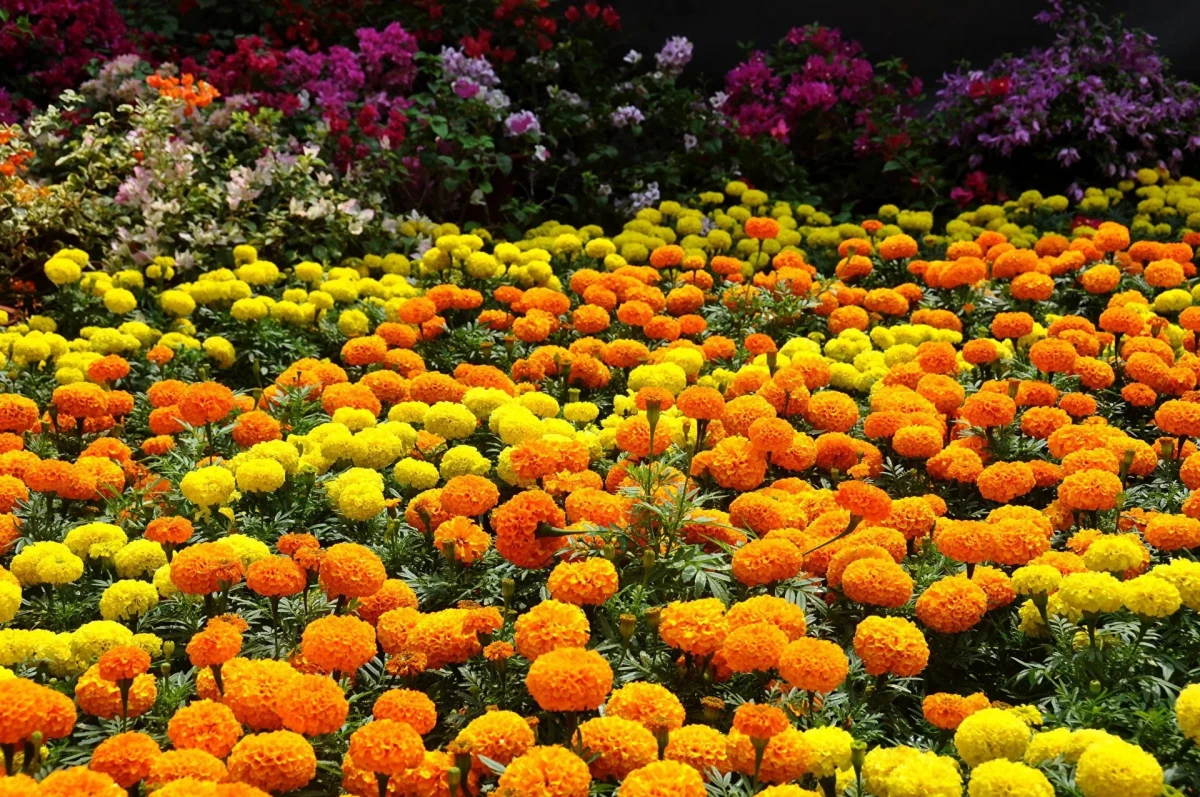
These sunny flowers are found in almost every summer cottage. But most owners do not even realize that marigolds are not just decoration, but a multifunctional helper. They can serve as a cover crop, a natural means of repelling pests, mulch, and even a spice. We explain how to use them to maximum benefit.
Method One: A Living Barrier Against Pests
The simplest method is to plant marigolds around the perimeter of the beds or in between rows. This will create a natural protective barrier.
Many pests dislike their scent: Colorado potato beetle, aphids, whiteflies, cabbage moths, onion flies, as well as wireworms and grubs.
Dwarf varieties of thin-leaved marigolds work best, and marigolds of the Tagetes patula species are particularly effective against nematodes.
Scientific studies confirm that marigolds indeed suppress the development of root-knot nematodes, as they are not host plants for them and prevent parasites from reproducing.
How to Plant: Place the flowers around potatoes, tomatoes, strawberries, and cabbage. For reliable protection, plant the marigolds around the perimeter of the beds or every 20–30 cm in between rows.
Method Two: Green Manure (Cover Crop)
Marigolds can be used as a cover crop — grown specifically to improve the soil.
The technique is simple:
- After harvesting, sow the vacant area with marigolds;
- Allow them to grow for about two months;
- When budding begins, mow the plants and incorporate the green mass into the soil.
What does this provide? The roots of marigolds release substances that suppress the development of certain pathogenic microorganisms and nematodes. The green mass, when decomposed, enriches the soil with organic matter and returns accumulated nutrients to it. As a result, the soil becomes looser and more aerated.
If the area is heavily infested with pests, you can use the method of "green fallow": densely sow it with marigolds for the entire season, periodically mowing and incorporating the green mass into the soil.
Method Three: Liquid Fertilizer for the Entire Garden
You can prepare a concentrated organic fertilizer from marigolds.
Recipe:
- Chop the plants and place them in a non-metallic container;
- Completely fill with water and weigh down with a weight;
- Stir 1–2 times a day while fermentation is ongoing;
- After two weeks, when the foam disappears and the solution darkens, the fertilizer will be ready.
How to Use: Dilute the concentrate with water before use. For root watering — in a ratio of 1:9, for foliar spraying — 1:20.
This fertilizer provides plants with organic substances and trace elements. Additionally, marigold infusion is traditionally used as a means to repel certain insect pests.
Method Four: Mulch and Winter Protection
Mowed marigolds can be used as mulch. Chopped plants are spread in a layer on the surface of the beds, around bushes and trees. This mulch helps retain moisture, suppresses weed growth, and gradually decomposes, improving soil structure.
In autumn, the long stems of upright and spreading marigolds can be used to protect fruit trees from rodents. They can be wrapped around the trunks — the part of the trunk from the root collar to the first branches.
Another option is to sow seeds in the root circles in the fall. In November, loosen the soil, make furrows, and sow the seeds thicker than usual. In spring, the marigolds will sprout and serve as an additional barrier against some pests.
Method Five: Imeretian Saffron in Your Bed
Few people know that marigold petals are edible. In the Caucasus, they are added to chakhokhbili, bozorgtmu, and borani. They are also part of the famous spice "khmeli-suneli" known as Imeretian saffron.
The flowers contain carotenoids, essential oils, vitamins, and minerals. Dried and crushed petals give dishes a golden color and a spicy aroma. Some varieties, such as Yellow Climax, have a milder taste and are suitable for salads and garnishing dishes.
If you keep chickens, try adding dried flowers to their feed — thanks to the carotenoids they contain, the yolk color may become more intense.
Practical Tips
When to Plant: Sow seeds in open ground after the last spring frosts, for seedlings — in March–April.
Where to Plant: Marigolds prefer sunny spots but also grow well in partial shade. They are not demanding on soil composition; the main thing is to ensure good drainage.
Important Note: Do not place marigolds too close to delicate ornamental plants — as they grow, they may overshadow them. However, they are excellent neighbors for vegetable crops.
Marigolds are one of the few flowers that combine beauty and practical benefits. Plant them not only in flower beds but also in vegetable patches — and they will help make your garden healthier and more well-kept.
















Leave a comment