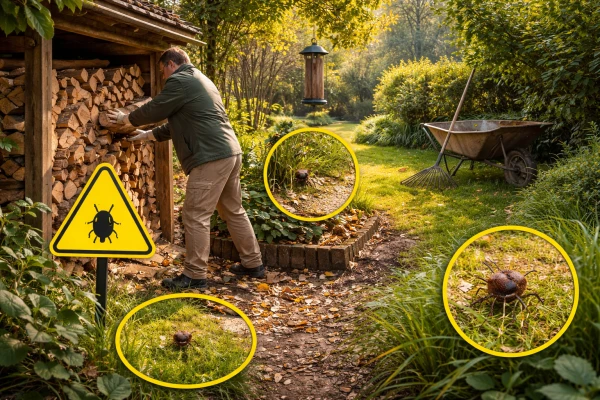
The common belief that ticks fall from trees is not true. These parasites inhabit much closer to the ground and choose places with increased humidity, shade, and natural shelters. They often concentrate in so-called "border zones"—where different surfaces meet and a suitable microclimate is created.
Path Junctions and Curbs
One of the most underrated places is the boundary between pavement and grass. Moisture is retained here, and sunlight barely penetrates. In the narrow strip along pathways, conditions are created where ticks can remain active for a long time, waiting for people or animals.
Woodpiles and Stacked Firewood
Stacked firewood serves as a refuge not only for insects but also for small rodents that often carry ticks. Inside the woodpile, shade and moisture are preserved, making it a convenient environment for parasites. Contact with such places—such as when carrying firewood—increases the risk.
Shrubs at Body Level
Although ticks rarely climb high, they actively use the low branches of shrubs. When clothing or skin brushes against them, the parasite easily latches onto a person, remaining unnoticed.
Accumulations of Leaves and Compost
Old leaves and compost heaps create a dense, moist layer that protects ticks from drying out and cold. In such places, they can not only survive but also remain active even in unfavorable periods.
Areas Under Feeders
Places where birds and small animals gather become points of tick concentration. Parasites can enter the grass from carriers and remain there waiting for a new victim.
Garden Furniture and Tools
Items that stay in the shade for long periods—such as wheelbarrows, buckets, or old furniture—create a localized moist environment. Condensation can accumulate under or inside them, attracting ticks.
Urban Lawns and Parks
The danger exists not only in the countryside. Even neatly trimmed lawns can be a risk zone if they are in the shade or near shrubs. This is especially relevant for areas where pets are walked.
How to Reduce Risk
To decrease the likelihood of encountering ticks, it is important to regularly remove dry leaves and maintain order on the property.
It is advisable to treat the borders of the territory with special agents and monitor the appearance of rodents.
When working in the garden or at the dacha, it is recommended to wear closed clothing and avoid direct contact with potentially dangerous areas.
What Is Important to Remember
Ticks are most often found not in the wild but near humans—in familiar and seemingly safe places.
A careful attitude towards such zones and simple preventive measures can significantly reduce the risk of bites.