
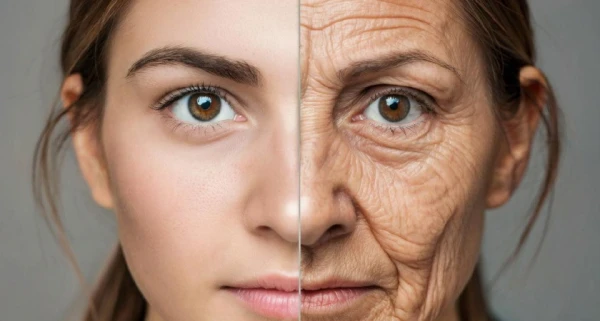
Chronic stress causes the body to age significantly faster than biological age would suggest. New scientific research shows that nervous exhaustion affects cells, hormones, and even genetic mechanisms in humans.
Psychological state, inflammation, and sleep disturbances trigger mechanisms of premature wear on the body. In a state of stress, the body actively produces the hormone cortisol, which helps to quickly mobilize resources. However, its prolonged elevation has the opposite effect and causes irreparable harm to cells.
Scientific observations have shown that a constant high level of cortisol accelerates cellular aging. Cells expend more energy, deplete faster, lose their ability to regenerate, and die more frequently.
How Do Cellular Biological Clocks Work?
Telomeres — protective segments at the ends of chromosomes — play an important role in the aging process, which scientists refer to as a kind of "life counter" for the cell.
With each cell division, telomeres shorten. When their length reaches a critical minimum, the cell loses its ability to renew itself.
Researchers have established that stress significantly accelerates the shortening of telomeres. This means that cells enter the aging phase faster even without serious diseases.
In recent years, scientists have also actively applied the method of epigenetic aging clocks, which allows determining a person's biological age based on changes in DNA structure.
Experiments have proven that stress can alter gene activity and affect epigenetic markers. In fact, nervous tension can "reprogram" cells.
As a result, a person's biological age increases faster than their chronological age, and aging processes are initiated even without external signs of diseases.
Aging or Chronic Inflammation?
Doctors increasingly refer to aging as a process of chronic low-level inflammation. Prolonged stress activates mechanisms that destroy the body from within.
Under the influence of nervous exhaustion:
-
the level of inflammatory molecules increases
-
immune defense weakens
-
tissues and internal organs are damaged
Such changes create favorable conditions for the development of age-related diseases of the heart, blood vessels, and nervous system.
How Does Psychological State Affect a Person's Age?
Scientists have also found that a person's psychological state directly affects the rate of aging. Social isolation and emotional stress are associated with faster wear on the body.
Among the main causes:
-
sleep disturbances
-
depressive states
-
decreased physical activity
-
impaired metabolism
Biologist and mitochondrial researcher Martin Picard from Columbia University explains that chronic stress causes metabolic overload in cells. As a result, they deplete faster and lose the ability to effectively produce energy.














Leave a comment