
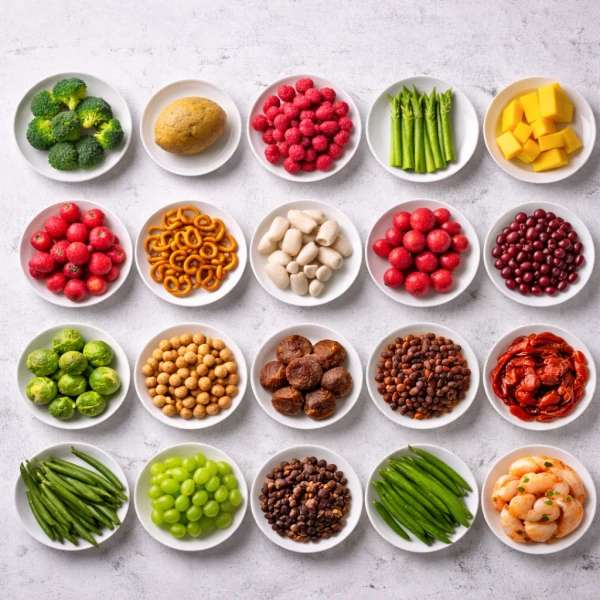
People who monitor their nutrition and try to control the calorie content of their diet often wonder what 100 calories looks like in different products. Experts from the Food Network have provided visual examples of how much popular food contains approximately the same energy value.
Vegetables and Greens
Many vegetables are low in calories, so you can eat quite a lot without exceeding your energy norm.
- Broccoli — about 9 florets
- Asparagus — approximately 31 spears
- Radishes — around 100 fruits
- Carrots (small) — about 28 pieces
- Brussels sprouts — around 12 heads
- Green beans — approximately 20 pods
Fruits and Berries
Fruits contain more natural sugars, but many of them can also be eaten in fairly large quantities.
- Raspberries — about 100 berries
- Seedless grapes — approximately 33 berries
- Dried figs — around 5 fruits
- Seedless raisins — about 50 pieces
Nuts and Dried Products
These products are more calorie-dense, so their serving size is significantly smaller.
- Roasted cashews — about 15 halves
- Small pretzels (unsalted) — approximately 21 pieces
Vegetables and Legumes
Some plant products contain more nutrients and calories.
- Red beans — about 82 beans
- Garlic — approximately 22 cloves
- Sun-dried tomatoes — around 20 pieces
Animal Products
Protein products are usually more calorie-dense, so their quantity for 100 calories is less.
- Cheddar cheese — approximately 60 grams
- Large shrimp — about 13 pieces
Starchy Products
Such products provide the body with more energy even in a small portion.
- Baked potato — 1 medium potato
Such comparisons help to better understand the calorie content of foods and plan diets more consciously.















Leave a comment