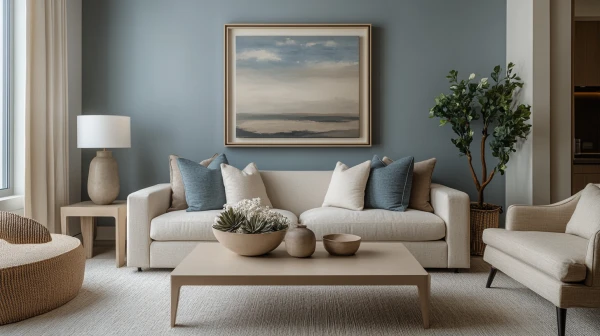
The interior can be perceived as a living organism that changes with its owners, mood, or season. To avoid starting from scratch, it is important to create a base that allows for easy changes in details.
Expert: Elena Bezruchenko, Designer
Creating a Universal Foundation
The base should be neutral so that adding elements does not create dissonance. For walls and floors, the designer recommends choosing complex shades of white, gray, and beige with undertones of gray, olive, or blue.
Furniture should be chosen to be minimalist, made from natural materials: wood, stone, fabrics. It is better not to clutter the space with furniture, preferring 'airiness'.
Additional lighting through table lamps and floor lamps helps create coziness and zone the space.
Changing the Mood with Details
-
Textiles — new curtains, cushions, throws, or a rug can easily transform the space. Cushions can match in color but differ in texture and patterns.
-
Art — paintings, posters, or art objects add a 'spark' to the interior and can become the focal point of the composition.
-
Mirrors — visually enlarge the space. Full-length mirrors or compositions of several mirrors add charm and can be combined with paintings and decor.
-
Plants — large-leaved monsteras, palms, and ficuses quickly enliven the interior. It is important to choose the right place and lighting.
-
Accent Wall — a winning way to change the interior. You can use thematic wallpaper or paint in a complex shade. Wallpaper is better placed where it is not constantly visible, for example, behind the headboard of a bed or a sofa.
The Main Rule
With a well-thought-out base, you can change the mood of the room by playing with details. It is important to choose one or two ways to change the interior to maintain balance and keep the space harmonious.