
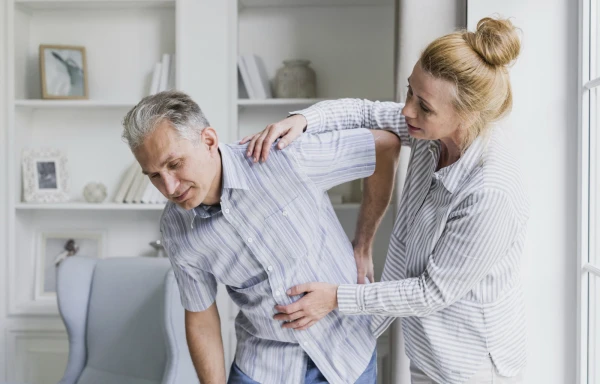
The modern lifestyle and loads are often cited as reasons for frequent back problems and the emergence of pain that interferes with life. But this is just a symptom, and the causes can be different. We explore them with a doctor.
Spinal problems can occur in people of any age, and unfortunately, young people are no exception. A herniated disc and a bulging disc are two conditions that are often confused due to similar symptoms, the main one being back pain. However, these conditions differ in nature. Elena Simonova, a neurologist, explained the mechanisms of their occurrence and potential consequences.
"Bulging" of the Disc — All About Protrusion
A protrusion is a chronic condition that can be described as the initial stage of degenerative changes in the intervertebral disc. In protrusion, the disc "bulges out," but its outer shell (the annulus fibrosus) remains intact. Typically, protrusions occur as a result of disc wear and excessive loads. Posture disorders can be considered both a predisposing and a causative factor for its appearance.
Protrusions most commonly form in the cervical and lumbar regions of the spine. Pain is localized in the back and radiates to the arms and legs.
The bulging of the disc often leads to the compression of nerve roots, which explains the numbness, tingling, or other unusual sensations in the arms and legs, as well as other parts of the body, limiting mobility.
If the process is not intervened in, if treatment is not conducted, and if the causative factor is not removed, the protrusion will progress and eventually develop into a more serious condition — a herniation.
"Rupture" of the Disc — Symptoms of Herniation
A herniated intervertebral disc is a more serious condition that occurs when the inner contents (nucleus pulposus) are pushed out through a rupture in the annulus fibrosus. This can happen due to trauma, excessive load, or other reasons, sometimes a combination of them. Herniations most often occur in the lumbar and cervical regions.
The symptoms of a herniation are generally more pronounced than those of a protrusion.
The pain is sharp and constant, possibly radiating to the legs or arms. It can be so severe that it deprives a person of the ability to move fully.
A herniation also causes severe numbness, weakness in the arms and legs, and even problems with organ function in cases of nerve compression that innervate these areas.
A herniation poses a serious threat to health. If left untreated, it can lead to irreversible consequences, such as chronic pain or even paralysis.
Both protrusions and herniations are degenerative diseases that can have similar symptoms, but they differ in severity. A herniation can be considered a complication of a protrusion; simply put, it all starts with a protrusion and can gradually lead to a herniation. In other respects, the similarities end.
In protrusion, the annulus fibrosus is not damaged, while in a herniation, it ruptures. In clinical practice, this means that conservative treatment methods are more often chosen for protrusions, while herniations usually require a more serious approach.
When comparing these two conditions, it is important to note that a herniation is more dangerous. It requires more careful monitoring and treatment, as it can lead to serious complications.
Treatment
The treatment of protrusions and herniations of the spine is always determined by the severity of the disease and is established after examination. The doctor may suggest:
Conservative Treatment
First and foremost, this involves taking medications. Usually, the doctor prescribes analgesics and anti-inflammatory drugs to normalize the condition and alleviate symptoms. Physiotherapy, massage, and therapeutic exercises are recommended; these methods help normalize mobility and return to a normal lifestyle. With a comprehensive approach, it is possible to restore functions and systematically strengthen the muscle corset, which can slow the progression of the diseases.
Surgical Treatment
In cases where conservative methods do not provide relief, the question of surgical intervention arises. This is aimed at removing the herniation or restoring the structure of the disc.
The prognosis for treatment depends on the initial condition and clinical situation. When making a prognosis, individual patient characteristics are taken into account. In most cases, with timely medical attention, complete recovery is possible.
Spinal problems, such as protrusions and herniations, require careful attention and timely treatment. Despite the similarities in symptoms, these conditions differ in nature and severity. Understanding the differences between them will help you take better care of your health. Remember that prevention is always better than treatment. Regular physical activity, proper posture, and a healthy lifestyle are key factors in maintaining the health of your spine.










Leave a comment