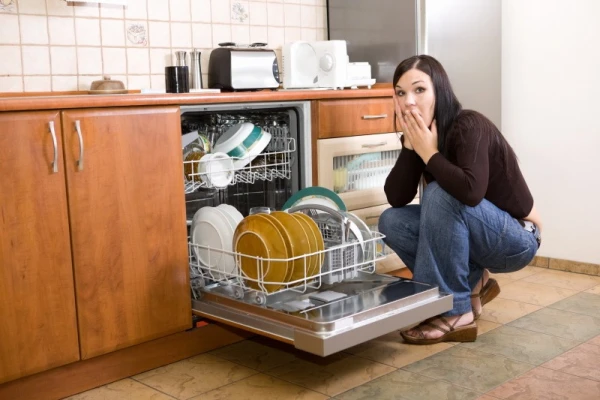
Dishwashers wear out from regular use and require certain care and maintenance.
Dishes can remain dirty after washing in the dishwasher due to common mistakes made by almost everyone. It is important to know what to avoid to forget about such a problem once and for all. This is reported by the website Real Simple.
Not Scraping Food Residues
Food residues on dishes can not only lead to poor washing but also create several other problems, namely:
-
contamination of filters and sprayers - large particles can clog filters or holes through which water is supplied, reducing washing efficiency
-
uneven coverage with water and detergent - if there are food residues on the dishes, water may simply not wash them away
-
settling on other dishes - during washing, particles can settle on clean dishes
-
unpleasant odors - food residues can lead to unpleasant smells inside the machine
Incorrect Loading of the Dishwasher
When loading the dishwasher, keep the dishes as far apart as possible so that they do not block the even flow of water.
Optimal loading principles for the dishwasher for the best washing:
-
upper basket - designed for glasses, cups, small plates, bowls. Light items should not touch each other or block the sprayer
-
lower basket - for large plates, pots, pans, and bowls. Place plates vertically and with a gap. Deep pots should be placed at an angle so that water gets inside
-
cutlery tray - separate forks, spoons, and knives with handles down for better rinsing
Make sure that large items do not block the sprayers. Follow the loading instructions for the dishwasher baskets.
Temperature
Using low-temperature water reduces the washing ability of the dishwasher.
General recommendations are as follows:
-
main mode (normal wash) - water temperature 50-60°C. Effectively removes food residues and grease
-
intensive - temperature 65-70°C, used for pots, pans, heavily soiled dishes
-
delicate dishes (glass, ceramics, plastic dishes that cannot withstand high temperatures) - 40-45°C
Detergent
Choosing the right detergent is crucial for effective cleaning. An ineffective detergent does not break down grease and food particles.
What to pay attention to when choosing a detergent:
-
tablets and capsules - very convenient, pre-measured, often contain complex components (detergent + rinse aid + salt)
-
powder - allows you to adjust the dose depending on the amount of dishes and water hardness
-
gel (liquid) - dissolves well, gentler on glass dishes
Cleaning the Dishwasher
Dishwashers wear out from regular use and require certain care and maintenance. Check the filter and clean it thoroughly to prevent debris buildup.
Food residues can clog the holes in the sprayers, reducing water pressure and coverage. Regularly remove and clean the sprayers with a toothpick or small brush to remove debris. Run an empty cycle with vinegar monthly to remove limescale and odors.