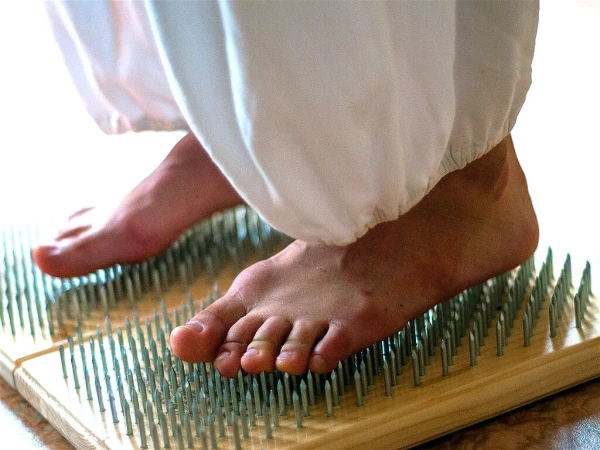
The Sadhus Board is a trendy practice of standing on nails that has come from an ascetic ancient tradition and has become a widespread trend in the wellness community worldwide. The essence is simple: the feet rest on an even field of nails, creating a powerful flow of sensory signals. For some, it is a way to train attention and self-control, while for others, it is a tool for body awareness and working with fear.
But the practice should be approached as a non-illusory and very serious load, not as a repetition of a beautiful picture on social media. Yoga instructor Maria Koroleva spoke about the important nuances of nail standing.
Is There Real Benefit
The potential effects concern three levels — the nervous system, pain, and psychology. Firstly, the sensory bombardment of the feet engages receptors and competes with pain signals. The brain learns to redistribute attention and reduce reactivity to discomfort. This is akin to pain control methods through attention redirection and breathing.
Secondly, gentle mobilization of the foot and ankle fascia combined with stable support can improve postural tone and quality of support while walking; this is an excellent training for the skill of grounding — returning attention to the body and contact with the ground.
"Thirdly, there is also a psychological aspect. A measured encounter with fear and pain stimuli teaches one not to run away, but to stay, breathe, and observe. Many experience a decrease in anxiety levels, while a sense of self-efficacy increases. However, it is important to understand that this is not a substitute for psychotherapy, but rather a working tool for self-regulation. It is also good to be clearly aware of the boundaries: there is no scientifically confirmed evidence that boards cure chronic diseases; this is a practice of skills, not treatment," the expert emphasizes.
Who Can and Who Should Refrain
It is suitable for relatively healthy individuals without acute injuries to the feet and ankles, without sensitivity disorders, with normal blood clotting, and healing skin.
Postpone the practice during pregnancy, diabetic neuropathy, varicose veins with trophic changes, psoriasis and eczema on the soles in the acute stage, fresh cuts and calluses, clotting disorders, when taking anticoagulants, severe anemia, osteoporosis with fracture risk, severe anxiety disorders, and panic attacks without specialist supervision. Children and adolescents can stand only with an experienced instructor and written consent from parents.
How Safe Technique is Structured
Always start under the supervision of an instructor and with full preparation. The board should have an even field of nails, uniform height, and factory geometry. The surface around should be clean, shoes removed, and feet dry and warm.
Entering the board is slow. "First one foot, shift weight, and gently place the second. Toes spread out, heels slightly pulled back, knees soft, pelvis neutral, crown reaching up. Hands on support or on a strap — until the body finds stability, breathing is even, through the nose, exhale longer than inhale. Exiting is also slow and controlled, followed by a short release — rolling the feet on a soft mat and stretching the calf muscles," says the yoga specialist.
In terms of time, it is better to go from seconds to minutes. The first goal is 30–60 seconds of stable standing without grimacing in pain. Progress — up to 2–3 minutes. Standing longer makes sense only for advanced practitioners and for mental training tasks.
How to Understand That the Practice Has Gone Too Far
Signals to stop include sharp pain, cold sweat, sudden paleness, trembling, nausea, numbness in the fingers, rapid heartbeat, and confusion in breathing. This is not overcoming, but overload. In such cases, stopping is the right thing to do. After stepping off the board, be sure not to sit down abruptly; walk for a couple of minutes and take a warm foot bath.
Do a "Safety Check" Before the First Attempt
Perform a warm-up: palpation of the feet, short rolls on a ball, calf stretching, 10 slow squats with support. If pain in the Achilles or knees is felt at this stage, the boards are not needed today. Preparation is an important part of the practice, not just a warm-up for the sake of it.
Focus on the sensations under the big toe and under the base of the little toe, then on the center of the heel. Imagine a triangle of support and distribute weight evenly. Every 3–4 breathing cycles, gently check the position of the knees and pelvis — conscious body geometry reduces the risk of micro-tears in the skin.