
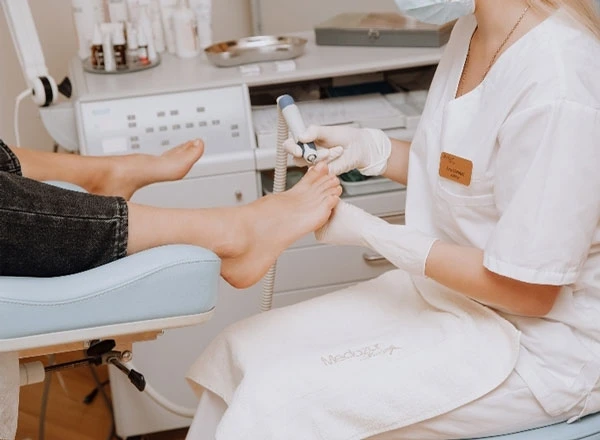
Medical pedicure differs from standard salon care. Sometimes feet need it specifically because regular pedicure not only fails to address existing problems but can also worsen the condition of the feet and nails.
What is Medical Pedicure
Medical pedicure is a hygienic procedure at the intersection of medicine and cosmetology. It affects the nails, periungual tissues, skin of the toes, and the entire foot.
Well-groomed nails and feet are not just about smooth heels and beautiful nail polish. Medical pedicure addresses much more than the classic care offered by almost all beauty salons.
The main goal of a regular pedicure is aesthetic. The specialist monitors the shape of the nail plate, the coating, and also takes care of the skin of the feet.
Medical pedicure always includes hardware treatment of the nail plate, cuticle, calluses, and hyperkeratosis. Additionally, orthonyxia may be used—a podiatry method for correcting ingrown nails with titanium threads or plates, taking into account the individual characteristics of each patient.
Sometimes the result of the procedure may not look as aesthetic: excision or cleaning of a nail affected by mycosis (fungal infection) is performed, or in the case of onycholysis—separation of the nail from the nail bed.
But the main thing: the patient is relieved from pain and discomfort in the feet.
When Medical Pedicure is Especially Important
There are conditions in which regular medical pedicure helps prevent complications. Doctors recommend not to neglect the procedure:
-
In diabetes
The procedure is extremely important, as patients have a high risk of foot damage. -
In obesity
Pain and discomfort may arise due to cracks, ingrown nails, and hyperkeratosis in areas of greatest pressure. This hinders physical activity necessary for weight loss. Deformation of the toes, thickening of the nails, and cracks on the heels can lead to a refusal to be active. -
In rheumatoid arthritis
Patients face joint deformities of the feet, causing non-physiological pressure, the formation of calluses, and trophic changes.
Source: ks-yanao













Leave a comment