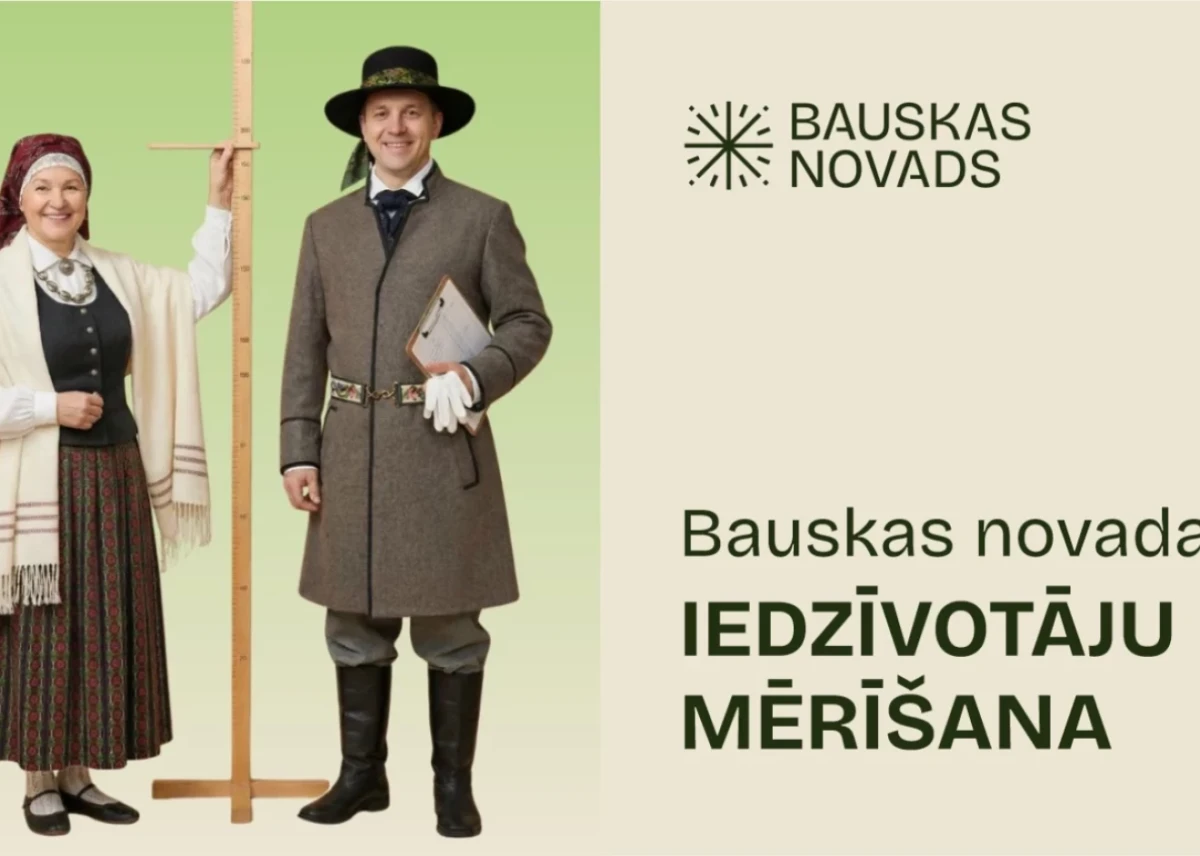
The Bauska region invites residents to become part of a unique and historically significant study — Professor Jākobs Primanis's project on the residents of Latvia.
This summer, the project team will come to the Bauska region to conduct measurements in Mežotne and Bauska, providing everyone interested with the opportunity to learn their body parameters for free and contribute to the development of Latvian science.
Who is Jākobs Primanis and what is the purpose of the study?
Professor Jākobs Primanis (1892–1971) was a physician, anatomist, and one of the founders of anthropology in Latvia. Under his guidance, large-scale expeditions were conducted in the 1920s and 1930s, during which approximately 35,000 people were surveyed to study the anthropological type of Latvians.
Many questionnaires and photographic films created since 1936 (including historical measurements in Mežotne) remained unprocessed due to World War II and subsequent occupations. Only in 2023 was the digitization of over 10,000 historical questionnaires completed at the University of Stradins (RSU) in Riga. These data are now being studied and are also available to the relatives of the participants.
The aim of the modern study is to compare historical data with the parameters of current residents. Such changes over the long term are referred to as centennial shifts; they serve as an accurate reflection of the socio-economic situation, lifestyle, and nutrition of our society. For example, data already shows that in the 1930s, people were shorter, influenced by the wars experienced, hard physical labor, and the dietary characteristics of that time.
What will participants receive?
Immediate results: you will be able to learn your anthropometric data immediately after the measurements (participants usually record them on their smartphones).
3D scanning: modern technologies are used in the study — a small black-and-white version of the 3D body scan will be sent to those interested via email.
Feedback: in spring 2027, the project team plans to return to the municipalities with outreach events to present the summarized results in the Bauska region and compare them with other regions of Latvia.
Genetic analysis in the future: adult participants can provide a blood sample for research in population genetics. Individual feedback on these results is planned to be provided starting in 2028.
Where and when will the measurements take place in the Bauska region?
Measurements will be conducted in two locations — in Mežotne, where historical measurements have already taken place, and in Bauska:
In the Mežotne Palace:
June 29 from 15:00 to 19:00 June 30 from 10:00 to 19:00
In Bauska City Primary School:
July 1 from 15:00 to 19:00 July 2 from 10:00 to 19:00 July 3 from 10:00 to 19:00 July 4 from 10:00 to 19:00 July 5 from 9:00 to 14:00
Who can participate and how to prepare?
Participants of any age are kindly invited to the study — it is not necessary to be registered at a specific location, as the project characterizes all of Latvia as a whole; however, local residents are especially welcome. From previous experience, the youngest participant was only 11 months old, and the oldest was 99 years old.
Important information for participants: 1. Come with the whole family! Children and adolescents (up to 17 years old inclusive) can only participate together with parents or guardians, as informed consent must be signed. 2. Confidentiality is guaranteed: to conduct measurements and 3D scanning, it will be necessary to remove outer clothing. Special isolated booths are equipped to ensure complete privacy. Full-size color 3D scans are stored on secure servers and will be used only for scientific purposes. 3. Genetic research: only adults (aged 18 and over) can provide a blood sample for population genetics research.
In 2026, it is planned to involve about 2,000 participants throughout Latvia, and the Bauska region plays an important role in this process.