
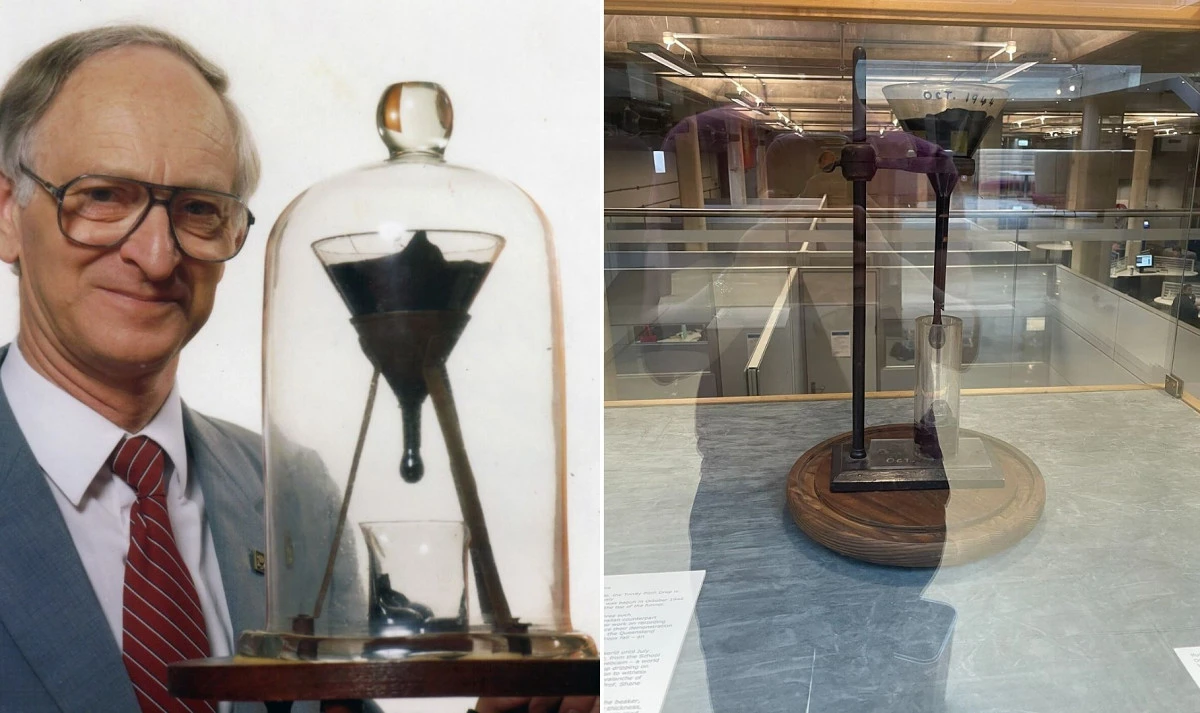
9 drops fell from 1938 to 2014.
The scientific community is anticipating a significant event, and anyone can participate in it – namely, by tracking its occurrence through an online broadcast of one of the longest-running experiments in history. Moreover, the hope rests solely on enthusiasts, as a legend has formed around this experiment over its 97 years of conduct. According to this legend, official scientists are fated not to record its stages — which is why the endeavor was awarded the Ig Nobel Prize.
In 1927, physicist Thomas Parnell from the University of Queensland in Australia poured liquid pitch into a funnel, allowed it to cool for 3 years, after which he cut the spout of the funnel and left the pitch to drip into a glass placed below. This substance has a viscosity 100–200 billion times greater than that of water, so over the elapsed time, only 9 drops have formed and fallen into the glass. The last one fell in 2014, and the interval between drops now stands at 12–13 years, so the next one is approaching.
This pitch is so hard that it can be broken into pieces with a hammer, yet from a physics standpoint, it is considered a liquid. And the 97-year-long experiment proves this – it gradually drips and falls as drops. The issue is that the process was only recorded in 2014, and that was with the help of a webcam. In all previous instances, scientists were late, sometimes by a day, and other times by mere minutes, but the drops fell precisely in their absence. Therefore, the task was handed over to the public – perhaps someone will be lucky enough to witness the next drop with their own eyes.
In October 2005, John Mainstone, the 'keeper' of the experiment at the time at the University of Queensland, and the late Thomas Parnell were awarded the Ig Nobel Prize in Physics, a parody of the Nobel Prize, for this experiment.












Leave a comment