
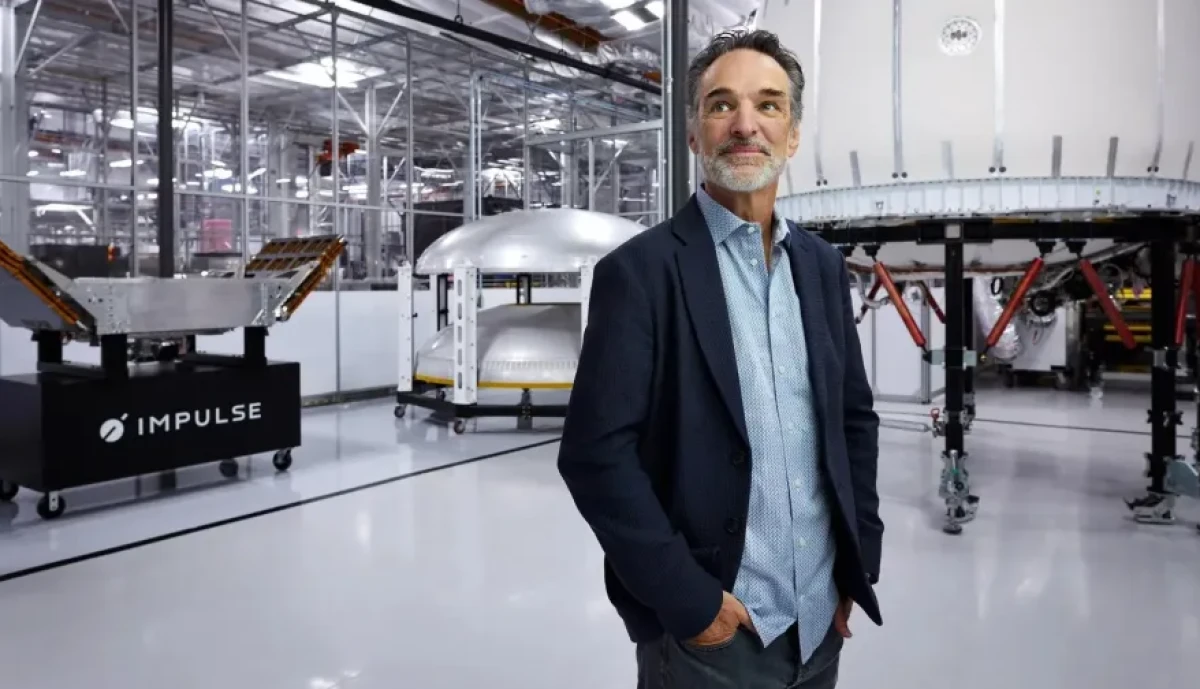
They will reach orbit aboard launch vehicles, detach, and transport cargo between orbits.
Tom Mueller created rocket engines that paved the way for Elon Musk to reach space. Today, this leading global expert in propulsion systems aims to launch his own space delivery service.
Behind the wheel of a bright green Porsche Taycan Turbo S, Tom Mueller follows his approach to creating rocket engines: instant acceleration and complete disregard for speed limits. He races west along Marin Avenue, slicing through the smog-tinted sunlight, and reflects on the limits of earthly capabilities.
"If the current growth rates don’t change, we will eventually just exhaust all the supplies of metals and energy," notes the 65-year-old Mueller, who is particularly concerned about the energy consumption of AI data centers. "By around 2045, the computing power will require the same amount of electricity that is produced globally today. Exponential growth could completely deplete Earth’s resources."
Mueller spots a break in the afternoon traffic. His electric sports car can accelerate from zero to 100 km/h in 2.3 seconds, and Mueller seems eager to demonstrate this. "Now let’s accelerate," he warns, pressing the pedal. The force of the engine hits us like a physical blow, pushing us into the leather upholstery of the seats as Mueller bursts into laughter. "The Moon and near-Earth asteroids," he continues a moment later, already slowing down for a red light, "contain billions of tons of metal, silicon, water, and ice, so it’s time to start utilizing them. It seems premature only because we haven’t built the space economy yet. We haven’t gotten there yet."
This is the direction Impulse Space is heading — Mueller’s startup headquartered in Redondo Beach, founded in 2021, just a few months after he left SpaceX. Just as SpaceX dominates the global launch market, Impulse Space plans to seize the next niche — "space logistics," moving satellites, cargo, and eventually people after they reach orbit. The company’s spacecraft are not designed to launch from Earth. They are expected to reach orbit aboard launch vehicles like those produced by SpaceX, and then detach and transport cargo between orbits. In the future, as Mueller hopes, transport will expand to the Moon, Mars, and beyond.
The main advantage of Impulse Space is not just the ability to move objects in space, but speed. Like Mueller’s fully electric Porsche, most satellites are equipped with electric propulsion systems, but unlike his electric car, they move extremely slowly: it takes most satellites six to 12 months to travel from low Earth orbit, located a few hundred kilometers above Earth, to geostationary orbit, which is over 35,406 km high. Impulse Space claims its spacecraft will reduce this journey to one day using chemical engines powered by liquid methane and liquid oxygen — essentially, this is the space equivalent of transitioning from ships to airplanes.
"Our spacecraft stand out because at launch, almost half their mass is fuel, which allows them to achieve high speeds," explains Mueller. "And high speed is exactly what our customers need."
Mueller’s company presentation comes against the backdrop of a record influx of capital into the space industry. Global spending on the space sector is projected to grow from about $600 billion last year to $1.8 trillion by 2035, and venture investors poured a record $55.3 billion into aerospace startups last year. By the end of this week, SpaceX is expected to raise $75 billion in a record IPO, targeting a valuation of $1.8 trillion. Meanwhile, Impulse Space, being a smaller company by comparison, has raised over $1 billion in funding, and in early June, its valuation stood at $4.3 billion. Mueller himself, thanks to his stakes in SpaceX and Impulse Space, made it onto Forbes USA's list of the world’s richest people this spring, with his net worth estimated at $1.7 billion.
However, Impulse Space has challenged not only its competitors. The company is trying to stay ahead of the market itself, hoping that the demand for express transportation of satellites, military cargo, and cargo for lunar missions will arise soon enough to justify Mueller’s multimillion-dollar investments in spacecraft designed for a yet-to-be-formed space economy.
"No one knows what these markets will look like," notes space industry analyst Chris Quilty. "At this point, they don’t even exist."
Mueller grew up in St. Maries, Idaho — a lumber town of 2,500 people located an hour south of Coeur d'Alene. He rode motocross bikes with his cousins from a young age and absorbed knowledge about the lumber industry from his father, a logger. In high school, he saved money by unpacking boxes at the local grocery store to buy his first car — a 1977 Triumph Spitfire, which he then spent a long time tinkering with under the hood. Inspired by his high school math teacher, Mueller began studying mechanical engineering at the University of Idaho. "He came from poverty," recalls former professor Terry Precht, a fellow Idaho native who compares Mueller’s hometown to the Appalachian region. "He knew how to succeed because he is a natural builder."
In 1985, Mueller moved to Los Angeles to join the aerospace conglomerate TRW as a propulsion and power systems engineer. He gained his first experience in the rocket division during a time when U.S. President Ronald Reagan allocated $30 billion ($90 billion in today’s dollars) for the development of space weapons. Generous government funding allowed scientists and engineers like Mueller to experiment freely. "I worked on incredible, crazy projects," he recalls, listing the chemicals he used to fuel rockets, the use of which is now heavily regulated.
Nevertheless, Mueller was frustrated by the bureaucratic red tape that accompanied a corporation with a workforce of 100,000. "I wanted to act faster. It felt like all decisions were made by a committee, and there were too many people in it," he recalls. "I was an entrepreneur, just didn’t know it yet."
He found his outlet in the Reaction Research Society — an unusual group of professional engineers who spent weekends installing homemade engines on trailers in the middle of the dry lakes of the Mojave Desert. By 2002, Mueller was already working on a massive 6-ton thrust engine in a warehouse in El Segundo. It was there that a consultant brought Elon Musk, who had just failed in his attempt to purchase Russian intercontinental ballistic missiles, to evaluate Mueller’s work. "Can you build something bigger?" Musk asked Mueller, who promptly left TRW to become the first employee of SpaceX.
At SpaceX, Mueller became Musk’s brain trust in engine development. As the company’s first employee, he led the creation of the Merlin engine that powers SpaceX’s flagship rocket — Falcon 9. According to the American Enterprise Institute (AEI), in 2024, this rocket accounted for 52% of all global launches and 84% of all satellite deployments into orbit. He also oversaw the development of the propulsion system for Dragon — SpaceX’s capsule that delivers cargo and astronauts to the ISS. By the time he left in 2020, when SpaceX had largely solved the problem of delivering cargo to orbit, Mueller was already pondering how to move satellites after launch vehicles delivered them to space.
The answer to that question is gradually taking shape in the 5,574-square-meter Impulse Space warehouse in Redondo Beach. Here, hundreds of engineers monitor the work of 3D printers recycling metal alloys in glass boxes and test glowing hot engines in airtight vacuum chambers. In addition to engines and chassis, the company also produces its own radiation-hardened avionics, fuel tanks, and X-band antennas. Partially completed equipment sits on shelves awaiting shipment to the next station on the engineering assembly line. Impulse Space, like SpaceX, aims for complete manufacturing autonomy.
"When you achieve vertical integration, you gain better control over costs, schedules, and quality," explains Mueller, sitting at his desk. Behind him is a bookshelf filled with textbooks such as "Space Mission Analysis and Design" and "Magnetic Actuators and Sensors." "I start with sketches, then usually move to CAD (computer-aided design), and only then do I start assembling," he adds, flipping through a notebook filled with sketches of engine parts. As the Chief Technology Officer, Mueller oversees the development of new propulsion systems for Impulse Space. He creates prototypes of ignition system components in his personal garage, which also houses a collection of sports cars and motocross bikes. According to Drew Damon, one of many engineers at the company who previously worked at SpaceX, many concepts and prototypes for Impulse Space were "born in Mueller’s man cave."
Impulse Space’s in-house developments have led to the creation of two main spacecraft: Mira, designed for small tasks in low Earth orbits, and Helios, designed for transporting heavier cargo to higher orbits. Mira — a horse-sized spacecraft resembling a toaster with solar panel wings — has already completed three missions. The company’s larger spacecraft, Helios, which resembles a futuristic water tank, is designed to deliver cargo weighing up to four tons from low Earth orbit to geostationary orbit, a distance of over 32,187 km, in less than 24 hours. The first Helios mission is scheduled for 2027.












Leave a comment