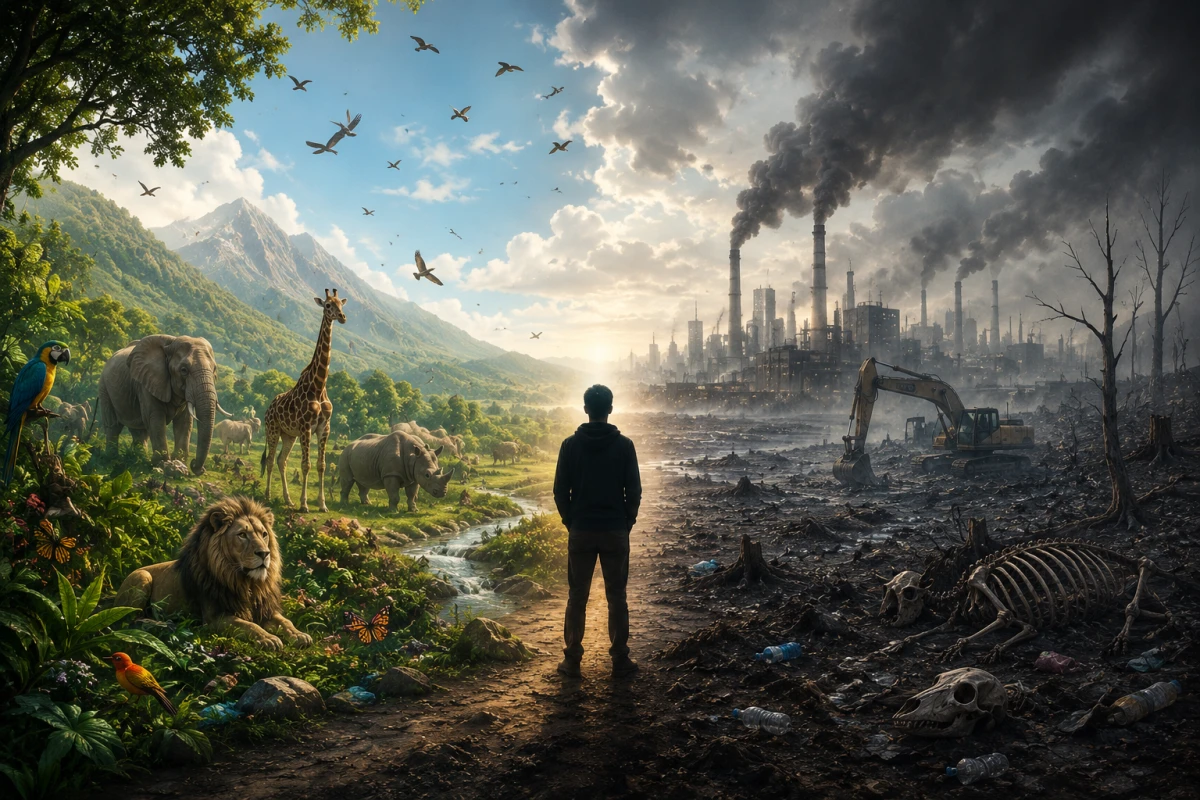
Humans versus nature: has humanity really triggered the sixth mass extinction? Unlike previous global catastrophes caused by asteroids, volcanoes, or climate changes, the current crisis is linked to human activity. However, not all researchers agree that what is happening can already be called a mass extinction.
Over the last 500 million years, our planet has experienced five major biological catastrophes, each of which wiped out a significant portion of living organisms. The last such event occurred about 66 million years ago when a giant asteroid struck the area of the modern Yucatán Peninsula, leading to the extinction of the dinosaurs.
After each mass extinction, life gradually recovered, although it took millions of years. It was precisely due to the last such catastrophe that mammals were able to occupy the vacated ecological niches and subsequently become the dominant group of animals on Earth.
What is considered a mass extinction
Scientists define a mass extinction as an event in which at least 75% of all species of living organisms disappear over a relatively short geological period. According to the definition by the Museum of Natural History, this period must be less than 2.8 million years.
All five previous mass extinctions fully meet these criteria. However, the question of whether a similar event is occurring now remains a subject of scientific debate.
The rate of species extinction raises concern
Proponents of the sixth mass extinction theory point to the rapid decline in biodiversity.
For instance, a study published in 2015 in the journal Science Advances, led by biologist Gerardo Ceballos from the National Autonomous University of Mexico, showed that 477 species of vertebrate animals have gone extinct since 1900. At natural rates of evolution, only about nine species should have disappeared over the same period.
According to scientists' estimates, the current rate of vertebrate extinction exceeds the natural background by 8–100 times. In other words, the losses that occurred in just one century would normally have stretched over a period of 800 to 10,000 years.
An even more serious situation is observed among invertebrate animals — snails, slugs, insects, and many other species that rarely receive attention.
According to a review published in 2022 in the journal Biological Reviews, led by Robert Cowie from the University of Hawaii, humanity may have lost between 150,000 and 260,000 species of living organisms since 1500. This represents approximately 7.5% to 13% of all known biological diversity on the planet.
Researchers believe that previous estimates may have been significantly underestimated, as most scientific studies have traditionally focused on large animals, leaving less noticeable species overlooked.
Why humans are blamed
The main difference between the current crisis and previous mass extinctions lies in its presumed cause.
While past catastrophes were caused by natural factors — large-scale volcanic eruptions, climate changes, asteroid impacts, or oxygen depletion in the oceans — today, scientists increasingly point to human activity.
Over the last few centuries, humans have transformed about half of the habitable land for agriculture, industry, and cities. The concentration of carbon dioxide in the atmosphere has increased by approximately 50% compared to the pre-industrial era, and the acidity of the ocean's surface layers has risen by about 30%.
All of this puts significant pressure on ecosystems and leads to declines in the populations of many animal and plant species.
Why not all scientists agree
Despite the alarming trends, some experts consider the term "sixth mass extinction" premature.
John Wiens from the University of Arizona and Kristen Saban from Harvard University analyzed data on more than 163,000 species of plants and animals. The results of their study were published in the journal PLOS Biology.
According to their calculations, only 102 genera of living organisms have gone extinct in the last 500 years. This represents less than 2% of mammal genera and less than 0.5% of all assessed genera of animals and plants.
In the researchers' view, humanity is still far from the threshold of 75% that defines mass extinction. Therefore, using such a dramatic term may create a distorted perception of the real situation.
While scientists continue to debate whether we can already speak of a sixth mass extinction, most researchers agree on one main point: the biodiversity of Earth is declining significantly faster than natural rates, and a key factor in these changes is human activity.
Disagreements primarily concern terminology and the scale of what is happening. However, regardless of whether the current crisis is considered a full-fledged mass extinction or a precursor to it, experts warn that further loss of species could have long-term consequences for ecosystems and humanity itself.