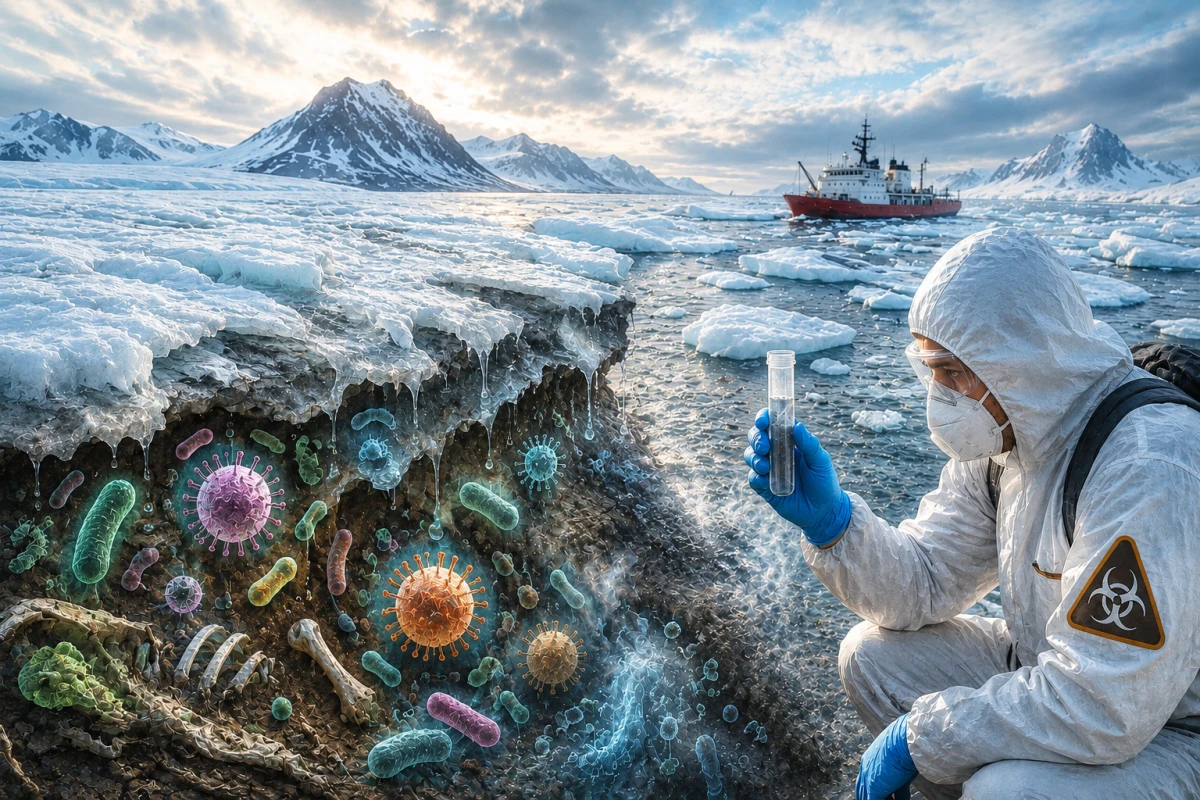
Scientists have found that the thawing of permafrost in the Arctic triggers a complex process of gradual 'awakening' of microorganisms. Some bacteria become active immediately after the ice melts, while others require weeks or even months to begin their activity.
The thawing of Arctic permafrost does not trigger an immediate activation of all microorganisms, but rather a phased return of life, where some microbes begin to act right away while others wait for months. James Bradley and Margaret Cramm from University College London thawed soil samples from Svalbard in the laboratory and added water with a heavy oxygen isotope to track which microbes were multiplying. Within a few days, the thawed soil began to release carbon dioxide, with the most significant spike occurring in the first weeks when fast-growing actinobacteria, bacteroidetes, and proteobacteria were activated.
After the first wave, slowly growing Verrucomicrobiota and Planctomycetota, which process complex carbon compounds left over from the first wave, became active. Bacteroidetes, which initially made up a small part of the community, became fully active by the end of the experiment, while predatory Myxococcota and Bdellovibrionota began hunting other bacteria, forming a food chain.
About half of the detected species showed no activity at all, and some methane-consuming microbes only became active after prolonged thawing.
The authors emphasize that many climate models assume a simple uniform response, while the actual phased activation of microbes has important implications for forecasting carbon emissions in the context of Arctic warming.
The study shows that the melting of Arctic permafrost may affect the climate in much more complex ways than previously thought, writes bb.lv. The phased activity of microorganisms can differently influence carbon dioxide and methane emissions, meaning scientists will need to revise climate models and predictions of global warming.