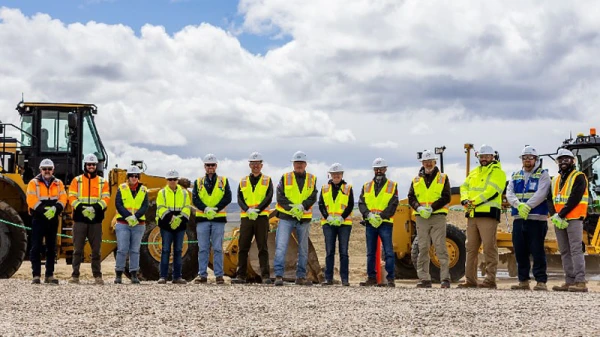
TerraPower has officially announced the start of construction of its first commercial advanced nuclear power unit in the U.S. The Kemmerer Unit 1 project in Wyoming, equipped with the innovative Natrium reactor using molten salts, marks a breakthrough in nuclear energy. Microsoft founder Bill Gates is actively involved in this ambitious endeavor, promoting the implementation of next-generation reactors.
TerraPower has officially announced the commencement of construction of its first commercial advanced nuclear power unit in the U.S. This ambitious project, named Kemmerer Unit 1, is taking place in the picturesque state of Wyoming.
At the core of the facility is the innovative Natrium reactor, which utilizes molten salts, marking a significant step towards the implementation of next-generation nuclear reactors both in America and around the world. Microsoft founder Bill Gates is actively and directly involved in this process.
One of Bill Gates' foundations provides substantial financial support for TerraPower's nuclear initiatives. Since 2006, Gates himself has served as the chairman of the company's board, leading its strategic development.
Notably, this breakthrough occurs against the backdrop of European events, where protests against nuclear power plants have led to their mass shutdown. In Germany, for example, all nuclear power plants have been completely halted, culminating the anti-nuclear movement.
Even in the U.S., nuclear energy lost its relevance for a time, falling out of the mainstream focus. However, in recent years, interest in it has surged, especially after the beginning of Donald Trump's second presidential term.
About a year ago, President Trump signed an important executive order aimed at expediting the review of new nuclear reactor projects by regulators. This decision significantly accelerated the approval process for the Natrium reactor by the U.S. Nuclear Regulatory Commission (NRC).
Instead of the anticipated 27 months, the project received approval in just 18 months from the date of application, setting a true record.
Bill Gates' and TerraPower's leadership's confidence in the project's success was so great that they began construction of the non-nuclear part of the facility as early as June 2024. This phase included the creation of infrastructure and a complex for the efficient disposal of heat from the reactor, starting just a month after the application was submitted to the NRC.
In March of this year, the NRC finally issued all the necessary permits, paving the way for the construction of the nuclear part of the project. Actual construction work began on April 23, marking the start of a new era.
This facility has become the first commercial nuclear project approved by the NRC in the last ten years. Moreover, it is the first heavy-water nuclear reactor to receive construction approval in the last forty years, highlighting its uniqueness.
Features of the Natrium Reactor
The Natrium reactor operates on the basis of a sodium molten salt, which integrates radioactive fuel. This unique molten salt performs several critically important functions simultaneously.
It effectively stores heat, serves as a fuel carrier during loading and unloading from the reactor zone, and acts as a powerful coolant, preventing overheating and heat retention.
The Natrium system is a modular design that serves a common turbine complex operating on regular water or steam. One such reactor can generate an impressive 345 MW of electrical power.
If necessary, its capacity can be increased by adding several neighboring reactors that work in tandem.
The project also includes a special buffer in the form of a closed pool for the molten salt. Thanks to this buffer, the output power of even a single reactor can be temporarily increased to 500 MW.
This feature is designed to ensure flexible management of electrical load, which is especially valuable in conjunction with unstable renewable energy sources.
Future Prospects and Challenges
In January, Meta announced its ambitious plans for the development of nuclear energy, including funding for the creation of up to eight TerraPower fast neutron reactors in the U.S. Among them are two new units capable of producing up to 690 MW of electricity, which could be launched as early as 2032.
Additionally, Meta plans to apply for the rights to purchase energy from six other reactors with a total capacity of 2.1 GW, with commissioning scheduled for 2035.
The start of construction of the first reactor as part of this large-scale project significantly brings these grand plans closer to realization. However, an important issue related to fuel remains unresolved.