
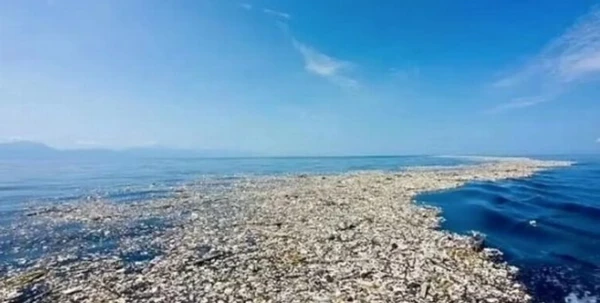
Fierce debates have erupted around the Great Pacific Garbage Patch and measures for its cleanup. Some experts argue that it is now impossible—it has become home to dozens of species.
When we talk about the ocean, we usually envision endless blue water and nothing more. However, marine researchers are actually observing something different: places like the Great Pacific Garbage Patch, where plastic waste has created a sort of artificial coastline far from land, writes Focus.
In the North Pacific subtropical gyre, a massive system of rotating currents between California and Hawaii, floating objects tend to get trapped rather than swept away by the current. This is where what is known as the Great Pacific Garbage Patch is located—a region that has now become home to tens of thousands of plastic debris, durable enough to drift across the ocean for years.
For a long time, biologists viewed coastal waters and the open ocean as two separate realms: it was assumed that coastal species would remain on rocks, piers, and shorelines, while pelagic species were meant to inhabit the open ocean.
It was previously thought that a storm could dislodge a log or a raft of algae, carrying coastal organisms away from the shore, but these "passengers" would ultimately perish, as conditions in the open ocean were too harsh. However, this view, as new data shows, is far from complete.
Using the example of the Great Tsunami in Eastern Japan, scientists observed how massive waves could sweep boats and numerous plastic items off docks, carrying them into the Pacific Ocean. For many years afterward, debris washed up on the shores of North America and Hawaii. When scientists examined these items, they found that many species living on the Japanese coast remained alive on them for at least six years while they crossed the ocean.
This raised the question: did Japanese coastal species merely pass through the open ocean, or did they begin to form more permanent communities there? In a new study, scientists focused on exploring this question. Researchers monitored the sea surface and collected plastic items measuring at least 15 centimeters in length.
In total, they managed to gather 105 floating plastic debris, including fragments, buoys, boxes, nets, ropes, and buckets, as well as an "unexpected" group of particularly life-rich items. Each item was tagged, photographed, and labeled with its location, after which it was set aside for thorough examination in the laboratory.
Next, in the laboratory, scientists examined each plastic debris and searched for invertebrates—animals without a backbone. As a result, the team was able to discover a wide variety of organisms, such as crustaceans, crabs, amphipods, bryozoans, hydroids, and sea anemones.
According to the scientists, when they examined the plastic, almost every piece they collected contained living organisms, primarily invertebrates. Invertebrates were present on 98% of the items. Pelagic species were found on more than 94% of the items, while coastal species were found on just over 70%.
Interestingly, many items simultaneously contained both coastal and pelagic species, meaning these entirely different organisms shared the same floating "islands" in the middle of the ocean. On average, each plastic item contained four to five species of organisms, with coastal species occurring slightly more frequently than pelagic ones.
One of the most important questions was whether coastal organisms were merely temporary passengers on the plastic or if they could live there for their entire life cycle. The study's results indicate signs of reproduction and growth. Moreover, scientists also found reproductive structures in hydroids. This pattern suggests that new generations were growing on these rafts rather than arriving all at once from the shore.
The team also found that pelagic communities were closely linked to the type of plastic object, while coastal communities were more closely related to the timing of debris collection during expeditions.
The authors note that today plastic pollution is not just an unsightly sight or a waste problem. It is also capable of altering the habitats of marine organisms and allowing coastal organisms to survive, reproduce, and spread over vast distances. This discovery could change marine ecosystems and species ranges worldwide.











Leave a comment