
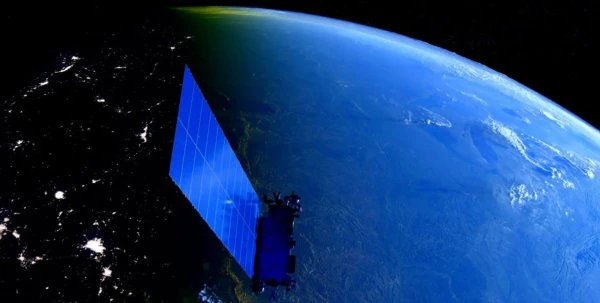
The incident occurred at an altitude of about 560 kilometers above the Earth's surface. It is believed that one of SpaceX's internet satellites disintegrated into dozens of objects.
In December of last year, SpaceX reported that it had lost control of one of its Starlink internet satellites due to an anomaly. This satellite exploded in low Earth orbit. Now, more than three months after this incident, Elon Musk's company has reported that a second Starlink satellite also exploded at an altitude of about 506 km in low Earth orbit for unknown reasons, writes Focus.
In December 2025, SpaceX reported that an unknown anomaly caused a fuel leak from the Starlink satellite's tanks, leading it to lose altitude and explode. As a result, a "small number of objects" were created. It has now been revealed that another Starlink satellite exploded at an altitude of 560 km above the Earth's surface on March 29.
According to Leo Labs, a company that tracks spacecraft in low Earth orbit, Starlink 34343 disintegrated into dozens of objects. The company believes that the satellite's explosion was caused by an internal event rather than a collision with space debris or another satellite. It is reported that the debris from SpaceX's satellite will likely fall into the atmosphere within a few weeks.
Elon Musk's company claims that this incident poses no threat to the International Space Station and its crew, nor to the scheduled launch of the Artemis 2 mission on April 1. This is NASA's first crewed flight around the Moon and back since 1972. SpaceX stated that the investigation into the incident is ongoing and measures will be taken to address the causes of the anomaly to prevent similar occurrences with other Starlink satellites.
These two incidents highlight how serious the issue of space debris in low Earth orbit remains. The amount of rocket debris and non-functional spacecraft is increasing. Meanwhile, SpaceX plans to send thousands of new Starlink satellites into space.
Even if all non-functional or defective Starlink satellites fall back to Earth and burn up in our planet's atmosphere, scientists warn that the consequences for the ozone layer could be catastrophic due to the release of substances that destroy this protective layer.
According to recent estimates, one to two Starlink satellites fall to Earth every day, and this number may continue to grow as SpaceX continues to expand its satellite constellation.
















Leave a comment