
Scientists have also developed a semi-humanoid hybrid robot.
China recently presented a lunar robot and a lunar truck: the exploration of Earth's satellite is getting closer! But why are leading space powers competing for dominance on the empty and lifeless Moon?
The space race is repeating itself: in the 1960s, the USA competed with the USSR for the right to be the first conquerors of the Moon, and now their main competitor has become China. India is lagging behind but is also trying to establish a presence on Earth's satellite.
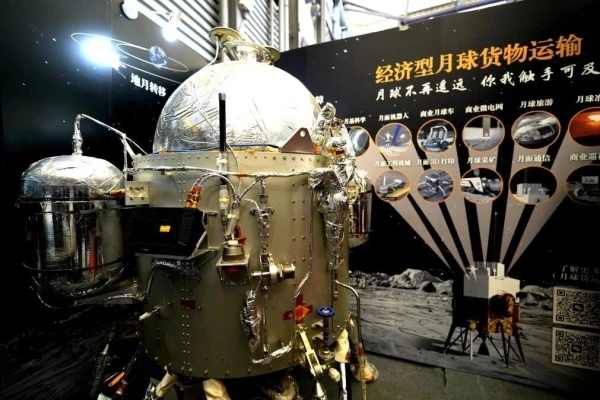
And now Chinese companies have created two lunar vehicles. First, the Shanghai Academy of Space Technology (SAST) presented a model of a landing module. In the future, a whole family of such trucks is expected to emerge: depending on the design, they will be able to deliver from 120 kg to five tons of cargo: various equipment for the International Lunar Base, in the creation of which Russia is also participating.
The main feature of the new trucks is expected to be their low cost. And this is no longer just abstract plans. Recently, the first flight tests took place: at the testing ground, the model of the spacecraft lifted off the ground using its own methane engine and hovered in the air.
Additionally, Chinese scientists have developed a semi-humanoid hybrid robot: the chassis is wheeled, and a structure with manipulators, similar to a human torso, is mounted on top. Such a machine is expected to be stable, passable, and capable of performing delicate tasks.
The Moon is an excellent scientific base. There is low gravity — new materials and pharmaceuticals can be produced under conditions not available on Earth. There is no atmosphere — telescopes can be installed without any obstructions. Studying the Moon will allow us to better understand the origins of the Solar System.
The Moon is a good training ground for preparing humanity for more distant flights, such as to Mars. All previous programs for long-term human presence in space have been limited to flights in low Earth orbit. That is, in greenhouse conditions: the Earth's magnetic field protects against cosmic radiation, communication with the home planet occurs without delays, and crewed ships are always docked to the space station for crew rescue.
But all these goals can be achieved without haste and competition. Urgent lunar exploration should have practical applications. And it does. Firstly, there is water ice on the surface of the Moon. This means that hydrogen and oxygen — fuel for interplanetary ships — can be obtained directly in space. Without an atmosphere and strong gravity, launching to Mars, for example, is much easier than from Earth.
But these are minor details. The main point is that lunar soil, regolith, contains helium-3. Potentially, this is the ideal fuel for generating large amounts of clean energy. During nuclear fusion with deuterium, a colossal amount of energy is released without radioactive contamination and destructive neutron radiation. Currently, obtaining energy from a nuclear fusion reactor is closer to science fiction than practical implementation: such installations exist only in the format of scientific devices for conducting experiments.
However, it is possible that scientists will make a breakthrough in the foreseeable future. Construction of the International Experimental Thermonuclear Reactor ITER in France is currently ahead of schedule.










Leave a comment