
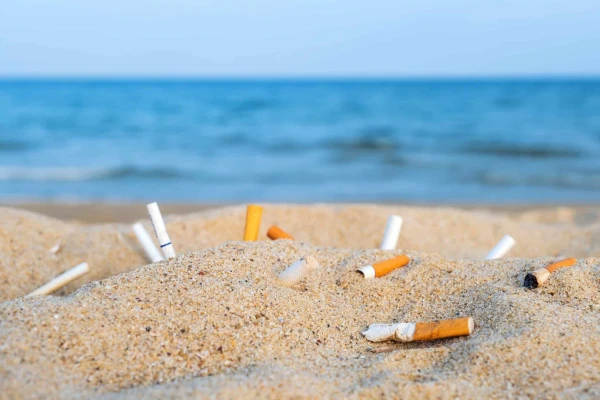
Their base is made of cellulose acetate—a plastic polymer that does not decompose in the natural environment.
After 10 years in the soil, cigarette filters did not dissolve but merely disguised themselves as dirt. Their plastic fibers broke down into micro-particles, firmly bonded with minerals, and turned into secondary microplastics. Moreover, by the fifth year of decomposition, the waste began to poison the soil with renewed vigor.
For decades, people have thrown trillions of cigarette butts onto streets, roadways, beaches, and parks. Their base is made of cellulose acetate—a plastic polymer that does not decompose in the natural environment. In the manufacturing of cigarettes, thousands of thin fibers are tightly packed inside a paper shell to retain harmful substances while smoking.
Previous measurements of ecological threats lasted from weeks to months. Scientists only assessed the initial release of toxins into puddles or soil. Science needed to understand how plastic polymers degrade under real conditions over long periods of time.
The results of a decade-long monitoring study were published in the journal Environmental Pollution. Ecologists placed thousands of cigarette butts in permeable mesh bags and laid samples in three environments for comparison. Some were left lying on hard urban surfaces. Other bags were buried in poor sandy soil and in nutrient-rich meadow soil.
Researchers regularly retrieved control bags to assess mass loss. The degradation of plastic filters went through several stages. In the first weeks, the process was rapid: the paper dissolved, water washed away light surface chemicals, and the butts lost up to 20% of their weight.
Later, physical degradation slowed due to the resilient molecular structure of cellulose acetate. On urban asphalt, the breakdown of fibers nearly stopped, and after 10 years, the mass reduction was only 52%. In fertile, moist soil, the butts lost about 84% of their mass. However, this loss does not signify complete biological "digestion." The brittle plastic simply crumbled into powder and was washed into the ground by rain.
No definitive destruction of plastic fibers occurred in any test area. Under an electron microscope, scientists observed that the degraded cellulose acetate fibers lost their basic shape and firmly bonded with minerals from the soil, forming solid microscopic aggregates. The polymer transitioned to the status of secondary microplastic, which ceased to be conspicuous but physically remained in the ecosystem.
To test the danger of old waste, biologists made aqueous extracts: they soaked butts from different years and dripped this liquid into colonies of sensitive luminescent bacteria Aliivibrio fischeri (a standard laboratory indicator). If the bacteria died, the solution was deemed toxic.
The poisoning graph showed a wave-like pattern. Extracts from fresh filters killed microbes the most due to the high dose of soluble nicotine and heavy metals. Gradually, the chemicals were washed away by rain, and the butts became less toxic. However, at the five-year mark, the toxicity of the leachates suddenly soared again.
The authors of the article suggested that by this time, the molecular structure of the plastic began to break down, releasing new toxic chemical components of the polymer into the water. The methodology of the experiment leaves open another reason: over five years, the porous filter acted like a sponge. Soil fungi that settled inside could have left behind toxic waste products of their activity, which poisoned the test bacteria. The decade-long observation proved the resilience of cellulose acetate to natural decay. Visual degradation of the butt in fertile soil only means its fragmentation and transition into a form of mineralized microplastic with residual toxic properties.













Leave a comment