Scientists used spectroscopy that allows for the identification of molecules by the characteristic vibrations of their chemical bonds.
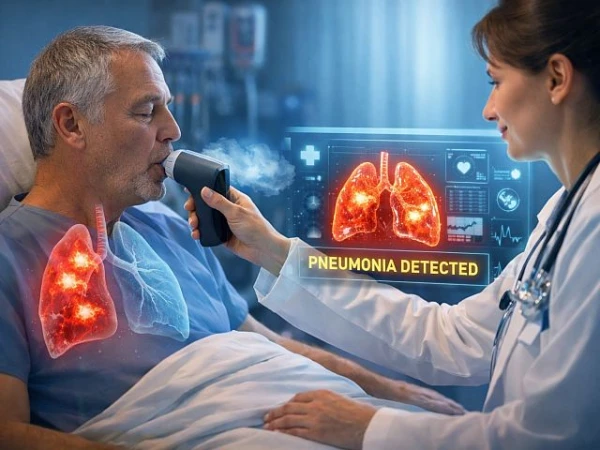
Engineers from the Massachusetts Institute of Technology have developed a new test that allows for the detection of disease-related compounds in the air exhaled by a person. This technology could accelerate the diagnosis of pneumonia and other lung diseases: instead of a chest X-ray or waiting for laboratory tests, a patient could undergo a breath test and receive results in just a few minutes.
The development is a portable microchip sensor that captures synthetic molecules – so-called disease biomarkers. These markers are initially attached to inhaled nanoparticles and are released only when interacting with specific "keys," such as enzymes associated with a particular disease. It is assumed that the patient first inhales such nanoparticles – much like medications for asthma. If the person is healthy, they are expelled from the body unchanged. However, in the presence of an infection, such as pneumonia, the enzymes that arise during the illness detach the biomarkers from the nanoparticles. These molecules are then exhaled and can be detected by the device, indicating the presence of disease.
Previously, identifying such biomarkers required complex laboratory equipment that is rarely found in ordinary medical offices. Now, researchers have shown that their new portable device can detect such molecules even at very low concentrations. The device is called PlasmoSniff, and in the future, it is planned to be integrated into a compact diagnostic device that can be used both in clinics and at home. The development is based on a field of science known as Plasmonics – the study of the interaction of light with matter at the nanoscale. Scientists used Raman spectroscopy, which allows for the identification of molecules by the characteristic vibrations of their chemical bonds. However, detecting the desired biomarkers is not easy, as they are very few among the multitude of other molecules in exhaled air. According to researchers, this is akin to searching for a needle in a haystack.
To solve this problem, the team created a sensor that amplifies the signal of the desired molecules. Its foundation is a thin gold film coated with a layer of gold nanoparticles with a porous silica shell. There is a gap of only about five nanometers between the particles and the film. The surface of the sensor is modified to bind with water molecules, which in turn "stick" to the biomarkers. This structure enhances light through plasmonic resonance: electrons in the gold nanostructures begin to oscillate collectively under the influence of light, concentrating the electromagnetic field in the microscopic gap. The biomarkers that enter this gap produce a significantly stronger scattered light signal, which can be measured and matched with the characteristic "fingerprint" of a specific molecule.
During experiments, scientists tested the sensor on samples of lung fluid from healthy mice, adding pneumonia biomarkers to them. The samples were heated to simulate exhaled air, and the sensor recorded the molecules passing through it along with the vapor. The results showed that the device is capable of quickly detecting pneumonia biomarkers even at very low concentrations that are clinically significant.