The effect of heat generation was simply added to the calculations.
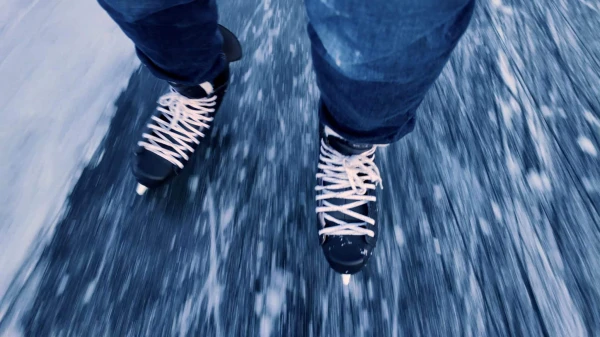
Although ice seems like a simple substance, the reason it is so slippery has remained a topic of debate. Recently, physicists showed that when moving on ice, friction slightly heats its surface. This leads to the formation of a very thin film of water that acts as a lubricant. Some details of this mechanism still need to be clarified by scientists.
The slipperiness of ice has long been one of the classic mysteries of physics. Michael Faraday suggested back in the 19th century that a thin liquid film — the so-called premelting layer — spontaneously forms on the surface of ice, facilitating sliding. Then another hypothesis emerged: the pressure from skates or other objects could lower the melting point of ice, causing localized melting.
In the 20th century, physicists Frank Bowden and Thomas Hughes proposed a third explanation — heating due to friction. According to this idea, the very act of moving on ice generates heat that melts a thin surface layer and creates a lubricant of water. However, despite decades of research, a unified explanation did not exist: different experiments and computer models pointed to different mechanisms.
The authors of the new work, presented on the Cornell University preprint server (New York, USA), tried to combine all scenarios using multiscale modeling — a method for studying complex systems that integrates models of different scales or levels of detail. They first modeled the friction between ice and glass at the level of individual atoms and water molecules. This approach allowed them to identify the dependence of frictional force on temperature and sliding speed in microscopic contact areas.
However, these simulations proved insufficient. The fact is that they produced an incorrect dependence of friction on speed: in the model, friction increased with acceleration, whereas real experiments showed the opposite.
To resolve this contradiction, the calculations incorporated the effect of heat generation. When an object moves on ice, contact occurs not across the entire surface, but only at small micron-scale roughness. It is at these points that intense friction generates heat. In particular, at a speed of just about 0.1 meters per second, the temperature in the contact area can sharply rise and approach the melting point of ice.
The increase in temperature also leads to enhanced formation of a liquid-like layer of water on the surface. As a result, the thickness of the film increases, and its viscosity decreases, sharply reducing resistance to motion. Consequently, at the macroscopic level, friction decreases, which is what occurs in real experiments with ice.
Comparing the obtained data with laboratory measurements of friction and even data on the movement of stones in curling showed that the calculations reproduce the observed "behavior" well. Thus, physicists have finally demonstrated that the slipperiness of ice arises from a combination of several processes, but the decisive role is played by heating from friction.
Moreover, the surface layer of water and structural changes in ice may participate in the formation of the film, but without the thermal effect, they cannot explain the dependence of friction on speed. This discovery helps reconcile different theories and offers a more holistic picture of one of the most well-known and controversial physical phenomena in everyday life.