The UAE Martian orbiter "Al-Amal" witnessed the disintegration of the interstellar comet that ground-based telescopes could not capture.
When the interstellar comet 3I/ATLAS came closest to the Sun in October last year, telescopes on Earth were unable to see it. The comet was hidden behind the Sun, out of their view. However, the UAE spacecraft "Al-Amal," which orbits Mars, was on the same side of the Sun and had the unique opportunity to see what ground-based telescopes could not. The UAE Space Agency published the first results of observations of the third confirmed interstellar object 3I/ATLAS, discovered in the Solar System. The data provide a rare opportunity to glimpse the chemistry of another star system and show how the comet 3I/ATLAS was disintegrating under the influence of the Sun, writes Focus referencing Gulf News.
The interstellar object 3I/ATLAS, which is a comet arriving from another star system, was discovered on July 1, 2025. It was moving toward the Sun at a speed of over 200,000 km/h. Unlike comets in the Solar System, 3I/ATLAS has a different chemical composition, allowing for greater understanding of the chemistry of another star system and the building blocks from which it was formed. Currently, 3I/ATLAS is already leaving the Solar System, but scientists continue to provide data collected during the second half of 2025, when the comet 3I/ATLAS approached the Sun and Earth.
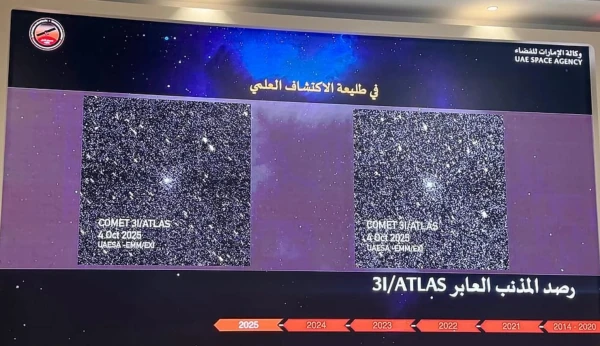
The "Al-Amal" spacecraft studies the atmosphere of Mars, but scientists from the UAE used it to observe the comet 3I/ATLAS when it was at its closest distance to the Sun in October 2025. This way, unique data were collected that ground-based telescopes could not achieve.
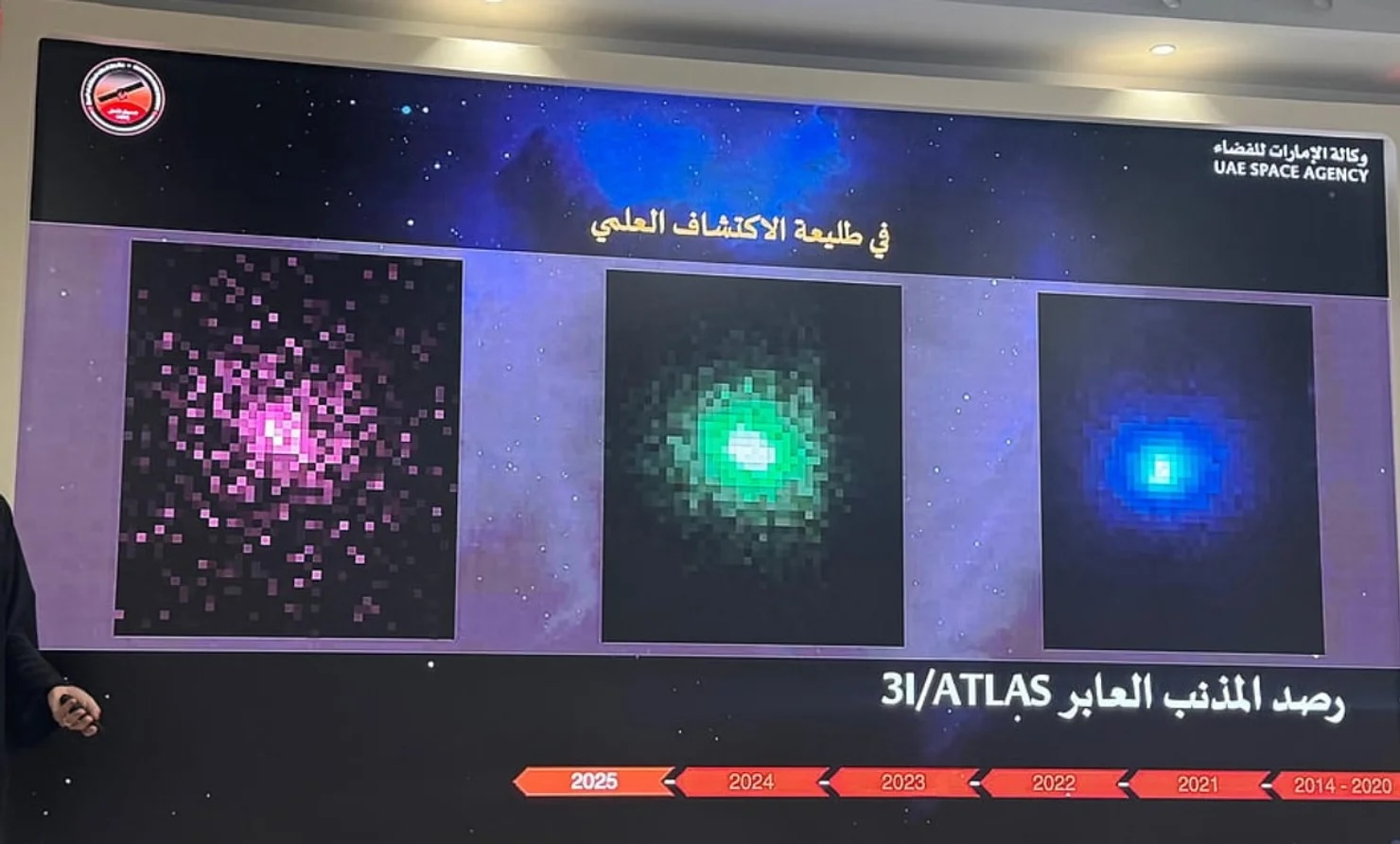
The "Al-Amal" probe captured a series of images of the comet 3I/ATLAS in visible and ultraviolet light using its EXI and EMUS instruments.
The UAE Space Agency reported that the "Al-Amal" spacecraft detected hydrogen and oxygen extending hundreds of millions of kilometers from the comet's nucleus as it began to shed some of its material into space under the influence of the Sun's radiation and heat. But the most remarkable discovery was carbon monoxide, detected at the moment the comet was actively disintegrating near the Sun.
According to scientists, the uniqueness of this observation lies in the fact that they were able to see 3I/ATLAS at the moment of its actual disintegration near the Sun. Since the comet was formed in another star system, its chemical composition reflects the composition of its birthplace.
A more detailed analysis of the obtained data is expected to be published soon. Although the "Al-Amal" probe is not designed for observing comets, it found itself in the right place at the right time to witness one of the rarest astronomical events of the century.