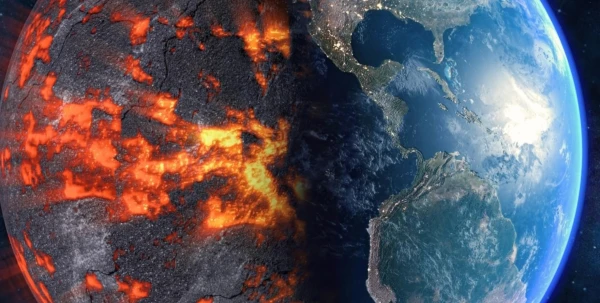
In the new study, scientists examined tiny zircon crystals and found that in the early stages of development, our planet likely exhibited remarkably complex tectonic activity.
Modern Earth is built on recycling: old crust sinks, melts, and returns to the surface as new rock. However, new research on zircon suggests that this cycle may have actually begun surprisingly early — it is believed to have occurred when Earth was only half a billion years old, writes Focus referencing SciTechDaily.
In the study, scientists from the University of Wisconsin-Madison discovered characteristic chemical patterns within zircons — the oldest minerals on Earth. The data suggest that at the beginning of its journey, around 4 billion years ago, our planet was significantly more tectonically active than previously thought.
If the new theory is correct, our early planet was not simply wrapped in a hard, immobile outer shell — the classic idea of a "stagnant lid," which also suggests a small amount or complete absence of continental crust. Instead, scientists now believe that at least some regions of Earth were likely dynamic enough to alter the surface. This is important because the recycling of the Earth's crust and the formation of continents influence where stable, potentially life-friendly environments can exist.
It is noteworthy that the new analysis is based on ancient zircons found in Jack Hills in Western Australia. These grains are often found as tiny crystals weathered from older rocks and preserved in younger sediments, and they are valued because they carry the only direct record of the first 500 million years of Earth's existence. All of this makes zircons rare witnesses to how the planet's surface and its internal structure interacted in the early stages of continental formation.
In the study, scientists measured the trace element content within individual zircon grains using a highly sensitive instrument. This technology, according to the team, allows for the analysis of objects approximately ten times thinner than a human hair. The team also developed new analytical methods that enabled the measurement of elements that were previously impossible to study reliably.
According to John Valley, a professor of geoscience at the University of Wisconsin-Madison, zircons are essentially tiny time capsules and they contain a vast amount of information. The chemical composition of zircons from Jack Hills indicates that they formed from a completely different source than other Hadean zircons found in South Africa.
Professor Valley stated that he and his colleagues found that most of the zircons discovered in the Jack Hills area do not appear to have formed in the Earth's mantle. The chemical composition results of these zircons suggest that early Earth’s geology was more diverse than previously thought, with various tectonic processes acting simultaneously, rather than within a single homogeneous system. This means that at the beginning of its journey, our planet was not covered by a uniform stagnant lid.
The results show that early Earth was geologically diverse, with different tectonic styles operating simultaneously in different regions. This discovery is believed to fundamentally change scientists' understanding of the first billion years of the planet's existence, and the implications extend beyond tectonics. Subduction and continental formation influence when land first appeared and how the surface environment developed.