
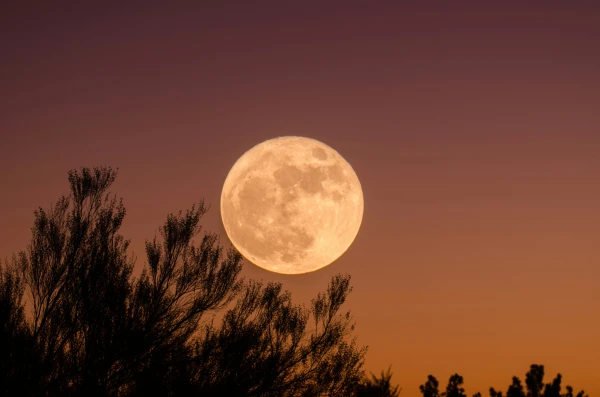
The Wolf Moon will be the first supermoon of 2026 and will grace the sky this weekend, but this lunar event will somewhat hinder the observation of another spectacular sight: the Quadrantid meteor shower, Focus reports.
According to The Old Farmer's Almanac, from which all the poetic names of full moons are derived, the Moon began to "wax" around New Year's Eve but will reach its peak on Saturday, CNN reports.
"The day before January 3 and the day after, the moon will look very full," said Noah Petro, head of NASA's Planetary Geology, Geophysics, and Geochemistry Lab.
The Wolf Moon will be so bright and large that it will overshadow another spectacular celestial event – the Quadrantid meteor shower.
According to Robert Lunsford, coordinator of reports for the American Meteor Society, the peak activity of the Quadrantid meteor shower will occur on January 3. The best time for viewing will be from midnight until dawn on January 4.
January's "Wolf Moon" will also be the first supermoon of 2026. However, Petro noted that the difference between a supermoon and a full moon is minimal. "To see it, you have to look carefully," he added.
To help notice the differences, NASA offers an animation depicting the phases of the Moon in 2026, allowing skywatchers to visualize the Moon throughout the year.
For optimal viewing, if local conditions permit, special glasses are not needed – the moon can be comfortably observed with the naked eye or using a telescope or binoculars for a more detailed look. Ideally, one should find a dark place with a good view of the horizon, but if that is not possible, your favorite beach or recreational spot will suffice.
NASA's Artemis II spacecraft is expected to send a crew of four to the Moon in early February, and Petro encourages people to observe Earth's closest celestial neighbor in anticipation of this long-awaited mission. This will be the first time in over 50 years that astronauts will venture beyond low Earth orbit.
How January's Full Moon Got Its Name
As reported by The Old Farmer's Almanac, January's full moon is named because wolves typically became active in the forests at this time, and their howls were often heard.
"We name full moons based on what happens at that time," Petro added.
The name comes from the Sioux language, where this lunar period is described as "wolves running together." Alternative names come from other Native American tribes, such as mkokisis, meaning "bear moon" for the Potawatomi people, and wiotehika wi, meaning "hard moon" for the Lakota people.
What Other Full Moons in 2026 Will Be Called
- February 1: Snow Moon
- March 3: Worm Moon
- April 1: Pink Moon
- May 1: Flower Moon
- May 31: Blue Moon
- June 29: Strawberry Moon
- July 29: Deer Moon
- August 28: Sturgeon Moon
- September 26: Harvest Moon
- October 26: Hunter's Moon
- November 24: Beaver Moon
- December 23: Cold Moon
Meteor Showers of 2026
The Quadrantid meteor shower will be active until January 16 inclusive. The meteors appear to originate from the constellation Boötes, also known as the "Herdsman." This region was once called Quadrans Muralis, hence the name Quadrantids.
Quadrantid Meteor Shower
With clear skies, up to five meteors from the Quadrantid shower can be seen per hour, along with possibly five additional random meteors.
Quadrantids typically move at a "moderate speed, with the brightest ones leaving persistent trails that last for several seconds after the meteor disappears."
After the peak of the Quadrantids, skywatchers will have to wait until the Lyrid meteor shower in April.
Meteor Showers of 2026 – When to Watch the Sky Show
- Lyrids: April 21-22
- Eta Aquariids: May 5-6
- Southern Delta Aquariids: July 30-31
- Alpha Capricornids: July 30-31
- Perseids: August 12-13
- Orionids: October 21-22
- Southern Taurids: November 4-5
- Northern Taurids: November 11-12
- Leonids: November 16-17
- Geminids: December 13-14
- Ursids: December 21-22













Leave a comment