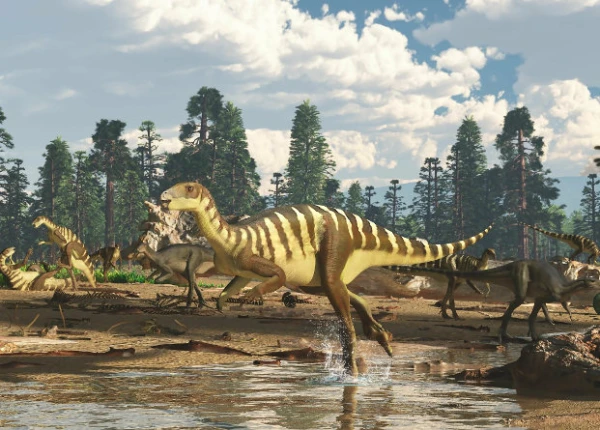
These reptiles thrived from the late Jurassic to the late Cretaceous and often reached lengths of 6 to 9 meters.
Scientists were surprised when they found two dinosaur eggs in eastern China, each about 13 centimeters in diameter and nearly perfectly round. Instead of fragile shells filled with embryonic bones, the fossilized eggs were cavities filled with shiny mineral crystals. This was reported by earth.com.
The work was led by paleontologist Qing He from Anhui University and the Nanjing Institute of Geology and Palaeontology of the Chinese Academy of Sciences. Her team described the two eggs as a new species.
One of the eggs had a cracked shell, exposing a cluster of pale calcite, a mineral of calcium carbonate that is commonly found in sedimentary rocks.
"Groundwater rich in dissolved chemicals seeped into the buried eggs, and then minerals slowly crystallized inside the hollow chambers over millions of years," the material explained.
It is noted that the thickness of the shell and the dense pattern of microscopic columns inside the dinosaur eggs helped the team classify the fossils into the family Stalicoolithidae. This family consists of dinosaur eggs with thick shells and spherical shapes, often found in dense clutches.
"The new species Shixingoolithus qianshanensis is the first discovery of the genus Shixingoolithus from the Qianshan Basin," Qing He wrote.
The publication adds that the eggs from Qianshan have an almost spherical shape and do not contain clear remnants of embryos, making it impossible to accurately identify the parents.
"The shape, size, and microscopic structure of the shell indicate a herbivorous ornithopod. This is a bipedal runner with a broad, duck-like beak. These dinosaurs thrived from the late Jurassic to the late Cretaceous and often reached lengths of 6 to 9 meters from snout to tail," the material notes.
These animals went extinct along with other large non-avian dinosaurs when a 9.5 km diameter asteroid struck the Yucatán region about 66 million years ago.
Although scientists could not identify the parents to the species level, they assure that the dinosaur eggs expand the understanding of ornithopod reproduction in southern China. This adds new data for understanding how these herbivorous animals laid and protected their clutches.